Zhang Jingchu丨Grandma's Wisdom – Happiness is a Choice
I won't spoil Jingchu's article—tell me your thoughts after reading it.
I won't spoil Jingchu's article—tell me your thoughts after reading it.
I think our feelings would be similar—a sense of being touched by the wisdom and love reflected in the little moments of life.
I will start an online workshop on May 7th, focusing on inner order and authentic growth. Jingchu will be a guest for the workshop and will connect with the participants. Another guest is Paul MacGowan, the producer and director of the documentary on Mingjue Rinpoche (with Chinese subtitles and translation).
Due to the uncertainty of my own schedule, the workshop is held irregularly each year. I hope to see everyone online this time. Registration information can be found at the end of the text.
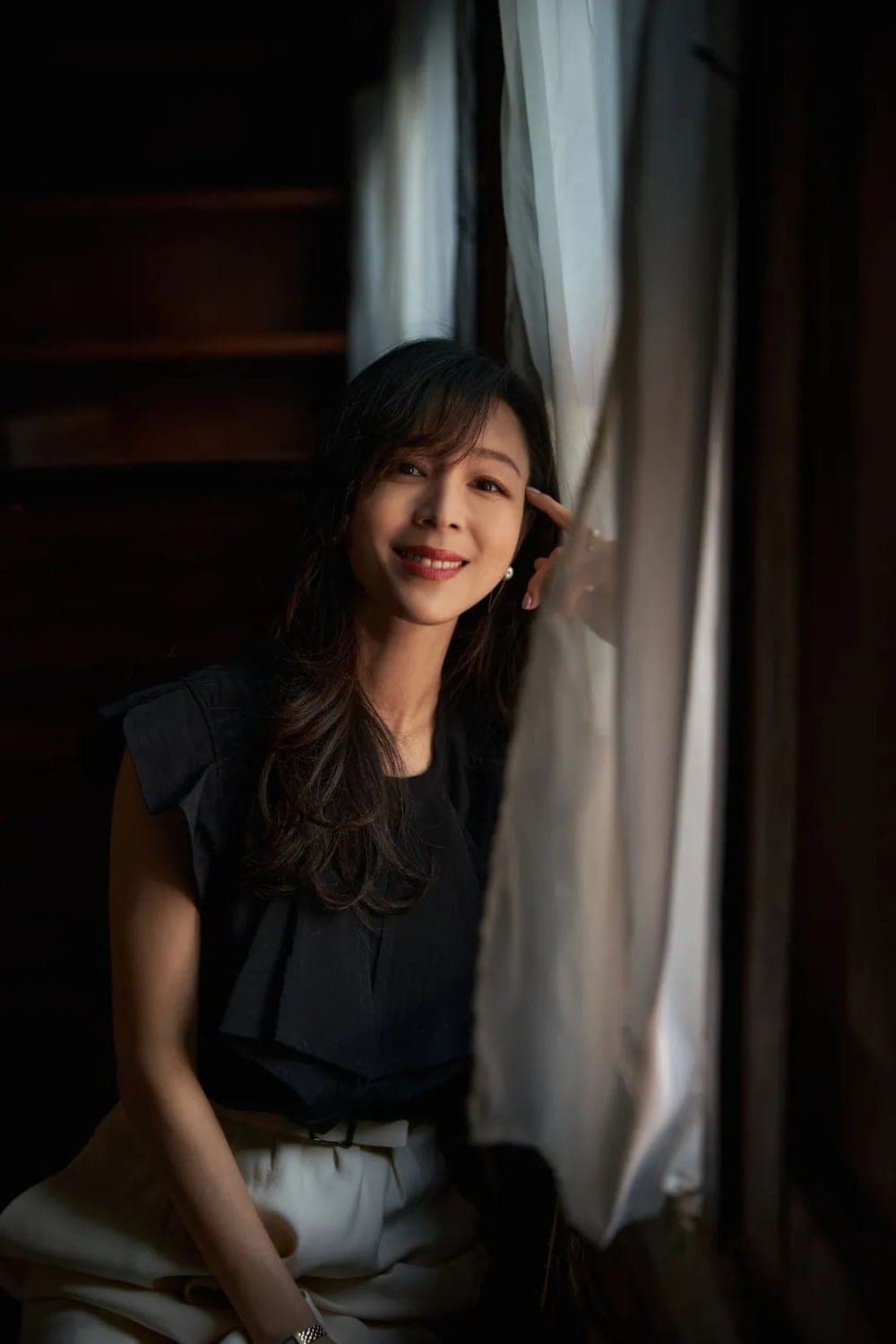
Author: Zhang Jingchu, actress, known for her roles in "Peacock," "The Protégé," "Project Gutenberg," "Aftershock," and others. This article is based on the author's sharing at the "Her Power · Phoenix Network 2023 Women's Influence Awards."
Hello everyone, I'm Zhang Jingchu. The theme of today's event is the power of women, and I'd like to share with you a story about a woman who is both ordinary and extraordinary. She was born in 1922, became a widow at the age of 42, and single-handedly raised 12 children. She never lost her temper and always wore a smile. In her, I see a wisdom as profound as water. She is my 100-year-old grandmother.
I know it's difficult to share her story, and it might be a bit hard to believe. After all, she is human, not a god—how could she possibly have no negative emotions? Let me give you an example to help you understand just how special she is. When I told my mom that I wanted to share Grandma’s story, my mom sincerely praised her, saying, "Grandma is truly remarkable." It’s often said that conflicts between mothers-in-law and daughters-in-law are a timeless challenge. Grandma had seven daughters-in-law, yet our family never experienced any such conflicts. Just this alone is already incredibly rare.
In my life, apart from spiritual practitioners, I have never met anyone with such emotional stability and worldly wisdom as my grandmother. Of course, I also feel that I am far from reaching her level. So, I want to take this opportunity to explore where my grandmother’s wisdom comes from, hoping to gain some inspiration from it.
Let me start with a little story about my grandmother. When she was 91 years old, she decided to clean up some of her rarely used bank passbooks. One of them still had a little over a thousand yuan left, so she wanted to withdraw all the money. At the bank, the young teller, perhaps because she had mistakenly accepted a counterfeit 100-yuan bill earlier, thought my elderly grandmother wouldn’t be able to tell the difference between real and fake money. So, when she handed my grandmother the stack of cash, she slipped in a counterfeit 100-yuan bill. My grandmother took the money, counted it, and immediately noticed. She pulled out the counterfeit 100-yuan bill, handed it back over the counter, and said gently, "Miss, could you please exchange this one?" The young teller was startled and instantly flustered. Just then, her colleague next to her leaned over and asked with concern, "Grandma, what’s wrong? Is there a problem?" My grandmother smiled and said to the colleague, "Oh, it’s nothing. I’m just old and prefer new bills." The teller who had given her the counterfeit bill hurriedly found a brand-new 100-yuan note and handed it to my grandmother. After her colleague returned to her workstation, my grandmother said to the young teller, "Miss, you mustn’t do something like this again." Then she turned and left.
After hearing my grandmother's experience, I tried many times to put myself in the same situation. I realized I simply couldn’t do it—I would be overwhelmed by righteous anger and would most likely report it to the supervisor. I would believe that such unprofessional behavior cannot be ignored. Yet, in that moment, my grandmother chose to consider the other person’s perspective, fearing the young woman might lose her job. By lowering herself—saying she preferred new bills because she was old—she defended her own rights, preserved the other person’s dignity, and taught her a lesson. I truly lack that kind of emotional intelligence. Between handling tasks and dealing with people, I often only think about the task at hand.
I pursue perfectionism in my work, and when things don’t go smoothly, I experience feelings of anxiety and anger. Between focusing on tasks and focusing on people, I have always chosen tasks without hesitation.
After practicing meditation, I gradually gained some control over my emotions and slowly began to understand where my grandmother's calmness came from. I observed that anger is not an uncontrollable emotion but rather a choice we actively make. We choose anger because we believe it can intimidate others and prevent them from acting out. Realizing this made me understand that we do have other options. By setting aside emotions to solve problems, wisdom and creativity can arise, allowing us to find win-win solutions, just like my grandmother would.
I've gradually come to understand why, in many situations, "how you conduct yourself" is more important than "what you accomplish." Take my work, for example. Every film carries the risk of spiraling out of control, as filmmaking is a collaborative endeavor. An actor's role in it is just a small part of the whole. When you're faced with the choice between "accomplishing the task" and "conducting yourself well," the outcome of the matter has often already headed in an irreversible direction. So, what you can do at that point is to give it your all—do your part well, make the most of the time, and get along well with your colleagues. Overcoming challenges together and forging precious bonds of camaraderie is also a kind of reward. After all, there's a long road ahead, and we'll meet again in this vast world.
Grandma's wisdom subtly influences us. Although I was a bit slow to realize it, after turning forty, I gradually began to discover that her way of handling things followed a discernible pattern and could be learned. I once asked my uncle where Grandma's harmonious approach to life came from. He said it might be because she attended a missionary school from a very young age, so she received a good education. Additionally, she started doing business at a young age, which taught her that "harmony is the most valuable thing in all matters." Her wisdom lies in not being swayed by emotions and being able to step back and see things from the other person'ss perspective.
The second point is that Grandma remains true to her own feelings and does not overextend herself beyond what she can bear. This might be the underlying reason why she never complains.
In my memory, Grandma rarely busied herself in front of the stove. She had the mindset of a career woman, working until her nineties, with her last job being a cashier at a small supermarket. Grandma lived quite casually too—if she missed mealtime because of work, she would simply solve it by having tea over rice. Looking back now, I realize Grandma was always doing what she loved. As for household chores, she probably didn’t enjoy them much, so she never forced herself to do them.
Since she turned 95, Grandma has asked her sons to take turns caring for her for three months each. I was quite surprised when I first heard about it, especially since my uncles are already in their sixties—an age when they should be enjoying their own retirement. This is quite different from the typical approach of traditional Chinese parents. Most parents, like my own or my maternal grandmother, would say things like, "I'm doing fine, you focus on your work. There's no need to come back unless it's necessary—don't worry about me," even if they deeply miss their children.
Sacrifice and dedication are qualities worthy of praise. However, if a person's efforts exceed what they can bear, suppressing their own needs and feelings, a great deal of resentment will accumulate in their heart. With resentment comes complaints, and before we know it, we become people filled with bitterness. The result is that we end up exerting ourselves without gaining appreciation, feeling as though we have given everything and made so many sacrifices, yet our family members show no gratitude and instead drift further away.
Respect your own feelings and needs, without over-sacrificing or giving too much. Just as the airplane safety announcement reminds us: Please put on your own oxygen mask first before assisting other passengers. Only by learning to care for yourself first will you have the capacity to genuinely care for others.
Third, for things she could not change, Grandma chose acceptance and surrender.
My father was diagnosed with cancer in 2008, an advanced stage of stomach cancer. At that time, my grandmother was already 86 years old. Considering her health condition, my uncles decided to keep my father's illness a secret from her. In the last three or four months before my father passed away, even though they were so close, my grandmother never got to see him again. My father's greatest regret before his death was not being able to see his mother one last time and say goodbye. It wasn't until six months after my father's passing that my grandmother finally learned the news.
My father was the eldest son. After my grandfather passed away, he took on the role of a father figure, helping my grandmother raise his ten younger siblings single-handedly. In my grandmother's heart, he held a very important place. When she learned that my father had passed away six months earlier, she sat on the edge of her bed all night without sleeping. The family outside the room was tense, fearing she wouldn't be able to bear the news. Yet, the next morning, she walked out of the room as if nothing had happened. She didn't ask why they hadn't told her about his illness, nor did she complain or blame anyone, because she understood their intentions were good. In that one night, she accepted this unchangeable reality. Like a mother who has lost her young, she quietly completed her mourning, and when the sun rose, she continued to live on.
However, Grandma's strength was not innate. When she was 42 years old, Grandpa left this world in a very extreme way. At that time, my mother was only ten years old, and she lived next door to Grandma's family. Mom said that every morning she could hear Grandma crying, and she cried for a whole month. My mother said that perhaps Grandma had cried all her tears back then. After that, no one ever saw Grandma cry again. In our memory, Grandma always wore a smile on her face.
In Schopenhauer's "The Wisdom of Life," there are two descriptions of happiness that he discovered in ancient books. Though simple and even clichéd, they have always remained fresh in his memory.
That is:
"If you always wear a smile, then you are happy; if you are always weeping, then you are unfortunate."
I think my grandmother, who always wears a smile, has lived a happy life—and this happiness is the result of her own active choices.
In the book "The Science of Happiness," there is a model called the Four Quadrants of Happiness. Based on different coordinate positions, it is divided into: happy now, unhappy now, happy in the future, and unhappy in the future.
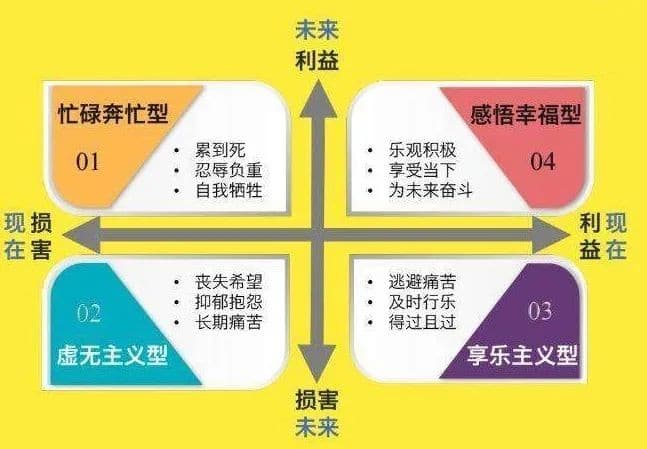
Some people are happy now but will be unfortunate in the future. For example, drug addicts know the consequences all too well, yet they cannot resist the temptation that drugs bring. They think, regardless of what tomorrow holds, they will seize the pleasure today first. This is the "live for the moment" type. People of this type equate pleasure with happiness. They only focus on satisfying their immediate desires. However, desires are like seawater—the more you drink, the thirstier you become.
There is another type of person who is unfortunate both now and in the future. They feel that their current life is terrible and that the future won’t be much better either. These individuals are typical examples of "learned helplessness." Under the constant blows of life, they have lost the courage to change their fate. This type of person is the helpless type. Often, we unconsciously become the helpless type without even realizing it. For example, "Ah, men, none of them are any good," "Ah, the relationship between mother-in-law and daughter-in-law, it’s never going to work out," or something I often say, "I’m from the south, don’t even try to tell me east, west, north, or south—I can’t tell them apart." See how much helplessness we’ve learned from life.
The third type of people are those who are unhappy now but will be happy in the future. These individuals are called the "busy and striving type." They have a goal in their hearts, and they believe that although their current life isn’t great, they will be happy once that goal is achieved in the future. Most of us fall into this category. For example, we often hear things like, "I’ll finally be relieved once my child gets into college," or "Life will be better once I buy my own house"... Unfortunately, the busy and striving type also fail to find happiness—once the child gets into college, they start worrying about whether the child will find an ideal job in the future; after finally buying their own house, they feel happy for a while but soon realize that it seems to get smaller and smaller the longer they live there. Just like a friend of mine, who, after moving two or three times, concluded: "Oh, whether it's a big house or a small house, let me tell you, it's all the same wherever you live—it always feels like you’re missing one room, forever missing one room!"—No external goal can bring us lasting happiness.
So there remains only the last type of person: those who are happy now and will also be happy in the future, also known as the "perceived happiness type." These individuals, like children, retain a strong ability to perceive happiness. A ray of sunlight or the blooming of a flower can evoke joy in their hearts. They live in the moment, as people often say. Living in the moment is a principle everyone knows, but it’s difficult to practice. For example, while working, I might look forward to finishing filming quickly so I can take a break and sleep in. But after being idle for a while during the break, I start to feel restless again, thinking I should go back to work. As an English proverb goes, "The grass is always greener on the other side." Happiness always seems to be somewhere else.
My grandmother is truly admirable in this regard. No matter the situation, the message she conveys to us is always: "Everything is fine." If you forget to save her lunch, she'll happily eat rice soaked in tea. At family gatherings, everyone will first serve her the most delicious chicken legs and wings, and she gladly accepts them, doing her best to finish them as long as she can.
Grandma loves to look beautiful. Even at the age of one hundred, she still dyes her hair every two or three months. The hair salon she frequents has moved to a farther neighborhood. To help maintain her mobility, the family didn’t get her a wheelchair. Instead, they accompany her on a slow walk, carrying a small stool. Every hundred meters or so, they set down the stool for her to rest. Walking and stopping like this, each trip to the salon takes over an hour round trip. Though Grandma gets very tired, she never complains. Every time she returns with freshly dyed hair, she is as happy as a child.
When Elder Ye Man was asked about her views on death in her over-a-hundred-year-old age, she said she is now "ready to die at any moment, yet striving to live with every step." She does not fear death, yet she continues to live with great effort. She ate when it was time to eat, taught when it was time to teach, right up until the very last moment of her life.
Grandma is the same way. She lives each day of her life earnestly, respects her own feelings and needs, accepts what she cannot change, and chooses happiness both now and in the future.
At the beginning of this year, Grandma passed away at the age of 101.
When we, as grandchildren, speak of our grandmother, our tone is filled not only with longing but also with deep affection, for she is like a treasure in our family. She has never brought a trace of negativity to her descendants, only a sense of ease and tranquility.
The pandemic has just ended, and the world is changing rapidly. Faced with such an era of uncertainty, it’s natural for everyone to feel some unease and anxiety—I’m no exception. In times like these, I think of my grandmother and the times she lived through, which were filled with war, famine, and turmoil. Yet, her calm and steady heart was like an anchor cast into the sea, holding together a large and fragile family. Her wisdom of surrender and acceptance was like the deep, tranquil currents beneath the ocean’s surface—no matter how fierce the storms and waves raged above, the depths remained peaceful and serene.
We do not know what the future holds, nor can we control the world around us, but we can control the feelings within our hearts. This is our most precious freedom. Just as my grandmother practiced throughout her life, despite the many hardships life imposed on her, she chose forgiveness and a smile. This freedom of choice allows us to navigate all uncertainties. At the end of life, we can say with peace, "My life was happy—because I chose happiness."
This workshop will feature five live sessions, two interactive Q&A sessions, two exclusive interviews (one of which is with the author of this article, Zhang Jingchu), and daily meditation support. For details, please refer to yesterday's article. You can scan the QR code at the end of the poster to register or inquire.