Why are women poorer?
Recently, I gave an online speech where I shared a viewpoint: the situation of Chinese women has not seen any real progress over the years.

Recently, I gave an online speech where I shared a perspective: the situation of Chinese women has not seen any real progress over the years.
There is a corporate executive who has worked in China for many years and disagrees with my perspective. She is American, has been in China for a long time, and works in the apparel industry. She mentioned that over the years, she has seen many female workers from rural areas move to factories. With higher incomes, they can send money back to their rural homes, and their status has already improved.
That is indeed the case, but when I refer to "genuine improvement," I mean not only an absolute increase in level but also a relative one. In other words, with years of economic development, the pie has grown larger—but has the share allocated to women increased proportionally?
The answer is, there isn't one.
The portion allocated to women has actually become proportionally smaller. Moreover, the trend shows that the smaller the locality and the more rural the area, the proportionally smaller the share for women becomes.
I am not a scholar in this field, but there are many excellent works in this area. I would like to share a few with everyone here.

In 2014, UN Women supported a study by Chinese scholars titled "Gender Equality in China's Economic Transformation."
This contains a wealth of detailed data and analysis. One of the conclusions is that the gender gap in employment income shows a trend of widening year by year. In plain language, this means that women earn less than men, and the gap is growing larger over time.
This is an excerpt from the report:
Income is a crucial indicator reflecting equality of outcomes, whether in education or employment, and embodies labor value and social justice. During China's planned economy era, all workers' job assignments were determined by state plans, resulting in relatively equal employment opportunities between men and women and a smaller gender wage gap. Since the reform and opening-up in 1978, enterprises and other employers have gained increasing operational autonomy, including the authority to decide employees' work and wages, leading to the emergence of wage disparities among the labor force. Data from three consecutive surveys on the social status of women in China show that over the 20-year period from 1990 to 2010, the gender income gap in the labor market has widened significantly. The average income of urban employed women declined from 77.5% of men's average income in 1990 to 67.3% in 2010, a drop of 10 percentage points. The income gap between men and women in rural areas expanded even more severely: in 1990, the average income of rural employed women was 79% of men's, but by 2010, women's average income was only slightly more than half (56%) of men's.
The gender wage gap may be caused by differences in ability or by discrimination. An important indicator for measuring differences in ability is educational attainment. Since the reform and opening-up, the gender gap in education has been gradually narrowing. Over the 30 years from 1980 to 2010, the proportion of female college students among all college students increased from 23.4% to 50.8% (An Shufen, 2011). The proportion of female students in higher education institutions has surpassed that of male students. Except for the lower enrollment rates among rural female students, urban women in China have largely gained equal access to education at all levels. However, the narrowing of the gender gap in educational opportunities has not led to a reduction in the gender gap in employment income. Some studies have calculated that gender wage discrimination within occupations accounts for as much as 68% of the gender wage gap (Li Shi and Ma Xinxin, 2006). The improvement in educational levels in China has led to an increase in income for both men and women, but it has not resulted in a narrowing of the income gap between them.
As mentioned in the "translation" above, the proportion of women's income relative to men's has been decreasing over the decades. The pie is growing larger, but the share allocated to women is proportionally shrinking.
In 2021, the Youcheng Foundation conducted a study on rural women titled "Rural Women's Economic Empowerment Scan Research Report."
Looking at the data in this report, the situation has not improved. Recall the previously mentioned proportion of rural women's income relative to men's, which dropped from 79% in 1990 to 56% in 2010. This report, published in 2021, states, "Based on data from the 2017 Chinese General Social Survey (CGSS), the research team calculated that, according to household registration, rural women (with agricultural household registration) earn approximately 16,419 yuan per year, while rural men (with agricultural household registration) earn approximately 33,080 yuan per year." A simple division shows that rural women's income accounts for only 49.6% of men's income, meaning that in just seven years, this proportion has decreased further. It has fallen below half!
Of course, these research reports always ask, why?
In the 2014 report, one key reason highlighted was: "Unpaid care work is predominantly undertaken by women and its value remains unrecognized."
"Translation" means that women are not participating less or contributing less to economic development; it's just that these contributions are not recognized.
After the founding of New China, the family model in China shifted from the agricultural society's emphasis on blood relations, the father-son axis, and male dominance to a modern family centered on the husband-wife axis and gender equality (Ding Wen, 2001). The government's advocacy of "gender equality" has significantly promoted the equal participation of urban women in social production activities. Although traditional gender perceptions still position women more within family roles, the dual burden of work and family borne by urban professional women in China has largely been "mitigated" by the public welfare policies and services implemented by the government through "work units" (Liu Bohong et al., 2008).
After the market economy reforms, these public services were transferred to the market and households. When market-provided public services fail to meet the needs of family care or when families cannot afford household services, the responsibility for family care once again falls on women. Data from the National Bureau of Statistics' time-use survey show that women spend nearly three times as much time on unpaid labor as men per week, a phenomenon that is even more pronounced in rural areas. Women—especially rural women—remain the primary bearers of unpaid labor. While undertaking heavy paid work, they must also shoulder a significant amount of unpaid labor, resulting in daily working hours far exceeding those of men and significantly less discretionary time compared to men (Dong and An, 2012).
In fact, unpaid care work holds significant economic value. Based on an analysis of China's 2008 time-use survey data, Dong Xiaoyuan and An Xinli estimated that the value of unpaid care work is equivalent to 25%-32% of China's GDP, 52%-66% of China's total consumption, and 63%-80% of China's total industrial output value (2012). However, the value of women's unpaid domestic labor and their contributions to the family and society have not been recognized under market economy conditions. Instead, this work has become an obstacle to their entry into the labor market. This shift in economic and public policies over the past 30 years has accelerated the marginalization of women in the labor market and highlighted gender inequality.
Looking at these figures, isn't it truly shocking? If unpaid care work were included in GDP calculations, it would account for one-third of GDP and two-thirds of total consumption. Yet, despite the economic development over the years, women's contributions have not been fairly compensated. Instead, they have become shackles and barriers to entering the labor market.
The 2021 Youcheng Foundation report also mentioned:
Rural women are the primary bearers of labor such as household chores, child education, and elderly care. Globally, women in rural areas and low-income countries spend 14 hours a day on unpaid care work, which is five times that of men in similar regions. According to the 2018 Second National Time Use Survey, the average daily time spent by residents on unpaid labor is 2 hours and 42 minutes. Among this, rural men spend about 80 minutes, while rural women spend approximately 230 minutes. Rural men spend an average of about 50 minutes on household chores, whereas rural women spend nearly 150 minutes on household chores, about three times that of rural men. Additionally, they spend about 50 minutes a day accompanying and caring for their children.
The report mentions many aspects of the current situation of rural women. Here, only the subheadings are pasted.
"Rural Women:
The overall level of education is relatively low, and the incidence of poverty is high.
Non-farm employment demand is high, but accessible training resources are limited.
The psychological condition is not optimistic, requiring psychological care and support, yet access to professional psychological intervention and assistance is nearly impossible.
Lack of awareness of women's rights, with low political participation awareness and capabilities.
The sense of subjective consciousness is relatively weak, and their status within the family is lower compared to men.
Each of these points, when placed upon an individual, is unbearably heavy. This is why, despite progress in recent years, the situation has not truly improved in a meaningful sense.
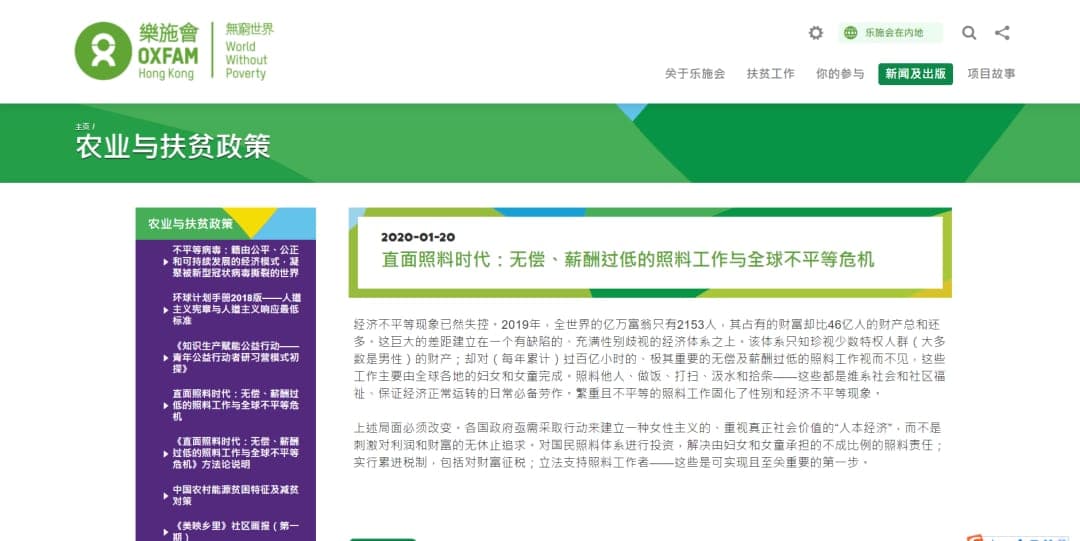
In 2020, Oxfam released a report with a striking title, calling on everyone to "Confront" — "Confronting the Care Crisis: Unpaid and Underpaid Care Work and the Global Inequality Crisis."
The summary states:
Economic inequality has spiraled out of control. In 2019, there were only 2,153 billionaires worldwide, yet their combined wealth exceeded that of 4.6 billion people. This staggering disparity is built upon a flawed and gender-biased economic system. This system values the assets of a privileged few—mostly men—while turning a blind eye to the over 100 billion hours of essential, unpaid, and underpaid care work performed annually, primarily by women and girls across the globe. Caring for others, cooking, cleaning, fetching water, and gathering firewood—these are the daily, indispensable tasks that sustain the well-being of societies and communities and keep economies running. The heavy and unequal burden of care work perpetuates both gender and economic inequality.
This situation must change. Governments urgently need to take action to establish a feminist, "human-centered economy" that values genuine social worth, rather than stimulating endless pursuit of profit and wealth. Investing in national care systems to address the disproportionate care responsibilities borne by women and girls; implementing a progressive tax system, including taxes on wealth; and legislating to support care workers—these are achievable and crucial first steps.
So the conclusion is:
1. Women are poorer than men, and the gap is widening.
2. This is not because women are not smart, capable, or hardworking, but because of significant structural constraints, with unpaid care work being the foremost among them. In other words, a substantial amount of women's labor is crucial to the functioning of the economy, yet it is not recognized by the economic system.
3. Moreover, and more importantly, the resulting time poverty, physical exhaustion, and mental depletion leave women with even less time to contemplate issues such as women's rights or the possibility of political participation. There is also a widespread psychological state that is "not optimistic," and they often lack support, thus creating a vicious cycle.
How to break through?
First, there are many organizations and scholars, as mentioned in the article, producing reports on this topic, which helps draw more attention.
At the individual level, it is hoped that more women will become aware of this overall situation, starting with the "subjective self-awareness" mentioned in the report.
So, as we enter the fifth year of the Promise, the theme I’ve set is "Fun and Wealth," and I’d like to talk with everyone about money—a topic that might seem "superficial" at first glance.
But the issues behind "money" are anything but superficial. On an individual level, it involves the profound question of how to achieve "self-awareness"—understanding and adjusting our personal relationship with money. On a macro level, it means examining economic phenomena through a gendered lens, acquiring the economic literacy that everyone should possess, and understanding how major wealth-related institutions operate.
A few days ago, I invited Sister Bing and Nana from the Nuoyan community to chat about "money" and explore the paths of life. This engaging conversation is now available on my YouTube channel.
Easter Egg One:
Recently, I had a conversation with the author of *Invisible Women*, which also contains a wealth of data. You can watch the replay on the Nuli Society video channel and my YouTube channel. Feel free to follow along.
Easter Egg Two:
If you find the data above enlightening, this way of thinking and analyzing data is actually very useful for how we view the world.
Give a similar example. Everyone knows that China's GDP has grown rapidly in recent decades. GDP represents the incremental wealth created each year, and this incremental wealth mainly goes to several major destinations:
Residents: The sources are wages and dividend interest income, primarily used for consumption and savings.
Government: The sources are tax revenue and various government fund-based incomes (primarily land transfer fees and rents), used for government expenditures and major investments.
Enterprise: The source is depreciation and profits, used for dividends or expanding production. (Finance is also an enterprise, so interest is also the income of financial enterprises.)
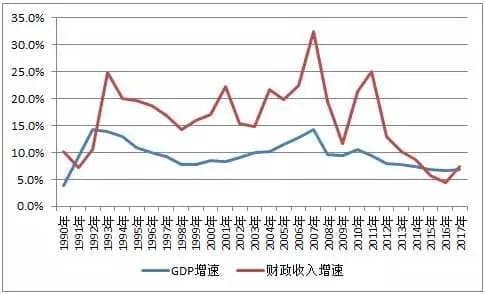
From 1993 to 2014, the growth rate of fiscal revenue consistently outpaced the GDP growth rate for 22 consecutive years. What does this signify?
The cake has grown larger, and every slice has grown larger, but whose slice has grown even larger?
Reference Materials:
1. "Gender Equality in China's Economic Transformation" https://cnlgbtdata.com/files/uploads/2020/01/8da8b3114494a28be31a86a6cb1a714f.pdf
2. "Rural Women's Economic Empowerment Scan Research Report" http://www.youcheng.org/upfile/20210507104335.pdf
3. "Confronting the Age of Care: Unpaid, Underpaid Care Work and the Global Inequality Crisis" https://www.oxfam.org.cn/uploads/2020/01/211433034372.pdf
4. "Is Fiscal Revenue Growth Rate Higher Than GDP Growth Rate?" https://www.zhihu.com/question/278412995