Went to America, and then what?
Tell a few fragments——
“Foreword:”
“First of all, let me clarify that this article is an advertisement. Starting in October, I will be conducting an 8-week online workshop for international students. The article will share some fragments and reflections I've gathered over the years, explaining why I'm doing this and how it will work. For those interested in the workshop, this piece is quite "substantial," so feel free to take your time reading it.”
Portrait of Chinese Americans
Tell a few fragments——
2015.
Compared to the present in 2023, the situation can be described as overwhelmingly positive. The economy continues to grow steadily, and Sino-American relations are harmonious.
We received a message on the backend of the Slave Society platform from a Chinese doctor who has lived in New York State for many years. She hopes I can do some work targeting international students. Because she has seen too many real situations of Chinese students abroad, and it makes her very distressed. Moreover, she is almost certain that their parents are unaware of these situations. The examples she gave were things I had never imagined: male and female students living together, unexpected pregnancies, and girls who don’t know how to get an abortion; boys suffering from depression, not leaving their homes for half a year; fake students who don’t attend school but constantly ask their parents for money, while their parents believe they are still studying...
The children are attending decent schools, and the tuition is not cheap. It's easy to imagine that parents back home, thinking they've reached the "promised land," breathe a sigh of relief and proudly tell their friends and colleagues, "My child is studying in the United States." But what is the reality? "It's terrible" are the exact words from the letter.
I didn't have the energy or opportunity to do it back then, but I've always remembered this email.
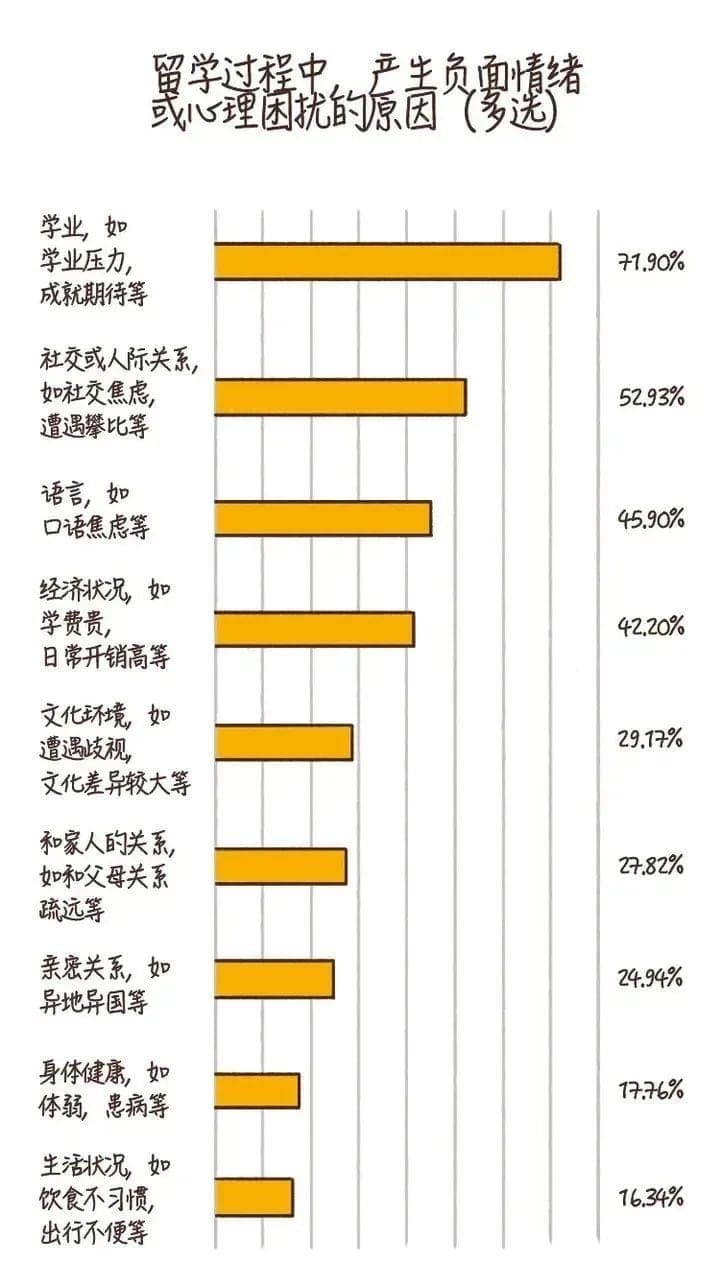
Later, KnowYourself released a "Mental Health Self-Help Guide for Chinese International Students," which revealed that over 83% of respondents had experienced at least one mental breakdown during their studies abroad. These respondents included not only children from wealthy families but also those from ordinary backgrounds who relied on scholarships and part-time jobs to complete their courses. Regardless of family circumstances or the schools they attended, the depressive emotions experienced by international students were largely similar.
2019.
I was attending an education forum in Guangzhou, where Xin Ying, the former vice principal of Tsinghua University High School, shared a statistic: 40% of Chinese students at Yale University are unable to complete their studies for various reasons. We were shocked by this number. Usually, what we see on social media are good news about children being admitted to prestigious overseas universities, but this 40% who cannot finish their studies is something we never see on social media.
The child's condition, the parents' pain—perhaps only each family truly knows.
Who they were, where they were, and what became of them—no one knows, and no one cares.
2022.
During the pandemic, I had a conversation with the renowned American sociologist Deborah Davis. Deborah has been teaching at Yale since 1978 and was previously a doctoral student of the famous sociologist Ezra Vogel. Over her more than forty years at Yale, she has produced numerous works and received many honors. She has served as the chair of Yale’s Sociology Department, the academic director of the Yale Center for the Study of Globalization, and the chair of the Women Faculty Forum, among other roles. Since 2016, she has also taught at Fudan University and Tsinghua University’s Schwarzman College, and she is a member of the editorial board of the Yale China Quarterly. She began learning Chinese in 1969, has worked in China multiple times, and holds deep affection for China and her Chinese friends. In the workshops I conducted on the career development of overseas Chinese, she participated as a guest speaker. (Video link)
During that conversation, she mentioned wanting to start an NGO (non-profit social organization) to help Chinese students studying in the U.S. volunteer at local non-profit organizations for a period of time, allowing them to better understand American society. As a sociologist, she was deeply concerned about the situation of Chinese students during that period. During the pandemic, many students came to the U.S. but attended classes online, living together with other international students and having almost no contact with American society. They would "finish their studies" and leave the U.S. without truly experiencing the country, which she felt was a shame—a "missed opportunity" both for the U.S. and for the students themselves. She said she hoped her NGO could raise some funds, identify local community non-profit organizations in the U.S., and persuade them to recruit Chinese students as volunteers. The money she raised would partly subsidize the NGO and partly provide stipends for the students. Although the amount might not be large, she believed such experiences would be invaluable for them. I thought this was a wonderful idea and told Deborah, "Let me know when you get it started—I’d like to donate some money too."
Half a year later, she told me that the trip didn't happen. The difficulty wasn't money, but rather the lack of a host organization—these local community organizations are relatively small and can only accommodate a limited number of volunteers. Even when positions are available, they prefer to offer them to high school students who grew up in the local community rather than international students who are seen as "transients." This is because these organizations are deeply rooted in the community and aim to contribute to its development. The United States is a bottom-up, self-governing society, which makes perfect sense.
This matter was not accomplished.
However, these issues faced by international students, these "missed opportunities," have not disappeared.
It was also 2022.
A friend's child came to the United States from Beijing to study. When asked why he chose to come to the U.S., he said it was because the pandemic was caused by America, which is China's rival, and he wanted to "learn from the strengths of the foreigners to counter them."
Ironically, because he was born in a maternity center in the United States when his mother was there, he holds an American passport.
I wonder how scholars like Deborah would feel if they knew that the young Chinese people they want to help hold such thoughts.
2023.
I received several long messages on LinkedIn. They were from a very thoughtful young man who arrived in the United States at the beginning of the year to pursue a Juris Doctor (JD) degree. With his permission, I’d like to share some of his observations that he wrote to me.
“A couple of days ago, a JD alumnus from the same graduating year as me started a WeChat group, and today everyone was discussing the U.S. Supreme Court's ruling on Affirmative Action (AA). The initial discussion focused on personal opinions about the ruling, but it quickly shifted to how much donation could secure admission into an Ivy League school without the usual application process. Someone even gave an example, saying that top Ivy League schools (a term I learned today) have a legacy admission list every year (for applicants whose family members are alumni), and they are directly admitted. Then, a committee of professors selects candidates from outside that list. Later, the conversation moved on to whether schools grade harshly (give low grades), how much big law firms care about 1L grades, approximately what percentage of graduates enter big law, and what salaries they might expect, among other topics.”
“After observing, I inexplicably felt a sense of incomprehension. This incomprehension wasn't about their actions, but rather about the fact that everyone has reached this stage—some have worked, studied abroad, or seen more or less of the "world"—so why is it that in conversations, they still convey a "focus" on undisclosed information like "dark secrets" or "sensationalism"?”
“Interestingly, just before everyone started discussing the "Ivy League," someone in the group had just shared a news story about three Chinese parents in the Bay Area getting into a physical altercation over arguments like "UC Berkeley is just an ordinary, run-down school," "Stanford isn't an Ivy League school," and "Tsinghua master's graduates don't deserve to mingle with Tsinghua undergraduate alumni."”
“After arriving in New York at the beginning of the year, I spent some time in the Chinese community and heard many bizarre stories—human trafficking, money laundering (more often illegal currency exchange), illegal income, and malicious car accidents (it is said that there is a law stating that if a non-green card holder causes a serious but non-fatal accident involving a U.S. citizen, the court may order the offender to care for the victim and grant them a green card to work and repay the debt, thus allowing them to obtain legal status through this method). Experiencing this firsthand gave me reason to believe why some people online say, "Overseas Chinese cheat Chinese." It has been said that when profits exceed 300%, some people will risk their lives. These Chinese individuals involved in human trafficking are a true reflection of the saying, "Money can make the devil turn the millstone."”
“Comparing the over twenty job descriptions shared in the group today, this approach of measuring American thinking through the lens of Chinese interests—especially for those who plan to practice law in the United States in the future—leaves me uncertain how to feel.”
In these fragments spanning nearly a decade, a vivid portrait of Chinese immigrants in America is pieced together.
There are "high-end" law PhD candidates who, on one hand, aspire to join "prestigious law firms" and become part of the mainstream elite, while on the other hand, their minds are preoccupied with "unspoken rules" and "scandals within wealthy families."
There are also those in the "low-end" "Chinatowns" who contemplate how to obtain legal status through criminal activities, as well as "compatriots" who specialize in deceiving Chinese people in business dealings.
There are young newcomers who struggle to break out of the Chinese student circle; and there are also "successful individuals" in the Bay Area who have been in the U.S. for decades, whose children attend North American universities, yet they engage in heated arguments over whether their child's university is an "Ivy League" school or whether a parent holds a bachelor's or master's degree from Tsinghua University, caught up in a hierarchy of prestige.
There are those who, back in the day, had the means to give birth to their children in the United States, raising them as "Americans" who would later come here to "learn from the strengths of foreigners to counter them." There are also young people born in China, who, in the eyes of their parents, made it to prestigious American schools but, for various reasons, were unable to complete their studies.
……
What is settling down?
In recent years, more and more Chinese people have been coming to the United States.
These individuals must be quite successful in their own right, as without substantial savings, it would be impossible to have the financial resources and capability to immigrate in middle age.
On the other hand, there is also a foreseeable sense of helplessness. If one hadn’t seen through certain things, who would willingly uproot themselves and settle in a new place in their middle or old age?
However, "settling down" is actually a long and arduous process.
Having the money to buy a house and finding a school for the children only means physically "settling down." It merely grants the identity to "consume" in the United States.
Finding a cultural and spiritual "home" is a long journey, one that may never truly be complete.
From the ukiyo-e above, it is clear that young people might easily feel like "floating duckweed," with nowhere to "settle down." However, those senior Tsinghua alumni who engaged in fierce disputes have already "settled down" in the United States for at least 20 years. Their English, status, property, and investments are likely long mastered, yet spiritually, they remain attached to the narrow-minded space of the old hierarchy of disdain. Is this attachment any more superior compared to those newly arrived "floating duckweed"?
So in this assembled ukiyo-e, what's unfortunate isn't the "floating duckweed," nor is it the young people who feel "unable to integrate into American society."
The trouble lies in this "attachment."
Barefaced deception of fellow countrymen is an attachment.
But aren't those who attend prestigious schools to study high-profile JD programs and spend their days pondering hidden rules also just clinging to something?
After twenty years in the United States, does sending your child to an Ivy League school mean you're no longer attached?
Of course, there are even more impressive ones—those who were born with an American passport. Shouldn't they be included as well?
So in the end, the message this young man gave me was this:
“Recently, with the start of the new semester, I've encountered more people and gained more insights. My overall perspective hasn't changed, but I've observed many different forms of survivorship bias and seen how the privileged descendants of Chinese society live in the United States. Many things become clearer the more I see and analyze them, yet I find myself growing increasingly concerned about the future of the Chinese nation as a people.”
Workshop
I share the same concern.
So starting this autumn, I will be conducting an online workshop for international students. The aim is to support overseas students in recognizing and eliminating this "attachment," not only by helping them "find a place to live" physically but also by embarking on a journey of "settling down" spiritually.
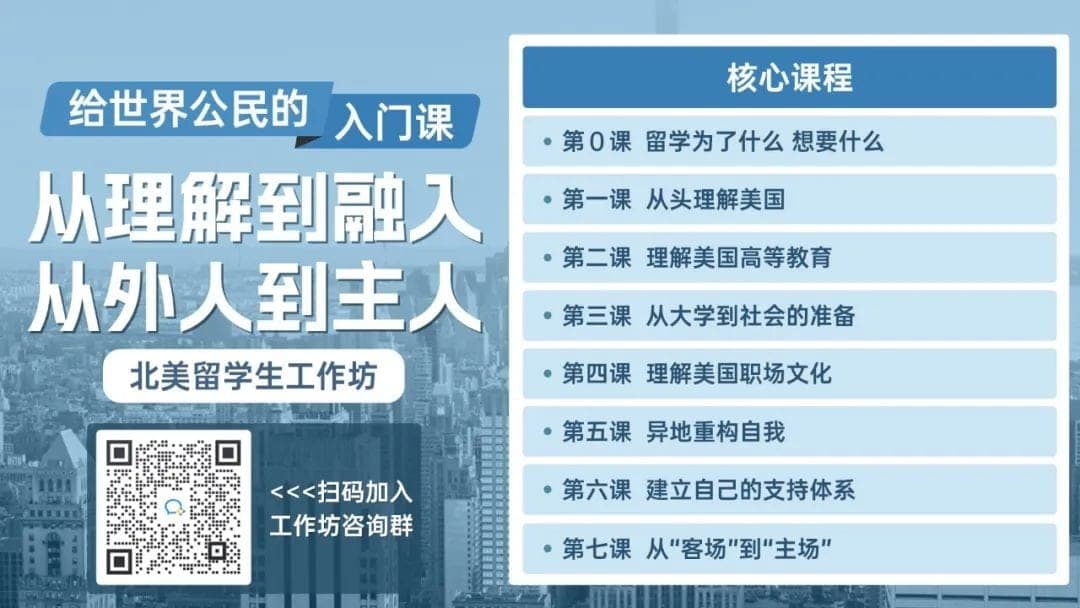
The workshop is called "An Introductory Course for Global Citizens: From Understanding to Integration, From Outsider to Insider."
The target audience includes international students currently enrolled in university or graduate school, those who have graduated within the past three years, and prospective students preparing to study abroad.

This workshop consists of four parts:
Part One, the main course, is an 8-week online LIVE course that I designed and lead.
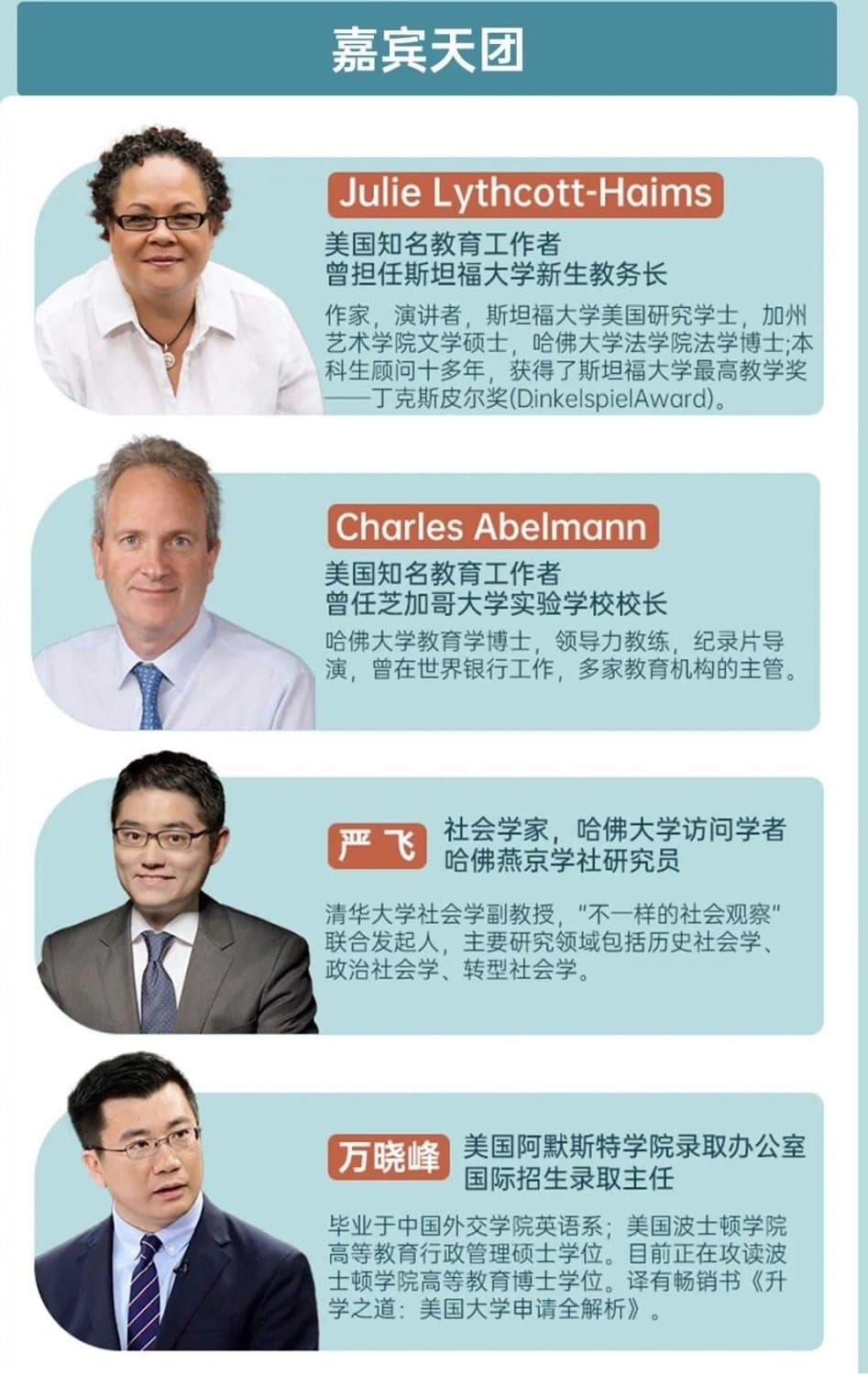
The second part revolves around this main theme, where I have invited a "luxurious" lineup of "guest experts" for the workshop participants. They will engage in LIVE online discussions with everyone. The guests include:
Julie Lythcott-Haims, who served as the Dean of Freshmen at Stanford University for 10 years, is a renowned TED speaker and the author of bestselling books such as *How to Raise an Adult*.
Charles Abelmann, a renowned American educator, former principal of the University of Chicago Laboratory Schools, former director of education programs at the World Bank, and the organizer of the 2021 centennial commemoration of John Dewey's visit to China in the United States;
Professor Yan Fei, a renowned sociologist currently serving as a visiting scholar at Harvard University, has authored two highly insightful works: "Suspended" and "Penetration."
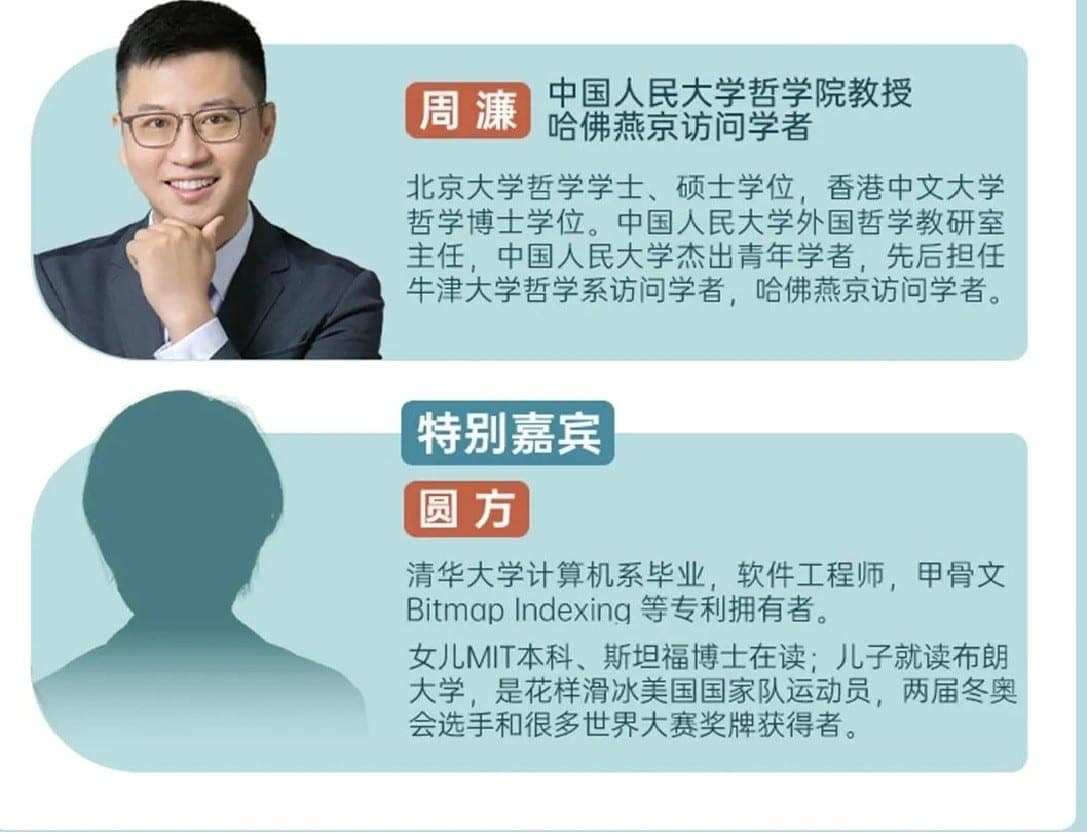
Zhou Lian, a philosophy professor at Renmin University and a renowned scholar;
Wan Xiaofeng, the international admissions director of Amherst College, a top liberal arts college in the United States, and the translator of "The Road to College."
There is also a special guest, my Tsinghua senior sister Yuan Fang, mother of two exceptionally outstanding children—her daughter completed her undergraduate studies at MIT and is currently pursuing a Ph.D. at Stanford, while her son attends Brown University and is a member of the U.S. National Figure Skating Team, a two-time Olympian, and a medalist in numerous world competitions. This will be Senior Sister Yuan Fang’s first public sharing of her thoughts on education and her advice for young people.
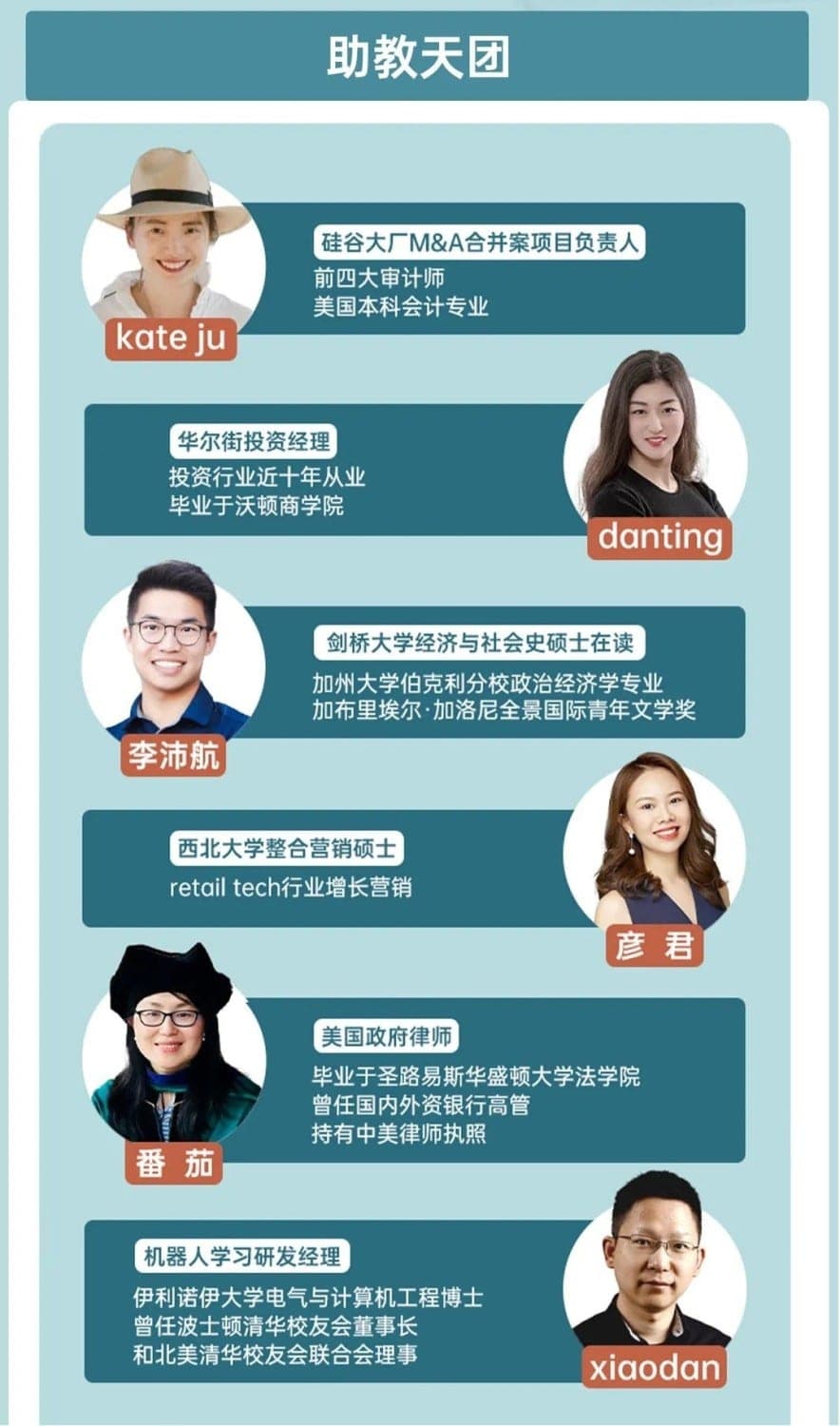
The third part is the workshop teaching assistants. I invited outstanding alumni who have participated in my North American workplace workshops—experienced individuals who have achieved remarkable success in various fields across the United States—to serve as teaching assistants. They will answer questions, support everyone’s learning experience during the workshop, and can also become part of your professional network in North America after the workshop concludes.
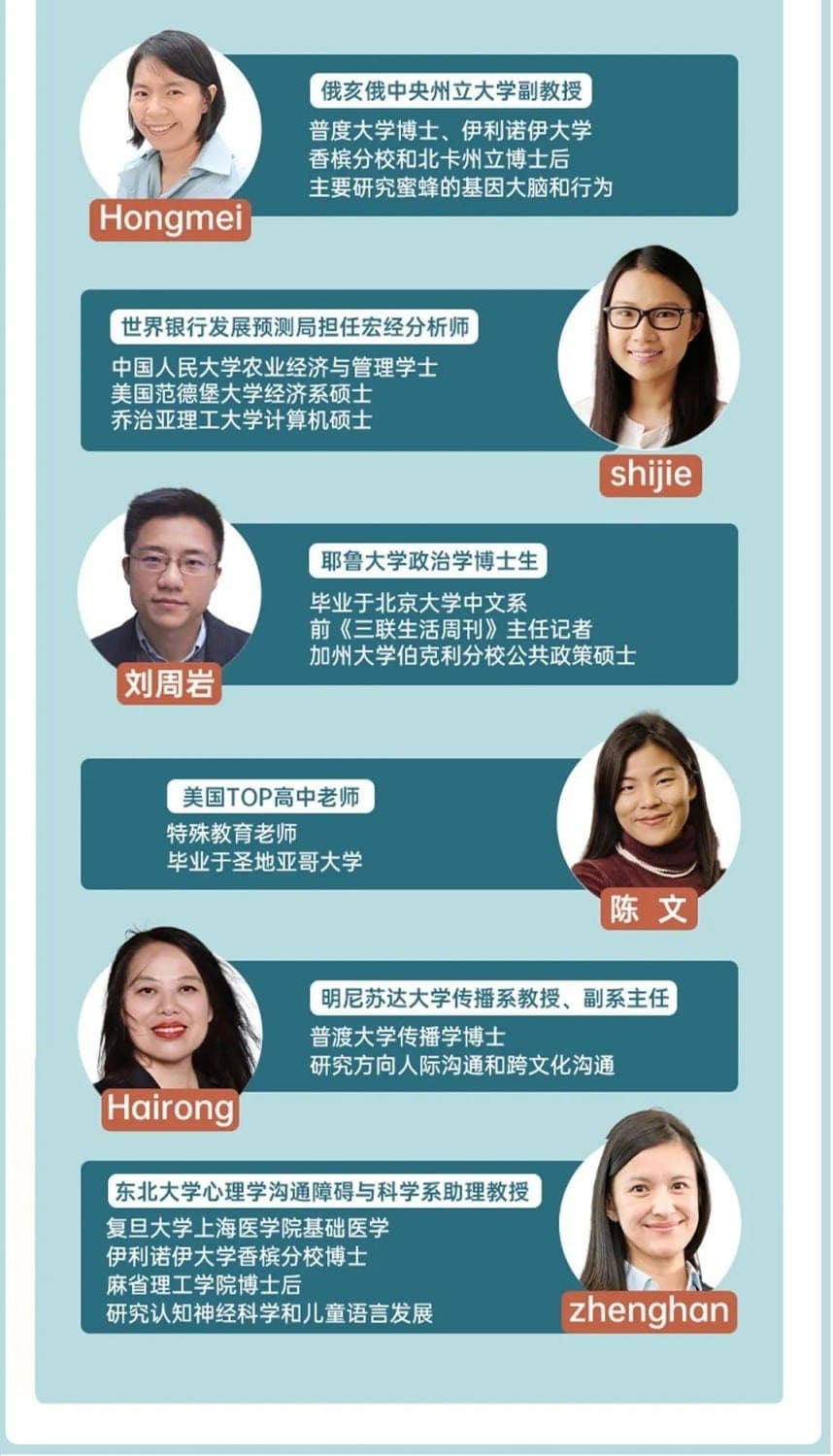
The fourth part, which is actually the most important, is the workshop's own field and community. The workshop includes a North American alumni directory, where everyone can find each other and connect. Since my workshop started over a year ago, it has formed a cross-regional and cross-industry online deep connection community. I believe this community is also an invaluable treasure for the growth of young people.
Written at the end
Leaving one's country in middle age is inevitably painful, yet for young people, while they may not have as many attachments as those in middle age, leaving home and familiar surroundings to go to a new country and a new school brings various impacts on the self. How often do they find themselves in a state of dizziness and confusion?
I know, because I've been through it too.
No matter what age you are, leaving your familiar cultural environment for a new one is always very challenging.
This sense of dizziness and confusion is even more profound for those who have left mainland China, because what has changed is not just the language and environment, but the underlying value system, worldview, and historical narrative.
It wasn't until after I turned 40 that I realized if I didn't put effort into this deeper level and only learned some superficial skills, I would remain trapped in the chaotic scenes of the "floating world," repeating the same cycles over and over. Many stories that appear glamorous on the surface, even those deemed successful, are, in a way, the jokes of civilization.
I started at the age of 40. If I had a choice, I wish I could have started earlier. That’s why I’m conducting this workshop for young people. On one hand, it aims to provide answers to some very specific needs, such as entering and preparing for the international workplace, and building one’s own network. On the other hand, it also helps to understand the underlying logic behind these specific paths—how to build oneself, how to build relationships, and how to do the deeper work to embark on the journey from being an "outsider" to becoming an "insider."

Live Video: I had a conversation with the teaching assistant Tomato and admissions officer Li Xue from this workshop—what is the purpose of studying abroad besides "gilding"? To learn more about the two live guests, you can read the "Recommended Reading" section below. Feel free to click and watch the replay of our live session.
Recommended Reading:
Top Mindsets Required in Overseas Careers—How I Found the Second Curve of My Career Development by Moving to the U.S. in Midlife (Author: Tomato)
Why Immigrate to America? (Author: Li Xue)