Three "Shortcuts" to Becoming a Leader: Making Mistakes, Breaking Down Walls, and Being the "Bad Guy"
Not all leaders hold high positions.
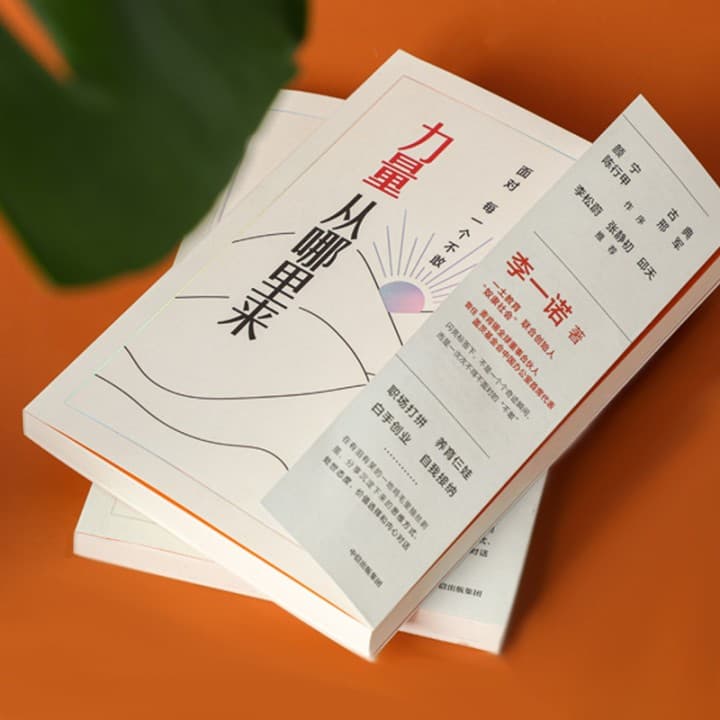
“This excerpt is taken from Chapter 3 of Yinuo's *Where Does Strength Come From*.”
Being in a high position doesn't necessarily make someone a leader.
As soon as you start leading a team, even if it's just one person, you've begun stepping into a leadership role. At this point, it's not enough to just do your own tasks well—you also need to think about the bigger picture. Here, the "bigger picture" doesn't refer to global trends, but rather the micro-level "big picture"—things that go beyond your own immediate "task-oriented" domain.
During my time at McKinsey, the transition from project manager to associate director was essentially a process of learning how to "build." Over the years, I’ve gradually learned—through trial and error—what it takes to "build," and I’d like to share some of these insights with you.
First, let me talk about where I learned "leadership." There are countless books and extensive research on leadership. However, for me, the most useful sources come from three areas.
First, some of my family members are good leaders in their work. The foundation of leadership lies in character, so my observations of how my family members conduct themselves were my earliest exposure to leadership.
Second, in career development, especially the mentorship and support from multiple mentors at McKinsey.
Third, I have witnessed all sorts of bizarre words and actions from poor leaders. Every time I encounter such situations, I think to myself: Oh my, I must never do that when I become a leader.
I have summarized three key traits of a good leader.
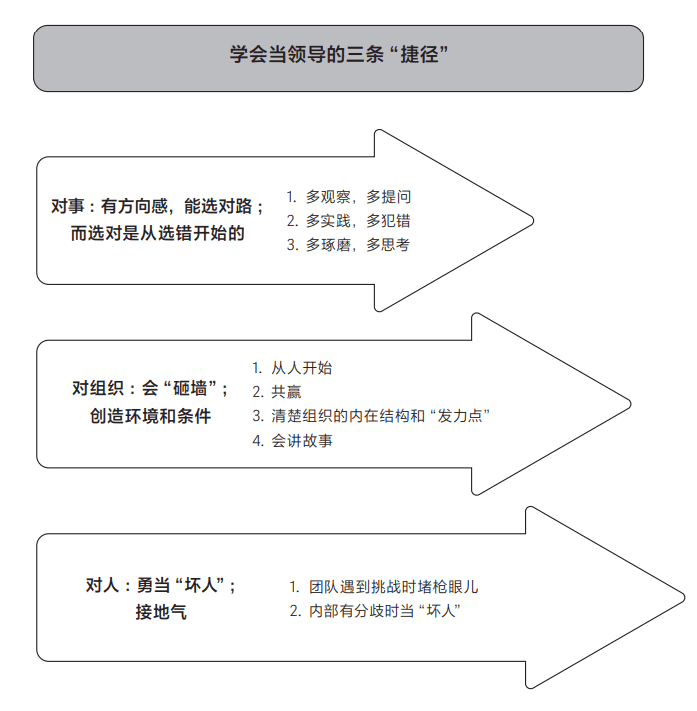
Regarding matters: Having a sense of direction and the ability to choose the right path;
And choosing right begins with choosing wrong.
At its core, leadership is about foresight, vision, and a sense of direction. Think back to the leaders you admire—they are insightful, strategic, and have a clear sense of direction, right? They can offer clear perspectives when everyone is confused, and when there are no ideas, they know how to find them.
Compared to "bad people" in the workplace, I'm more afraid of "nice guy" leaders because they often lack substance in their words, provide no clear direction, and frequently rely on the team to set the course under the guise of "democracy."
Where does a sense of direction come from? How can ordinary people like us develop a sense of direction? I’ve summarized three methods.
1. Observe more, ask more questions.
Pay attention to when leaders make decisions and what the basis is. If you can't figure it out, then ask—you'll understand after asking a few times. The biggest mistake here is guessing and then trying to justify it based on office rumors and vague clues. Not only will you fail to grasp the essence, but you might also go astray.
2. Practice more, make more mistakes.
Our experience and judgment are accumulated and refined through repeated practice and mistakes, with no shortcuts to take.
Throughout my years of working, I have experienced countless moments of awkward ignorance and faced many problems I didn't know how to tackle. Each time, the way out was to take action, make mistakes, reflect, and summarize, constantly improving. In this way, a sense of direction gradually took shape.
My second project at McKinsey was helping a telecommunications operator improve the performance of its retail stores. At the time, I knew nothing about this field and asked some pretty naive questions. To better understand, I went into the stores to observe and saw the store manager chatting effortlessly with customers. When I asked, I found out the manager was only 18 years old and had been working part-time since he was 15. I asked him for advice on how to excel in sales, and he shared a golden line: "Everybody needs SOMETHING, it's your job to find out."
In my many years at McKinsey, serving clients and participating in bids, I often reflected on the words of that 18-year-old boy. It could be said that this was my first training in client relationships.
3. Ponder more, think more.
Many people get lost in busyness, believing that as long as they put in hard work, they will be rewarded. Truly outstanding individuals are those who engage in continuous deep thinking. Compared to physical busyness, diligent thinking is far more important. For crucial issues, it is essential to think early, discuss early, and form perspectives on core assumptions and key problems as soon as possible. Spending one hour on this early stage is far more effective than spending ten hours later to correct a wrong direction.
For the organization: Will "break down walls"; create environments and conditions.
A good leader needs to see where the "walls" are, including those inside and outside the organization, and be able to "break them down," as well as build new ones. This is because everyone, even those in the highest positions, has limited abilities and energy. Therefore, the essence of leadership lies in creating the environment and conditions for the team's success.
"Walls" often arise because organizational structures create barriers, and many things become inefficient to advance due to the inefficient division of resources.
How to be a "wall breaker," I have a few tips.
Start with people. Recognize that no matter how intimidating the title may be, the person holding it is a real human being. Get to know them, understand their perspective, have a conversation, and see this "wall" from their point of view.
Win-win. My success does not mean your failure; it doesn't have to be a zero-sum game. "Breaking down the wall" can help not only me but also you.
Identify the "leverage points." Understand the internal structure of the organization and where the "leverage points" lie. Determine who the decision-makers are, who the advisors are, and whom we need to influence.
Being able to tell a story. Sometimes the "wall" exists because others don't know what you're trying to do. So, tell the story well—explain what you want to do, why, and how. Once you make these clear, the "wall" will crumble on its own.
How to build after "smashing the walls"? There are two pieces of experience.
Foster a culture of honesty. Whether for individuals or organizations, the greatest cost often stems from the internal friction and management expenses caused by distrust. Therefore, start with yourself—be true to your word, address concerns openly, and create an organizational environment built on trust.
Build the on-ramp. Having a sense of direction is not enough—you must first build the on-ramp yourself. If you need to write an email, draft one first to set the tone. If you need to conduct an analysis, provide an example. If you need to meet with a new external organization, schedule the meeting yourself and remember to bring your team along. In excellent organizations, everyone has strong learning abilities, but it is naive to think that simply setting a direction will allow the team to sprint ahead on their own. Good leaders build the on-ramp.
Towards people: Be brave to be the "bad guy"; stay grounded.
Here, "bad person" does not refer to someone with poor character, but rather to someone who is "difficult to deal with," which carries two meanings.
1. When the team faces challenges, you be the one to plug the breach.
At McKinsey, there was a leader I deeply respected. Once, during a meeting with a client, the company name that shouldn’t have been there was prominently displayed on the slides—a basic mistake. As the associate director leading the project, I panicked. But this leader calmly said, "I’m sorry, that was my oversight. We’ll remove it right away." He took all the responsibility upon himself. I still remember how his image in my mind at that moment—towering and magnificent.
2. When there are disagreements within the team, be the one to play the "bad guy."
In fact, when disagreements arise within a team, it's often not a matter of some people being right and others wrong, but rather that everyone sees the situation differently, leading to different conclusions or feelings. At such times, leaders must first avoid arrogance, thinking they can simply make the final call. Instead, they should genuinely understand the situation before making a decision. Decisions should not be based on personal preferences but on the organization's development direction.
"Being down-to-earth" has three meanings.
1. You may not need to do specific tasks, but you must understand the "suffering of the people."
At McKinsey, building complex data models, from structural assumptions to finalization, involves a massive amount of work. The type of leader employees dread the most is the one who offers no input at the beginning, only to casually remark after the model is completed: "Let's redo it." Wow, do you have any idea how much work that entails?!
So later, when I became a leader myself, I would discuss the core assumptions that could impact subsequent stages with the team early on and provide feedback promptly. This approach often yields twice the results with half the effort. Of course, this is based on the premise that you have a solid grasp and thoughtful understanding of the project's core, rather than just being superficially diligent.
2. Willing to share both joys and sorrows.
When I was a manager at McKinsey, I led a project in South Korea, and it was extremely challenging. The client, the problem, and the team all had issues. I remember one time when we had a major meeting scheduled for the next day, and on the day before, we needed to meet with the client’s general manager to go over the discussion points. The general manager was busy all day and only had time at 8 p.m. During the review, he had many ideas. Given the circumstances at the time, we had to make all those changes. By then, the team members had already gone home, as the meeting didn’t end until 10 p.m.
My mind was buzzing at the time, unsure how I could finish all the work that night. Just then, the project leader said, "Tell me what time you need it done by, and we'll do it together." So, at midnight, we met up at the hotel. He mentioned that he wasn’t as quick with PowerPoint anymore, but his mind was still sharp when it came to data modeling. In the end, it felt like I was "leading" this senior leader as if he were an analyst—he handled the models while I created charts and put together the PowerPoint. We worked until 3 a.m. and finally got everything done.
How could employees not love such a leader?
3. Possesses "life skills."
Many leaders, upon reaching high positions, live in a world where they are constantly praised and flattered by countless people, mistaking this for the real world.
When I was serving as the deputy director, I once attended a meeting in Shanghai where a senior internal leader I had never met before was scheduled to attend. Five minutes before the meeting, we were all busy preparing when I received a call from this senior leader. He said quite bluntly, "Come down here." I rushed downstairs and saw him stepping out of a taxi. He said to me, "Pay the fare." I was a bit stunned. He explained, "I never carry money when I travel for work, but today the car my secretary arranged broke down halfway, and I actually needed to use money." I thought to myself, "Wow, yes, 'actually'."
So always remind yourself, no matter how high your title is, don't become the kind of person who loses touch with the ground.
Having covered the above points, let’s summarize. To transition from an executor to a good leader, one needs a sense of direction, the ability to choose the right path, the foresight to see "walls," the skill to "break through them," and the capacity to create an environment and conditions for success. One must also be willing to play the "bad guy" when necessary and stay grounded. In simpler terms, it means having a vision that looks far ahead, feet firmly planted on the ground, a sharp mind to apply effort, a caring heart, and a "thick skin."
Back to that low moment when I wasn't selected. (Editor's note: In Chapter 3, Part 1 of *Where Does Strength Come From*, the author recounts the experience of not being selected for the first time as an associate principal candidate at McKinsey.)
I realize that, first and foremost, I don't know how, but I'm also afraid to be the one who "builds."
I am a good manager, someone who can execute tasks well, but I am not yet qualified to do what top leaders do—to think about the big picture, to "break down walls," to help the team overcome obstacles and achieve goals. I feel I can spend time making PPTs, but I hesitate to take the time to walk into a client's office and have a conversation with them about their genuine thoughts on the project and their concerns. To explore the reasons behind this, I had the following conversation:
Why can't it be done?
Because I think that's something for the big bosses, not my responsibility. I'm just a small leader, I can't handle it.
Is it a lack of capability?
Actually, it's not that—I just feel like I'm not qualified enough.
However, that failure made me realize that if I couldn't become a "builder" and take that next step, I would never be a qualified deputy director, which ultimately meant I would be fired.
If it's not a matter of ability, then what is it?
I think I've placed inner limitations on my own abilities and roles, believing that this is who I am, and that is not.
Why not me?
Because if I were to visualize the image of a "big leader," in my mind, it would be a tall, serious, and rational man—far from the image I embody: a woman, a mother, who loves to laugh and chat about gossip.
I was quite shocked when I realized this. We often talk about societal restrictions on women's career development, but the limitations we impose on women in our own minds are often even harsher.
Unless I let go of these limitations within myself, I cannot move forward. So, I must begin to envision the image of that "great leader"—not someone else, not that tall man, but me!
But this is very difficult; there is always a voice of self-doubt in my heart. So, I can only let my thoughts wander like a thief when I'm alone.
Sometimes before a meeting, I need to go to the restroom—really just to sit there for a while and imagine in my mind how a "big leader" like me would speak—both as myself and as a leader.
These imaginings in the bathroom gradually helped me break free from my inner limitations and step out of my comfort zone—instead of waiting passively in the office, I proactively scheduled meetings with clients to drive progress forward. This effort allowed me to move from discomfort and unease to gradual adaptation.
Six months later, I was successfully promoted to Vice President.
This process has actually been ongoing all along.