This woman's true story deserves to be known by more people.
In graduate school, she worked as a front desk operator from midnight to 5 a.m. for an extra 50 cents per hour. For her first job interview, she spent all she had on a formal suit, only to realize she looked "like a clown" and broke down in tears of embarrassment. She and her husband saved for years to buy their first house, but with limited funds, they only furnished one bedroom before selling it. To care for her two children, she took a job "close to home," never imagining that years later she would become the CEO of a massive American corporation, holding the position for 12 years and becoming a legendary figure in the American business world...
In graduate school, she worked as a front desk operator from midnight to 5 a.m. for an extra 50 cents per hour. For her first job interview, she spent all she had on a formal suit, only to realize she looked "like a clown," leaving her in tears of embarrassment. After years of saving, she and her husband bought their first house, but with limited funds, they could only furnish one bedroom before selling it. To care for her two children, she took a job "close to home," never imagining that years later she would become the CEO of a massive American corporation, holding the position for 12 years and becoming a legendary figure in the American business world...
During my years at McKinsey in the U.S. (2005-2015), I was already well aware of her, and one could say her name was on everyone's lips—Indra Nooyi. Born and raised in India, she came to the U.S. for her studies in her twenties, joined PepsiCo in 1994, and became the global CEO of PepsiCo in 2006. She is widely regarded as the first Indian-born executive to gain widespread recognition in the American corporate world.
Let me start by saying that today's article is a sponsored post. My 2024 North American Career Advancement Workshop is about to begin, and early bird registration details are included at the end. I sincerely invite all friends who aspire to advance their careers in North America or multinational companies to join. Moreover, Indra Nooyi herself will be one of the five distinguished guests joining us online for this workshop. The other four guests are also highly anticipated—more details to follow.
Indra has many labels, but in my view, she stands out in three distinct ways: First, she is a mother of two daughters; second, she was born and educated in India and moved to the United States in her twenties; and third, most remarkably, her success did not come in the high-tech industry, where Indian-origin executives have frequently emerged in recent years. PepsiCo is a quintessentially American company, selling beverages and snacks beloved by the American public, and it once even owned a pizza chain. These products have no direct connection to the life or culture of Indra, a vegetarian woman who grew up in India. Yet, she served as the CEO of such a company for 12 years, during which PepsiCo experienced rapid growth, and her leadership was widely praised in the industry, making her a legendary figure in American corporate leadership. From 2008 to 2017, she was consistently listed on Forbes' "World's 100 Most Powerful Women" list. In 2018, she was named the "Best CEO in the World" by CEOWORLD magazine.
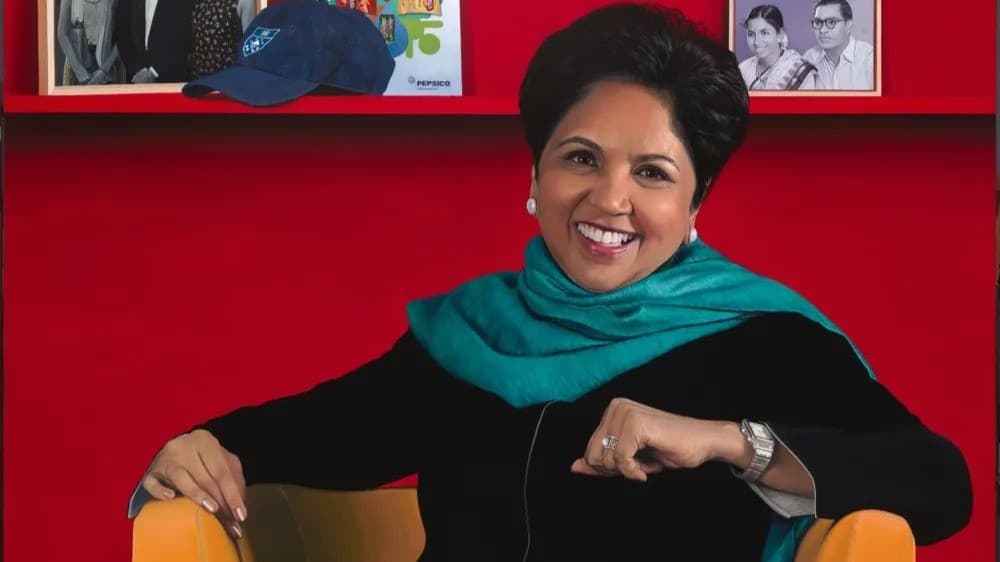
Indra Nooyi stepped down as CEO in 2018 after 12 years at the helm, yet her legendary status and reputation in the American business world remain undiminished. Over the years, she has continued to be a powerful voice for women, delivering keynote speeches at universities, corporations, and various events across the United States, addressing topics such as women’s leadership and advocating for change in the workplace and society. In 2019, her portrait was added to the Smithsonian National Portrait Gallery (the image featured here, with her signature blue scarf). In 2021, she was inducted into the National Women’s Hall of Fame.
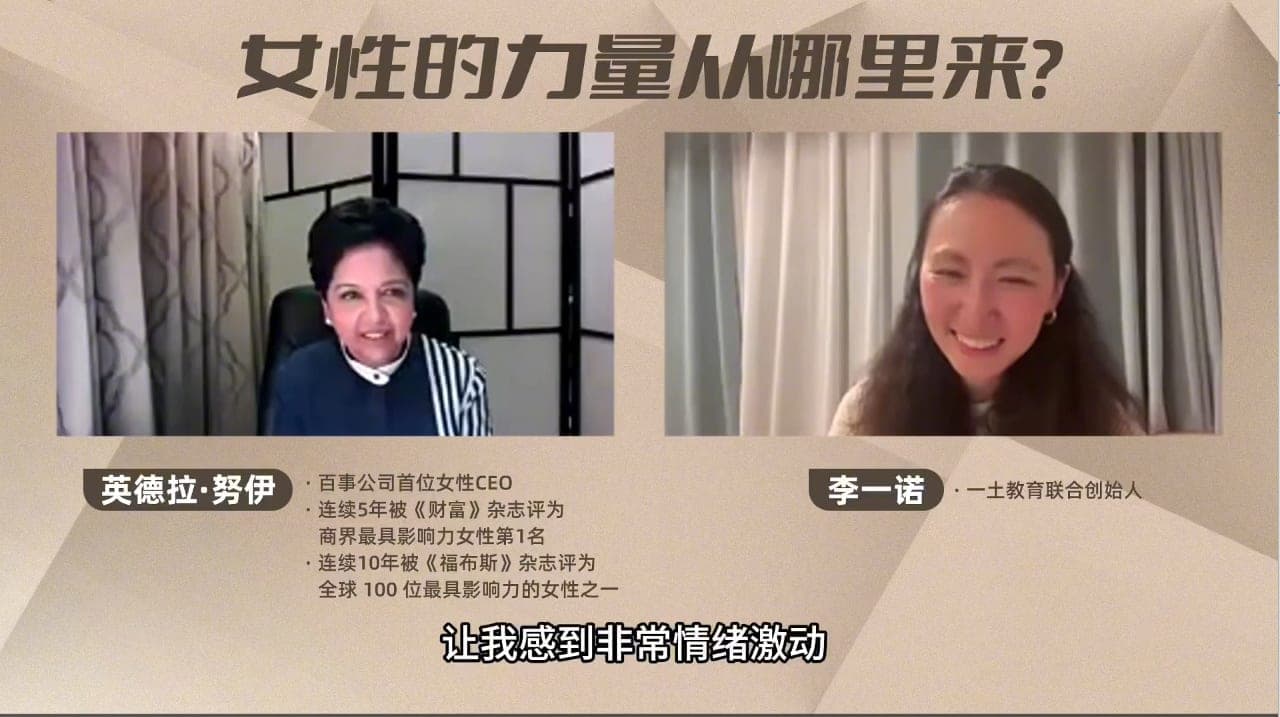
For this conversation, I read her book from cover to cover. It is a seemingly calm yet profoundly impactful book. The language is plain and conversational, delivered with sincerity. The content is incredibly rich: it includes her warm memories of both her extended and nuclear family during her childhood in India in the 1950s and 1960s (she has over 20 cousins); her educational journey in India and the United States during the 1960s and 1970s; the various challenges she and her husband faced as new immigrants in America (which I am all too familiar with!); family tragedies; decades of thrilling experiences in the workplace and business world; as well as her personal encounters with discrimination in predominantly white communities and schools, not to mention the challenges women commonly face in the workplace, from entry-level positions all the way to the top...
I laughed out loud more than once while reading the book, and I also shed tears more than once. Although she belongs to an older generation (born in 1955) and her achievements are far beyond my own, I still saw many reflections of myself and our generation of Chinese students in her experiences.
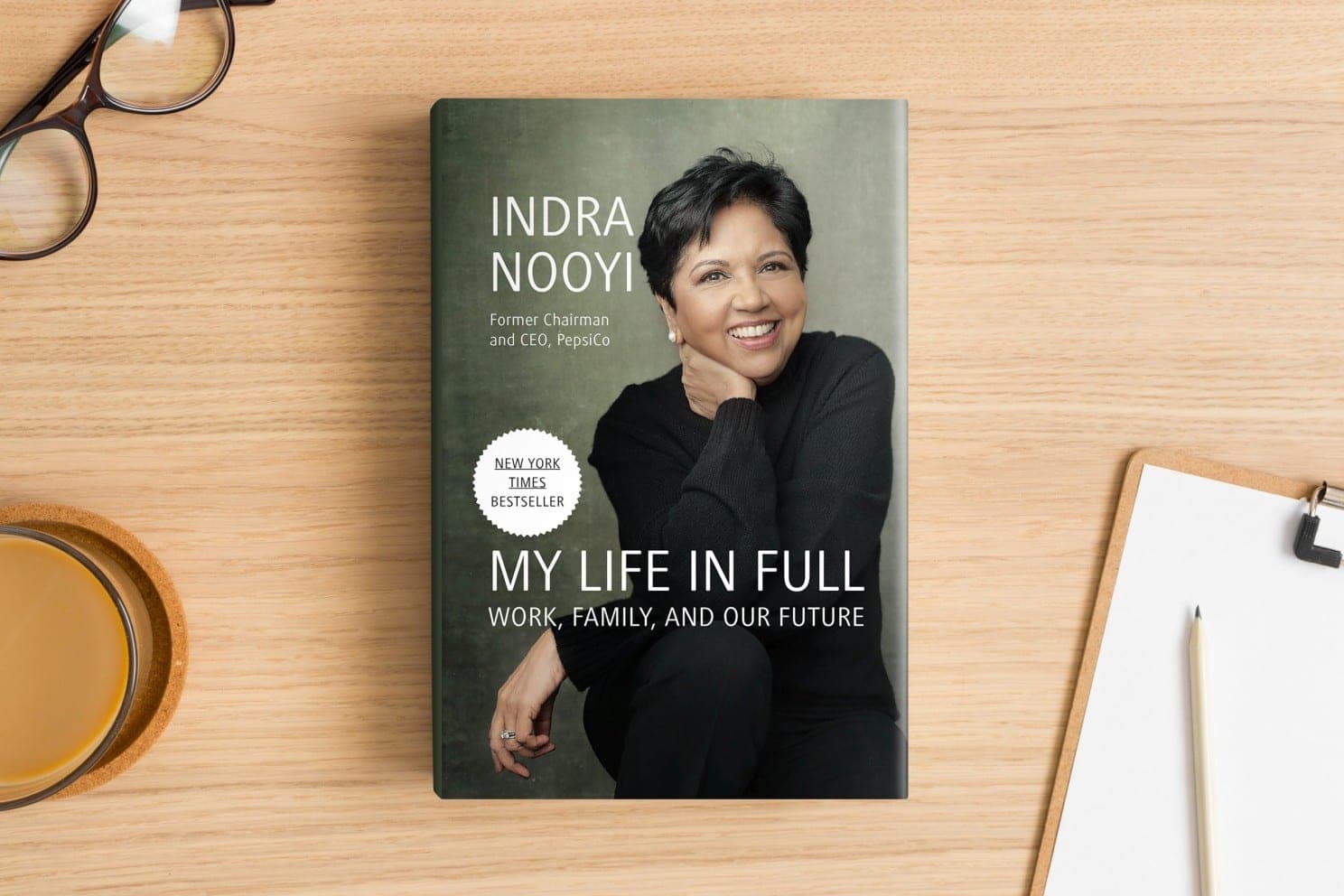
In this book—
She recounted the mentorship she received early in her career at a British textile company, where she traveled through the streets of India to connect with merchants. Two years later, she applied to business school in the United States. To secure her visa, she spent a night queuing outside the U.S. consulate in India. To her surprise and warmth, her British boss and colleagues drove to her in the middle of the night, bringing water and food.
She mentioned that on her first flight to the U.S., she chatted with an American seated next to her in broken Indian English, telling him she was heading to Yale University in Connecticut. The American said, "Look, I’m going to help you with something. Connecticut is called ‘Connett‑ih‑cut,’ not ‘Conneck‑tih‑cut.’" I laughed so hard when I read this because I didn’t know how to pronounce that state either. Another state I’ve mispronounced is Idaho—the correct pronunciation is something like "Ai-de-ho," with the stress on the first syllable, but I always thought it was "Yi-da-hu." I was teased by Huazhang for a long time about it, and it’s still a running joke in our family.
She talked about studying in the U.S. while working part-time to earn a little extra money. For four days a week, from midnight to 5 a.m., she worked as a dormitory front desk receptionist and switchboard operator (earning 50 cents more per hour than the daytime rate). For her first job interview, she spent the maximum she could afford—$50—on a formal suit but was too embarrassed to try it on in the store. It wasn’t until she put it on before the interview that she realized it didn’t fit. She didn’t own dress shoes either, so she wore a pair of orange sneakers, making her look like a joke when she walked in (when I interviewed at McKinsey, formal suits had already gone up to $200 a set, and I couldn’t afford one either—I borrowed one from a Korean girl in the lab).
Later in the United States, when she had a child, there was no one to help, so she had to rely on her mother who came from India. In the meantime, her father suffered from the pain and distress of pancreatic cancer. She and her husband used all their savings to make a down payment on their first house, which had three bedrooms, but they only had enough money to furnish one of them. Until the house was sold, the other two bedrooms remained empty.
She told us that her dearest grandfather in India had passed away from a serious illness. She took leave and rushed back to India, but still didn’t get to see him one last time. In the taxi, she couldn’t hold back her tears and broke down sobbing.
She mentioned that all the corporate executives, except for her, were white men. They would arrange private jet trips to go fly fishing in the mountains on weekends, as each of them had a wife at home to take care of the children. As a mother herself, she couldn’t participate in any of these activities, missing out on networking opportunities with them. To compensate, she had to rely on working harder and delivering higher-quality results.
Other male executives have been able to advance their careers through global rotations because their wives could relocate with the children. However, as a mother herself, she lacks that flexibility, which prevents her from taking on similar rotations and accessing the same career paths and opportunities as her male counterparts.
She said that in the workplace, "men and women are not competing on a level playing field." Women "start in a hole," beginning from a negative position, from a disadvantage. In every meeting, you have to climb out of that hole first, prove yourself, and only then can you get to the main topic.
She mentioned her first internship was at a typical American company in the Northwest, where she was the only woman wearing a sari (after that disastrous interview, a teacher from the school’s career development center asked her what she would wear to an interview in India, and she said a sari, so the teacher suggested she wear a sari for future interviews and work). I recalled that during my first year at McKinsey, I worked on a project in a small city north of Chicago, where I was probably the only Asian woman in the entire town. When I went to a restaurant with clients, the menu featured a one-pound grilled steak, and dessert was a half-pound cheesecake. Thinking about it now still feels psychologically scarring.
She said she often felt singled out in meetings, having to work harder than her male colleagues to earn trust and respect. She always tried to handle things calmly, until one time during a meeting in Europe, she couldn’t take it anymore and stormed out in the middle of the session, buying a ticket home. Everyone was stunned, saying it was "out of character." I had a similar experience at McKinsey—after being patient and accommodating for a long time, I finally reached my limit, stood up, yelled at the client, and walked out with my team.
……
As a Chinese reader, I inevitably and subconsciously compare her experiences with those of Chinese students studying abroad. From this perspective, what struck me most in her book were the formative experiences during her upbringing in India that played a decisive role in shaping her leadership later on.
The first was when she was eight or nine years old, she and her sister often asked their mother for snacks. Her mother, who had only graduated from high school and never attended college before marrying their father, always felt a sense of regret about her education. Despite being a mother without a college degree, whenever her daughters asked for snacks, she would first have each child explain what they would do if they were the President of India, and why. Although Indra now recalls that they simply said childish things at the time, the idea that "I could think about national issues as an elected president" planted a very important seed in her and her sister's minds.
The second experience was when she was 14 years old, in 1969, just over two decades after India's independence, when the country was still a young democracy. She was selected to attend a national conference for secondary school students on India's democratic development. This gave her the opportunity to discuss major national issues with peers from across the country: How can a democracy safeguard the rights of its people? How can power be balanced? How can consensus be reached? She recalls that this was a formative experience for her during her teenage years.
These two experiences were profoundly impactful for me. In contrast, during the early 1960s when she was eight or nine years old, China was undergoing the devastating Great Famine, and in 1969, it was in the midst of the Cultural Revolution. Although geographically close to its Indian neighbor, China of that era existed in a completely different "time," with young people and students inhabiting entirely different social spaces, pondering and discussing entirely different issues. She mentioned that these experiences, including later participating in debate competitions in university and engaging in various civil society issues, shaped her deep-seated democratic beliefs. Such beliefs, along with this effective way of engaging in debates, also formed the foundation of her leadership later on.
I have spoken with Professor Jackson Lu from MIT Sloan about his work, and at his invitation, I participated in an online discussion organized by the Committee of 100 on the bamboo ceiling in Asian career development. On the same panel was former U.S. Ambassador to China, Gary Locke. In one of Jackson’s key academic research papers, he mentions that compared to South Asians, East Asians face a unique "bamboo ceiling" in the workplace because they often lack a crucial trait—being "assertive," which means being able to express viewpoints, especially differing ones, in a reasoned and confident manner. South Asians significantly outperform East Asians in this regard.
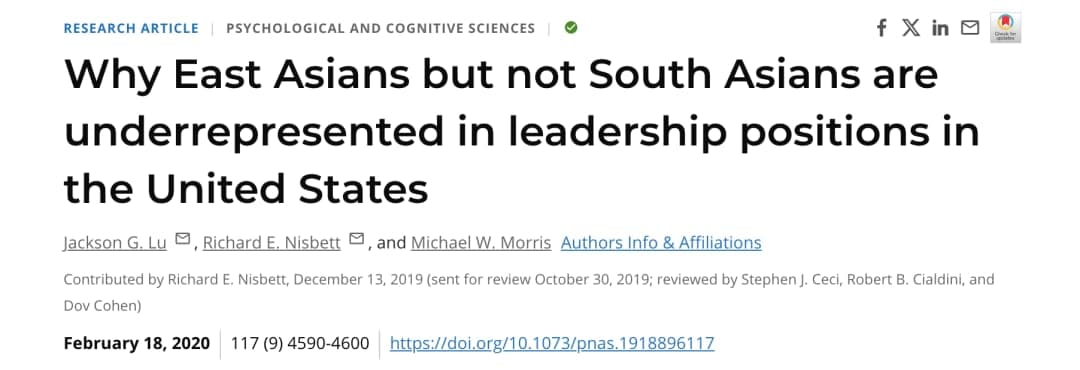
Through Indra's story, I can clearly see how this assertiveness is cultivated. Many people seem to understand "assertive" merely as a method or a communication technique. In reality, without the "underlying capability," it cannot be learned at the methodological level.
What is the foundation? Essentially, it is the ability to care about and engage with seemingly "grand yet impractical" issues, as demonstrated by Indra's two examples from his youth, and to form and express one's own opinions.
This is a glaring gap in China's education system, where the underlying narrative is a relentless pursuit of "practicality." Anything deemed "useless" is considered a waste of time. Concepts like "fairness" and "justice," seen as lofty and impractical, are often dismissed—not only as "time-wasters" but also as potential risks. Of course, this is closely tied to China's environment. However, when Chinese individuals abroad continue to operate under this mindset, it’s no surprise that they encounter the "bamboo ceiling" mentioned earlier.
Therefore, for Chinese people developing overseas, true "integration" begins with consciously examining social systems, civic roles, and community participation in an open society, and starting to care about "big but seemingly useless" matters while learning relevant pathways and skills. In fact, this has little to do with how many years one has spent overseas, and it can even be argued that it has little to do with whether one is overseas at all. Some people have been overseas for many years but are merely "away from home," still thinking and acting according to the logic of the Celestial Empire. Meanwhile, many people in China are also concerned about "big but seemingly useless" matters, actively thinking and taking action.
Indra also confirmed this in our email communication after our conversation.
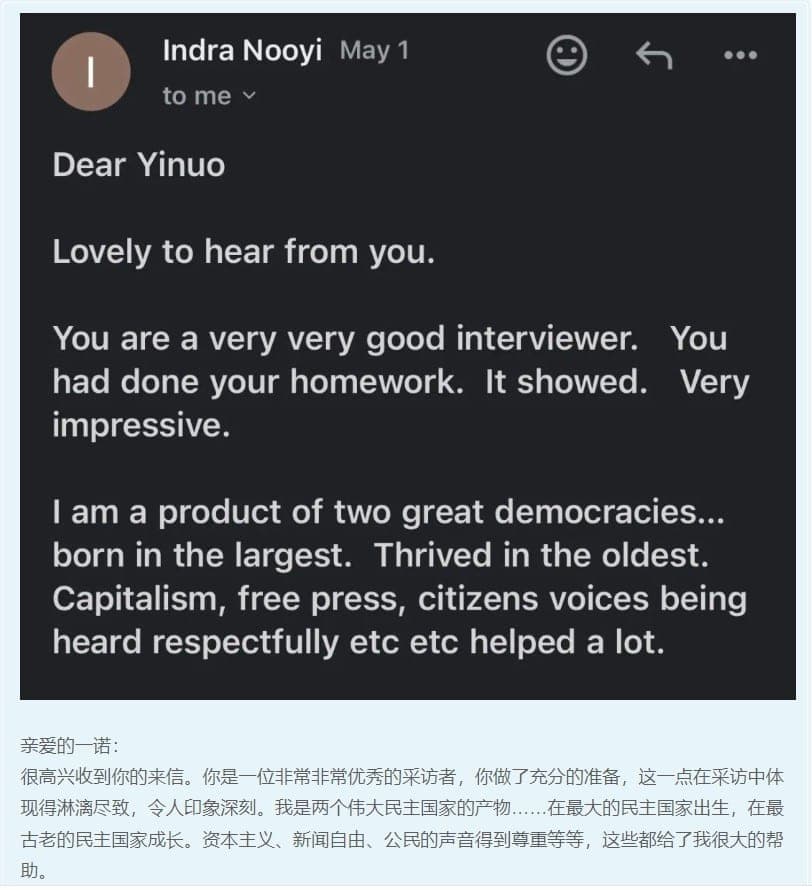
"I am the product of two great democracies."
I once wrote an article titled "The Deep-Seated Challenges Faced by Overseas Chinese in the Workplace," which essentially addresses the same issue.
From this perspective, for overseas Chinese to break free from their predicament and achieve career advancement, merely focusing on the "techniques" will not lead to genuine breakthroughs. Without understanding the underlying logic of an open society like the United States, it is impossible to grasp the true essence of workplace culture or achieve transformative growth in leadership.
Of course, it’s not enough to simply focus on the "big questions." This is more like a new "calibration." After this calibration, it’s essential to re-examine past ways of thinking, adopt new mental approaches, and find actionable levers for change. Only then can transformation truly occur. This is undoubtedly challenging, but over the past two years since the workshop was launched, more than 1,000 participants from around the world have genuinely benefited. The workshop is designed to provide a systematic six-week learning experience, featuring my structured curriculum and insights from five guest speakers. Additionally, participants receive support from a dedicated community and guidance from past attendees who serve as mentors and facilitators.
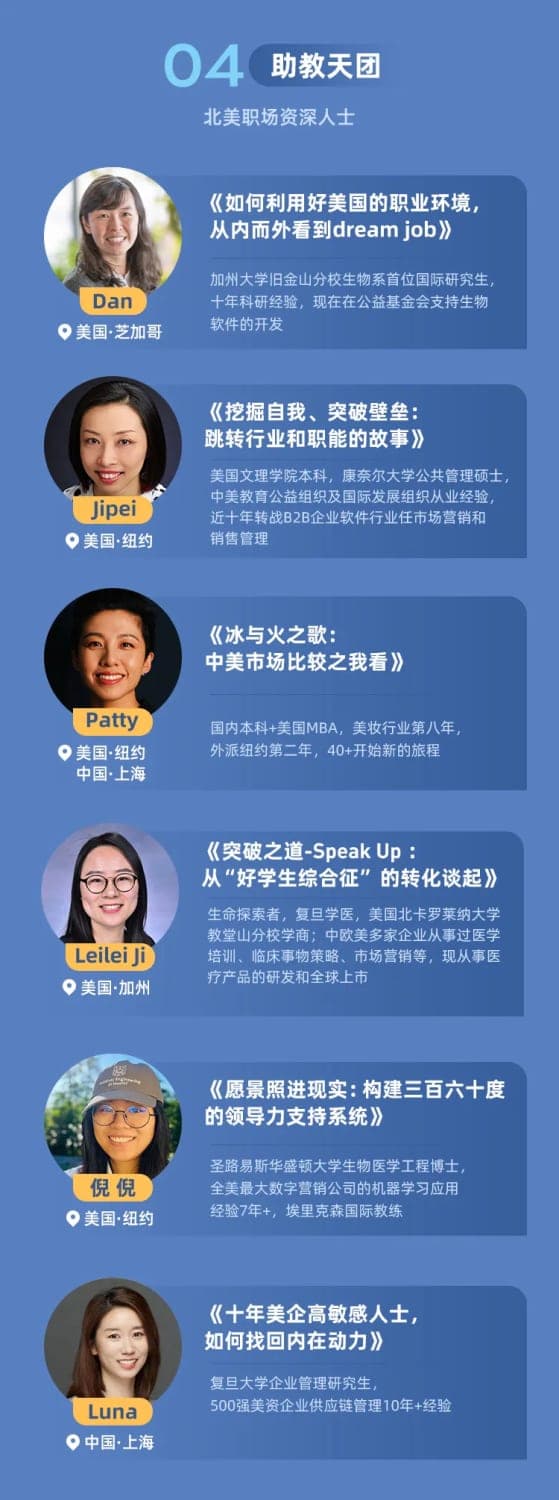
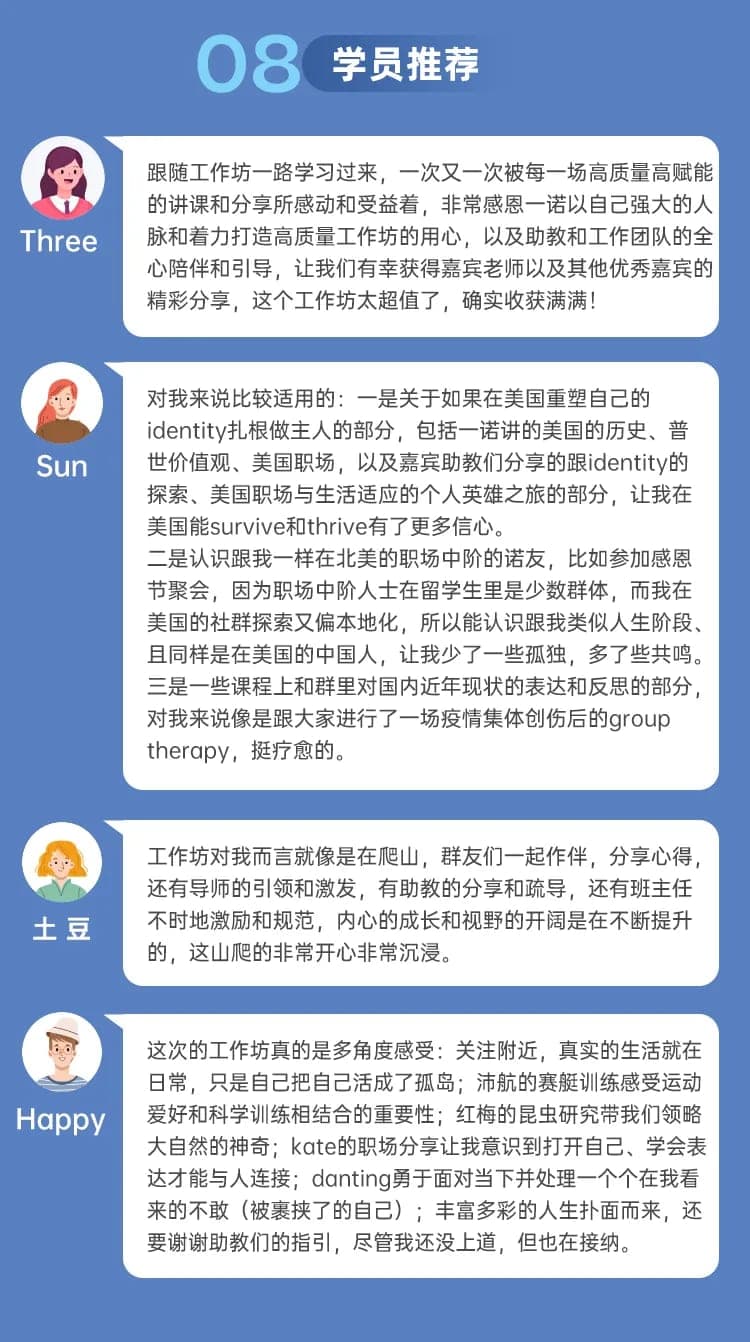
How effective is the workshop? Without being modest, it has received rave reviews. Over the past two years, it has brought profound and significant changes to participants (this is not self-praise—the poster at the end of the article showcases this). One piece of evidence is that all workshop assistants are volunteers who have benefited from the workshop, connected with others through it, and are now here to serve everyone. You can schedule the live session below to hear the assistants share their own transformative journeys.
工作坊的具体信息如下: **主题**:创意写作与故事构建 **日期**:2023年10月15日(周日) **时间**:上午9:30 - 下午4:30 **地点**:市文化艺术中心三楼会议室 **主讲人**:知名作家李华 **内容安排**: - 上午:故事构思技巧与角色塑造 - 下午:情节设计与写作实践 **费用**:免费(需提前报名) **报名方式**:发送邮件至 workshop@example.com,附上姓名与联系方式 **截止日期**:2023年10月10日 欢迎对写作感兴趣的朋友们踊跃参加!
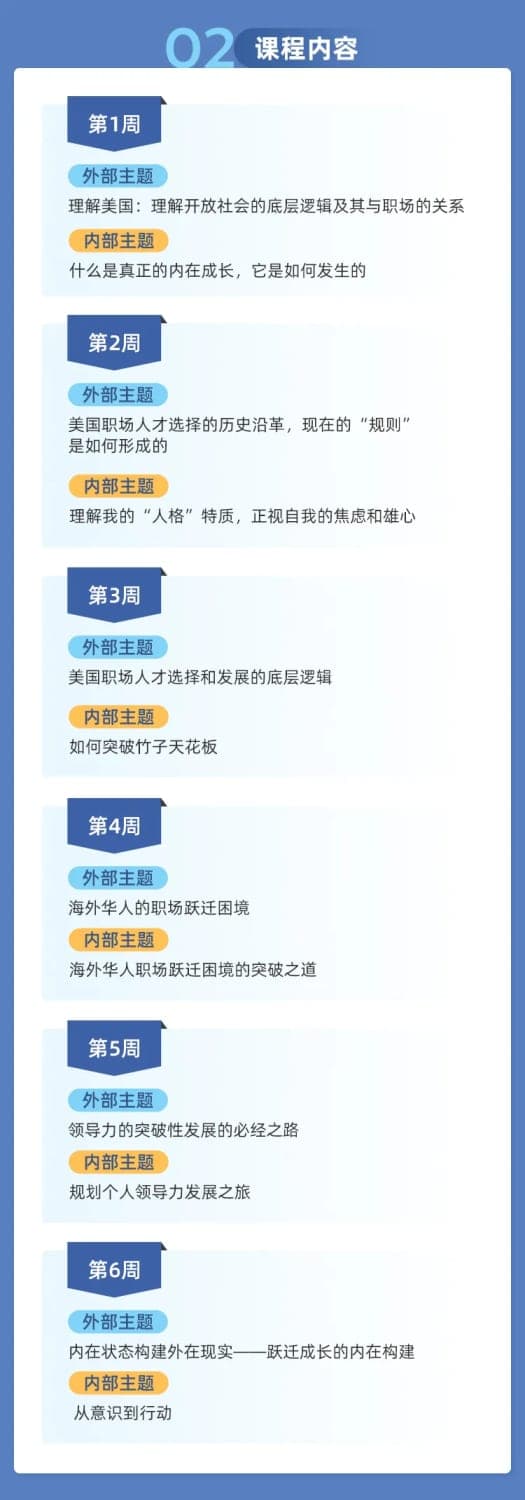
The program runs from October 12 to November 23 (Beijing Time), spanning 6 weeks. This immersive career advancement workshop is designed for individuals aiming to develop and transition their careers in North America or multinational companies. The course schedule is friendly to both Eastern and Western U.S. time zones as well as Asia, with classes held in the afternoon or evening after work hours. Participants from other regions are also welcome, though time zone differences may pose a challenge.
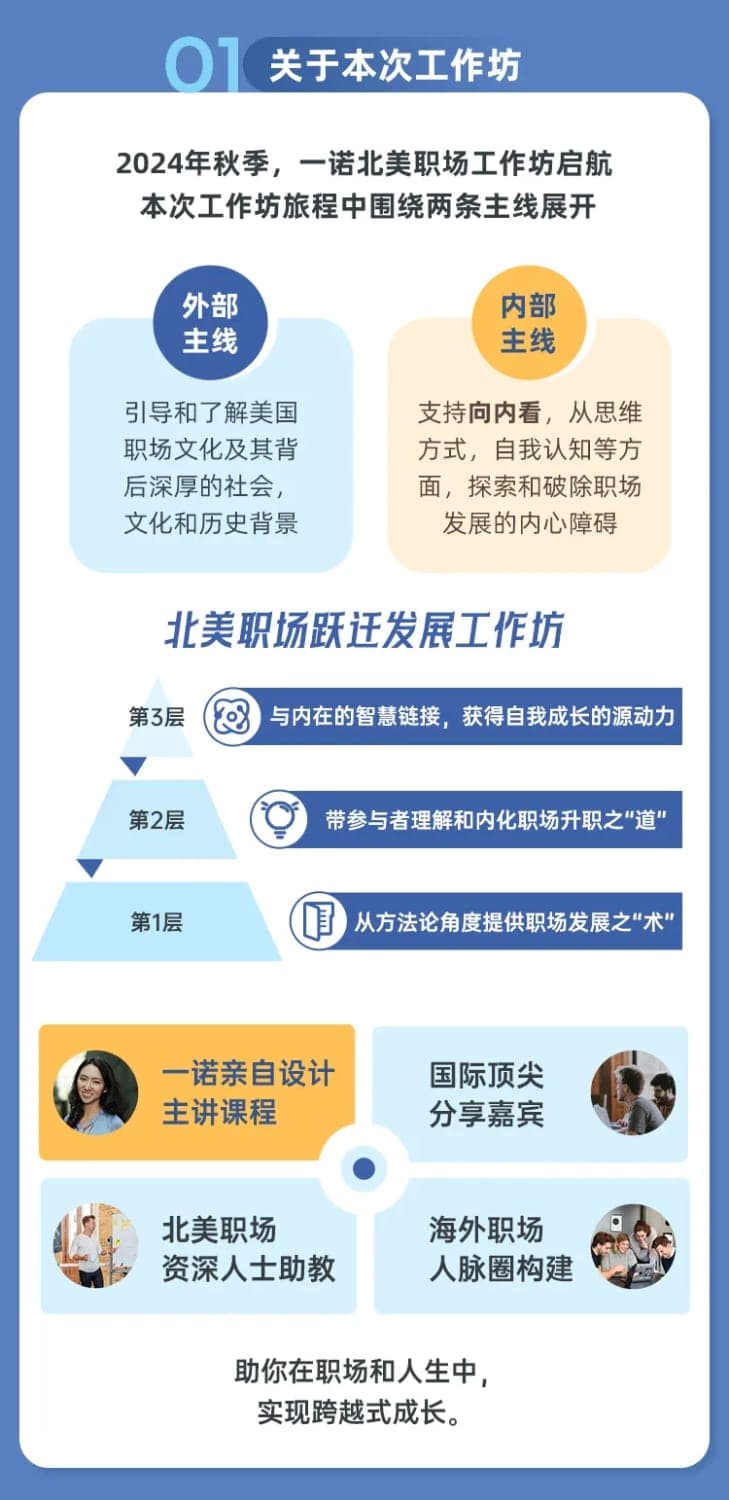
This course will be designed and led by me. Over the course of six weeks, the workshop journey will unfold along two intertwined main threads.
The "external" main thread guides and supports participants in understanding American workplace culture and its underlying social, cultural, and historical context, as well as gaining a deeper insight into the talent perspective and genuine leadership requirements in the American professional environment.
The "inner" theme guides participants to "look inward," helping them recognize and overcome internal barriers to personal growth, such as unconscious values, limiting mindsets, and habitual behaviors. The general plan is as follows:
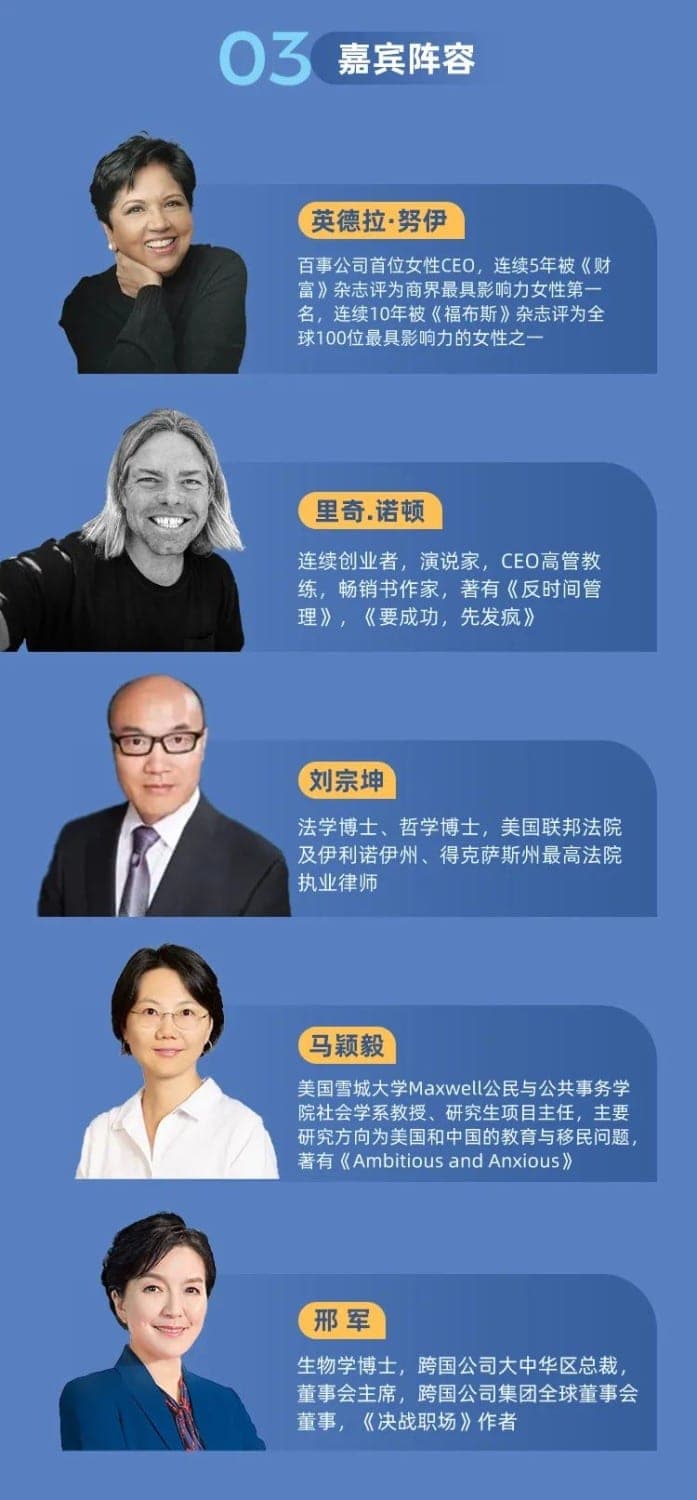
I must say, without any false modesty, that the guests I have invited form a "dream team" of the highest caliber.
There is Indra Nooyi, the first female CEO of PepsiCo mentioned above, a woman born and raised in India who overcame multiple barriers to become one of the most influential business leaders.
American entrepreneur and bestselling author Richie Norton is not only a serial entrepreneur and a master of "counter-time management," but also a CEO executive coach.
We have Professor Ma Yingyi from the School of Public Affairs at Syracuse University in the United States. Her research focuses on education and immigration issues in both the U.S. and China. Her English-language book, *Ambitious and Anxious*, is the first sociological study to systematically examine Chinese students in the United States. It is currently being translated into Chinese, and I have written a recommendation for it—it’s highly anticipated!
Liu Zongkun holds a Ph.D. in both law and philosophy and is a practicing attorney admitted to the U.S. Federal Court as well as the Supreme Courts of Illinois and Texas. He is also a prolific writer. His 2023 book, In Pursuit of Happiness, explores the stories of ordinary people within the context of America’s evolving legal system. The book has been recommended by renowned scholar Liu Yu and boasts an impressive rating of 9.1 on Douban.
Also, there is our well-known friend Xing Jun, author of "Slave Society." She is a member of the RDPAC 2024-2025 Executive Committee and serves as the Executive Chair of the Board at Mundipharma China, having achieved senior management positions in both the Chinese and American corporate worlds.
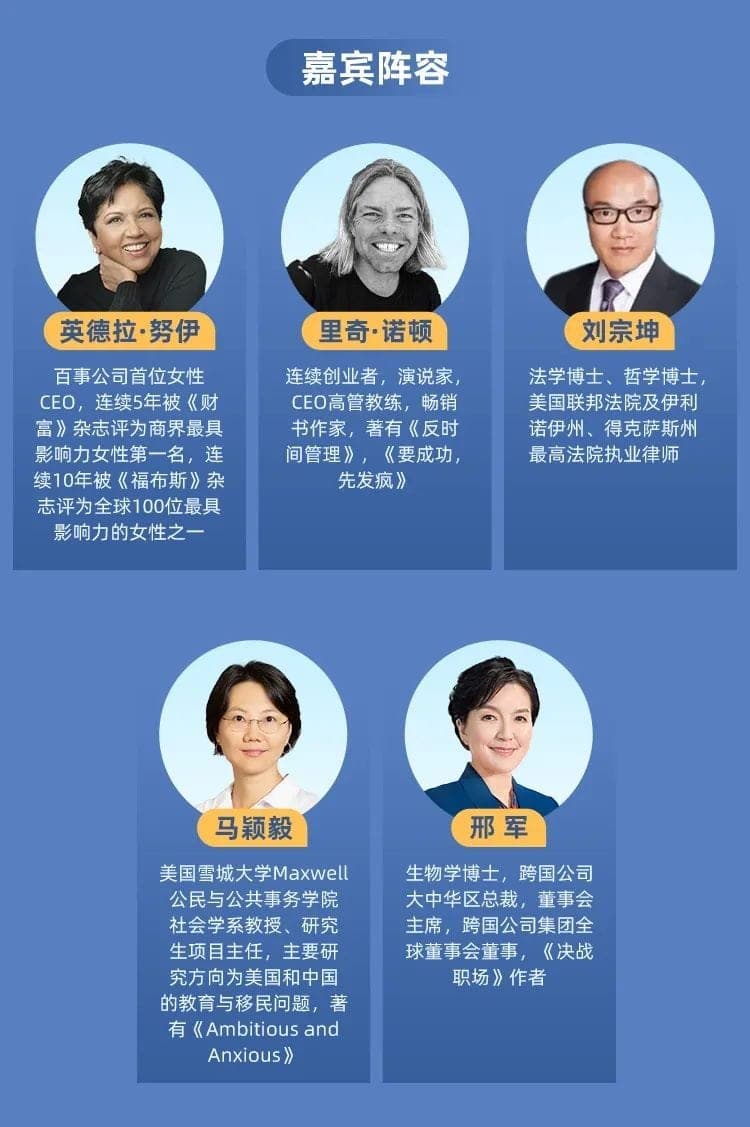
All five guests will participate in the workshop live, sharing their unique insights, reflections, and actionable advice with everyone.
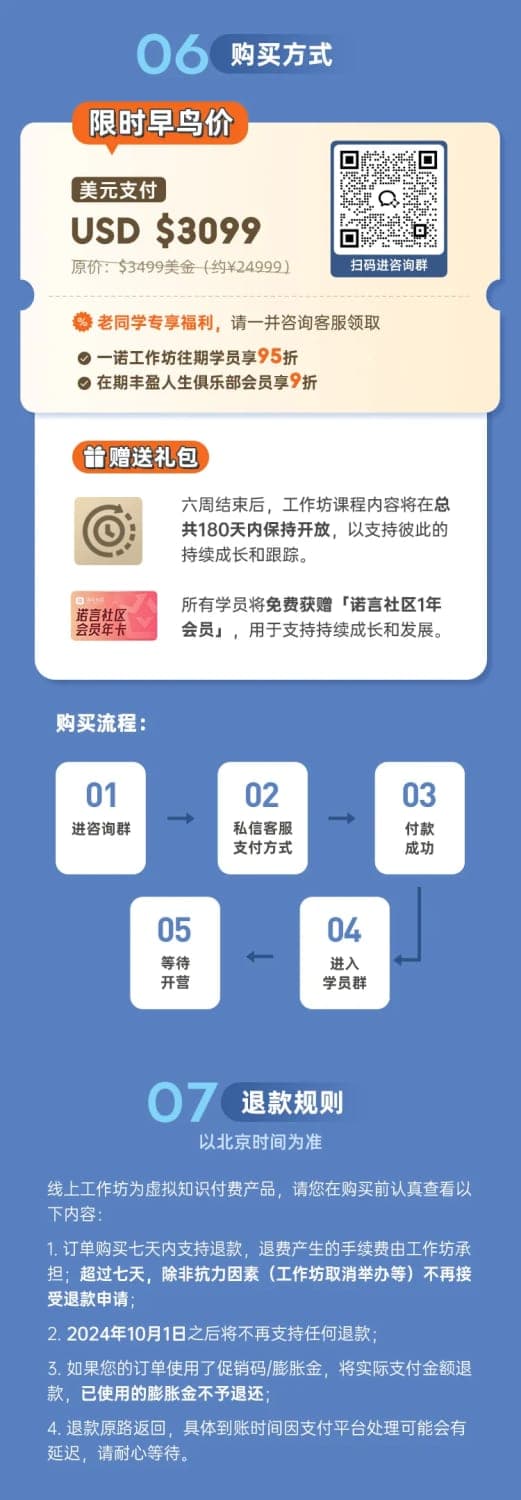
"Immersive" refers to both the experiential design of the online workshop and the expectation that, over the six weeks, every participant will fully engage and take responsibility for their own growth. With the support of the workshop, they will embark on a new journey in their career and life. The workshop fee is $3,499 per person, with an early bird price of $3,099. Past workshop participants and current members of the Abundance Club are eligible for exclusive benefits. For details, please scan the QR code on the poster below and contact customer service. We look forward to seeing everyone online.
Additionally, given my current work and life situation, I’m not sure when I’ll be able to do this again. So, if you can make time, I hope you won’t miss out.


For overseas users interested in inquiring about workshops, please contact info@yinuoli.org.