The Deep-Seated Challenges Faced by Overseas Chinese in the Workplace
After my book "Where Does Strength Come From" was published, many friends overseas also read it because the e-book version became available on WeChat Reading. It has maintained quite high ratings on WeChat Reading as well. However, I actually feel a bit apologetic that my overseas friends are reading this book, because it was primarily written for domestic readers. I didn’t spend much time in the book discussing my experiences in the overseas workplace, nor did I delve deeply into reflections on the challenges faced by Chinese people abroad.

After my book "Where Does Strength Come From" was published, many friends overseas also read it because the e-book version became available on WeChat Reading. It has maintained quite high ratings on WeChat Reading as well. However, I actually feel a bit apologetic about overseas friends reading this book, because it was primarily written for domestic readers. I didn’t spend much time in the book discussing my experiences in the overseas workplace, nor did I delve deeply into reflections on the challenges faced by Chinese people abroad.
In the past two years since I returned to live in the United States, many seemingly distant memories have resurfaced.
What's even more disheartening is that I've realized over the years, the challenges faced by Chinese professionals in the American workplace haven't truly improved. Or to put it more precisely, not only has there been no improvement, but due to the changes in the international landscape in recent years, the situation has become even more difficult.
When overseas Chinese discuss challenges, the biggest ones often seem to be language, skin color, and culture. However, I believe these are not the real reasons. A typical counterexample familiar to many Chinese is the Indian diaspora. They appear to be just as "un-American" as Chinese, yet they have achieved widespread success in mainstream American society—not only in business but also in academia and politics. From top executives of major corporations to deans of prestigious universities, governors, and former United Nations representatives, Indian Americans have made their mark.
A few years ago, I wrote an article about a number that shocked me after I became a partner at McKinsey. I was promoted to partner at the end of 2012 and moved back to the United States at the end of 2013. At that time, I learned that the United States, as McKinsey’s largest market, had over 600 partners. I discovered that among them, only two had received their undergraduate education in mainland China—and I could only count as half, since I wasn’t selected as a partner in the United States. In contrast, within this group, there were as many as 100 partners who had received their undergraduate education in India before coming to the United States and later becoming McKinsey partners. Moreover, among the newly selected partners each year, an average of 15% were of Indian descent, while Chinese partners remained a rare sight year after year.
The recent CEO of Twitter is a typical example of an Indian-American. Born in 1984, he holds a bachelor's degree from IIT (Indian Institute of Technology) and a Ph.D. from Stanford University. After entering the high-tech industry, he became the CEO of Twitter earlier this year. There are many Chinese international students with similar backgrounds every year, but for Chinese individuals to reach such positions, it still seems like a distant goal.
So, what is the real dilemma that troubles the Chinese people? This is a question worth our deep reflection. Because if the root of the dilemma is unclear, there is no path to break free from it. Of course, even if the root is known, breaking free is still not easy, but at the very least, the journey can begin.
Reflecting on my years of professional experience—from a decade at McKinsey to five years at the Gates Foundation, and moving from the U.S. to China and back to the U.S.—I have often pondered workplace challenges and even written about them, but I never had the opportunity to systematically analyze and share these insights. This year, that opportunity finally arrived. Since May, I have been conducting online immersive courses and workshops focused on career development and overcoming obstacles for professionals working abroad. My website is Yinuoli.Org, where I will also post updates on future overseas events. Feel free to follow along.

In the first chapter of my book, I wrote about some reflections on the early challenges I faced in my career when I first joined McKinsey in the United States. I realized that back then, I was simultaneously bridging three major gaps. The first was the transition from academia to the business world, from the laboratory to McKinsey. The second was the language and cultural barrier—even though I was in the U.S. and spoke English, I didn’t know how to speak, write, or communicate effectively in a professional setting. At the same time, I had little understanding or interest in American pop culture, such as football, baseball, and so on. The third gap was more subtle—what I call "generational dislocation." I quickly realized that my American "peers" and I were not actually from the same era. Born in China in the 1970s, I grew up using ration tickets to buy soy sauce, while middle-class American children born in the same decade started skiing with their parents at the age of three. Our life experiences were worlds apart.
For me, who was in immense pain during the early stages of my career, understanding these three dilemmas was the starting point for examining the challenges, which gradually helped me navigate through the initial phase of workplace adaptation. How did I manage to get through it? It wasn’t about becoming "someone else," but rather recognizing where I differed from my American colleagues, identifying what I needed to improve, and, on the basis of these differences and areas for growth, accepting myself and discovering my own strengths. This was a long process, but it wasn’t without "shortcuts"—we’ll discuss these in our online course.
As I gained more life experience over time, I gradually realized that what had once seemed like "profound" insights were actually quite "superficial" reasons.
If we peel back the surface layers of "skin color, language, culture, and era" and look deeper, I believe the real challenges faced by Chinese professionals in the American workplace lie in several more hidden layers.
"Basement Level One": Different Historical Narratives Lead to Different Perceptions of the World
Most Chinese who go abroad have a background in science and engineering. Moreover, since the majority received an education in China that is highly "disciplinary," the humanities, history, and philosophy are merely "disciplines" corresponding to the sciences. It seems only natural that those studying science and engineering do not need to study the humanities, history, and philosophy thoroughly.
Literature, history, and philosophy have not been regarded as part of "general education." This has led most people educated in China to operate under the belief that "mastering mathematics, physics, and chemistry ensures success anywhere," resulting in a superficial and one-sided understanding of both Chinese and world history. Consequently, after spending some time in the North American workplace, one may find that beyond technical skills and business matters, there is no deeper foundation for meaningful conversations with colleagues.
If you pay a little attention when going abroad, you will find that the education about history you received in China, including world history and Chinese history, is very different from what you see after going abroad.
A typical example is that almost all Chinese people know the invasion of the Eight-Nation Alliance was a very humiliating event in modern history. However, we rarely discuss its connection to the early missionary work in China, such as establishing churches, hospitals, and schools, its relationship with the Boxer Rebellion's siege of the legation quarter and the persecution of Chinese Christians, or its ties to the Qing court's refusal to provide protection and its decision to allow foreign countries to send their own troops to Beijing to safeguard their legations.
The history of the United States also serves as a classic example for studying history. Looking at the founding history of America, although there appears to be a clear main narrative, it has always been a history of entangled interests, conflicts, exploitation, and compromises among various parties. Starting from the late 19th century, from the corruption-ridden "Gilded Age" to the subsequent "Progressive Era," there were countless instances of ugliness and atrocities. For a long time, the tragic experiences of various ethnic groups, including Black people, Native Americans, and later Chinese immigrants, were deeply lamentable. The renowned Stanford University, for instance, was founded by Mr. Stanford during that "Gilded Age," who amassed immense wealth through various forms of power and money dealings. On one hand, it can be said to be filled with ugliness and bloodshed, but on the other hand, due to the involvement of media and investigative journalists, as well as the gradual improvement of the legal system, the existing system of checks and balances was established. When examining this history, one cannot help but marvel at how American scholars have been unsparing in their criticism of their own history and their "ancestors."
For example, most Chinese people tend to view Americans as if blond hair and blue eyes represent "purebred Americans." In reality, if one reads Thomas Sowell's classic work *Ethnic America*, published in 1981, they will gain a comprehensive understanding of the influx, conflicts, and integration of various ethnic groups. The book covers everything from the Irish famine to the reasons behind the influx of people from other European countries, the conflicts among Jewish communities from different nations after arriving in the United States, the "hierarchy of disdain" among different ethnic groups, the early history of Japanese and Chinese immigrants in America, and the subsequent Chinese Exclusion Act. Thomas Sowell himself is an African American who is still alive today at 92 years old, and many of his works have been highly influential. Reading such books reveals that every "American" has their own ethnic history and unique experiences of transitioning from "outsider" to "integration."
Why is historical narrative important? Because a shared understanding of history is actually a prerequisite for effective and deep communication among people.
This understanding is not about pursuing a "standard answer," because historical development rarely has absolute rights or wrongs. However, we must learn to ask questions: Are the facts we know complete? Have they been altered or taken out of context? We also need to recognize that most present circumstances are the result of some form of compromise, yet it is precisely within compromise that principles emerge and solidify into laws and values. This kind of questioning, this skepticism, and this reflection on matters of principle are also pervasive in American culture, including in the workplace.

"Basement Level Two": The Cognitive Divide Caused by Different Social Systems
Social systems encompass many fundamental and important issues, including the system of checks and balances, the rule of law, democratic principles, and so on. Many of these cannot be elaborated on in detail here, so we will only discuss one aspect: community participation.
The United States is a highly self-governing society, where countless grassroots autonomous organizations and communities form the foundation for the normal functioning of society. Civil society and community-based organizations are ubiquitous. If society is an organism, communities are its individual cells.
However, this concept and the way society operates are unfamiliar to those who grew up in a "top-down" society.
In the United States, from a residential HOA to soccer clubs, the Boy Scouts, school parent-teacher associations, and various city committees, these organizations largely rely on volunteer services. Soccer coaches are often parents, Boy Scout leaders are also parents, and the various committees and councils involved in city governance are mostly volunteers, not lofty "officials." These organizations operate under long-established principles and frameworks that guide behavior, with laws serving as the bottom line. Within this scope, they rely on self-governance, though in some areas, there are "top-down" standards or inspections. However, the authority of these regulatory bodies is strictly limited by law. On one hand, many Chinese believe the U.S. lacks history, but organizations like the Boy Scouts have existed for over a century, continuing to thrive through community-based volunteer groups. This kind of accumulated experience is incredibly valuable.
Not to mention the various churches, many of which serve as community centers. During the COVID-19 pandemic, public schools and churches played a crucial role in providing community services, offering free food to anyone without checking their identity. Of course, there are also various charitable organizations and civil society organizations. Therefore, community participation and volunteer service are core components of American life.
The development of the charitable sector in the United States is not simply driven by goodwill; it is closely tied to the passage of antitrust laws in the early 20th century. The enactment of these laws was linked to the exposure by "investigative journalists" (a profession that did not exist a century ago) of the various malpractices within the monopoly of oil tycoon Rockefeller and the poor conditions of workers. Thus, the history of the United States is one of interconnected and mutually constraining development among the media, corporations, civil organizations, and the legal system. This history is insightfully described in Mr. Zi's book *Twentieth-Century America*.
Understanding the nature of such a civil society is a crucial prerequisite for comprehending workplace culture. Often, our inability to grasp workplace culture stems from a lack of understanding of the foundation of social autonomy that underpins it.
Actually, for our generation of Chinese, the sense of "community" was quite strong when we were children. Adults all worked in "work units," and many children lived in the same dormitory area. After school, we could just hang a key around our necks and go home. If our parents were busy, we would go to the neighbors' houses. In essence, it was a community-style existence organized by the state-owned enterprise system at the time. However, the rapid urbanization over the past few decades, which has urbanized hundreds of millions of people, has led to the destruction of this kind of organic community. Moreover, after this organic community was dismantled, it was never rebuilt. In cities, what we see are many residential complexes and buildings where everyone is a neighbor, but because people are there to buy homes, there is no organic connection between individuals. This has resulted in the loss of the "nearby"—even though people are physically close to each other, there is no deep connection, and no true sense of community has formed.
So when someone who grew up in such an environment comes to the United States, they essentially have to relearn how to live in a "community," understand the rules of interaction, and form organic connections with this society.

"Underground Third Level": Faith and Culture
This question is quite profound and cannot be fully addressed here, so I'll just touch on a few points:
1. Faith is something everyone needs. But for many Chinese people, due to our upbringing and educational experiences, faith is something that needs to be reconstructed in adulthood. This reconstruction doesn't mean you must "believe" in something specific, but rather that you should have life pursuits, values, and a worldview that go beyond "pragmatism."
Chinese people value materialism and pragmatism, which certainly have their uses. However, if these are the only things emphasized, and they are glorified under the name of "atheism," then it is essentially "humanlessness" disguised as "atheism." In such a scenario, we fail to see the true essence of a person, only their social attributes—what job they have, how much money they earn, how much property they own—while overlooking their inner self, dreams, and aspirations. Without recognizing this deeper layer, one can at best become a mere tool in the workplace, with little potential for substantial growth.
2. Returning to the "historical narrative" discussed in the "Underground Level One" section above. Faith and religion are actually the core threads in the development of Western history and culture. To some extent, Western history after the mid-period of the Roman Empire is a history of religious development and conflict. Taking a more recent example, Martin Luther initiated the Reformation in the 16th century, and the formation of Protestantism and its conflict with Catholicism were underlying catalysts for the shaping of the modern Western world. Without this understanding, it is difficult to grasp the historical origins of the modern Western world's structure. In daily life, when driving down the street, one might also struggle to distinguish the seemingly peculiar names of various churches and the beliefs, communities, and subcultures they represent.
3. Regarding culture, a mainstream narrative among Chinese people is that there is a distinction and conflict between "Western culture" and "Eastern culture." However, I believe this is a false proposition. On the surface, there are certainly many differences. But the true essence of Chinese culture is actually universal and possesses universal values. It's just that many Chinese people, including myself, are still learning and do not truly understand China's authentic traditional culture.
A ready example at hand: the most translated book in the world is the Bible, and the second most translated is the Tao Te Ching. But how many Chinese people truly study and understand the Tao Te Ching? Searching for "Tao Te Ching" on YouTube reveals that it is mostly "non-Chinese" speakers discussing it, and they do so quite well—this serves as evidence. The Confucian ideas on personal cultivation, the worldview of Laozi and Zhuangzi, the literary spirit of the Wei and Jin dynasties, Li Bai's romanticism, and Du Fu's compassion are all timeless, universal, and modern. Therefore, our real "cultural dilemma" is not a conflict between the West and the East, but rather a "conflict" arising from contemporary Chinese people's lack of understanding of both the West and the East.
These "underground" triple dilemmas actually represent the essence of the challenges faced by most overseas Chinese.
These dilemmas are quite subtle because many of us (myself included) appear to hold doctoral or master's degrees from European or American universities and possess impressive professional credentials, making it seem as though "integration" shouldn't be an issue. However, in reality, many people feel like perpetual "outsiders" in both their lives and careers. On the surface, this stems from gaps in language, field, and generational differences, but at a deeper level, it is the existential struggles brought about by historical narratives, social systems, and cultural beliefs that truly shape our individual experiences.
This underlying predicament is actually greater than that faced by Chinese intellectuals studying in the United States a hundred years ago, or to be more precise, it is far greater. If you have read the English correspondence between Lin Huiyin, Liang Sicheng, and Wilma Fairbank, or perused Hu Shi’s English essays and speeches, you can catch a glimpse of it.
Of course, you could say that these were all great intellectuals, and we shouldn't compare ourselves to them. But if we only look at "great intellectuals," those in our era who can measure up are few and far between, aren't they? So, one mindset we need to break is the idea that we are "better" than our predecessors and that we are constantly progressing. On many fundamental issues, the heights reached by those before us may be far beyond what we have achieved. In terms of thinking about many problems, there hasn't truly been meaningful progress.
At this point, you might realize that the bottlenecks in our career development are not merely a matter of "workplace methods." To achieve substantial growth in our careers, we must first recognize and break through these "underlying challenges."
Writing this far, I want to share with everyone what I'm doing—
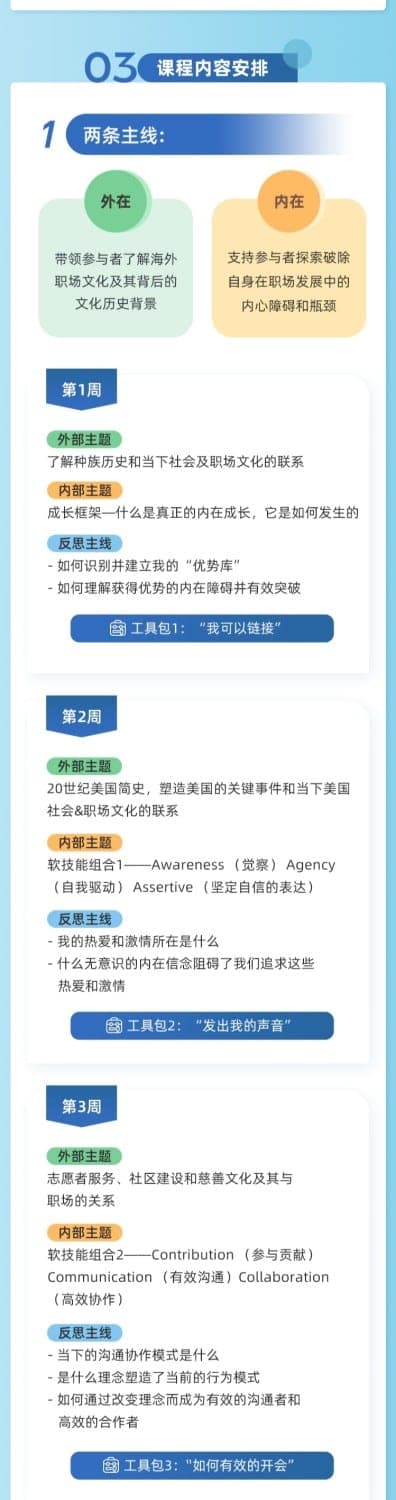
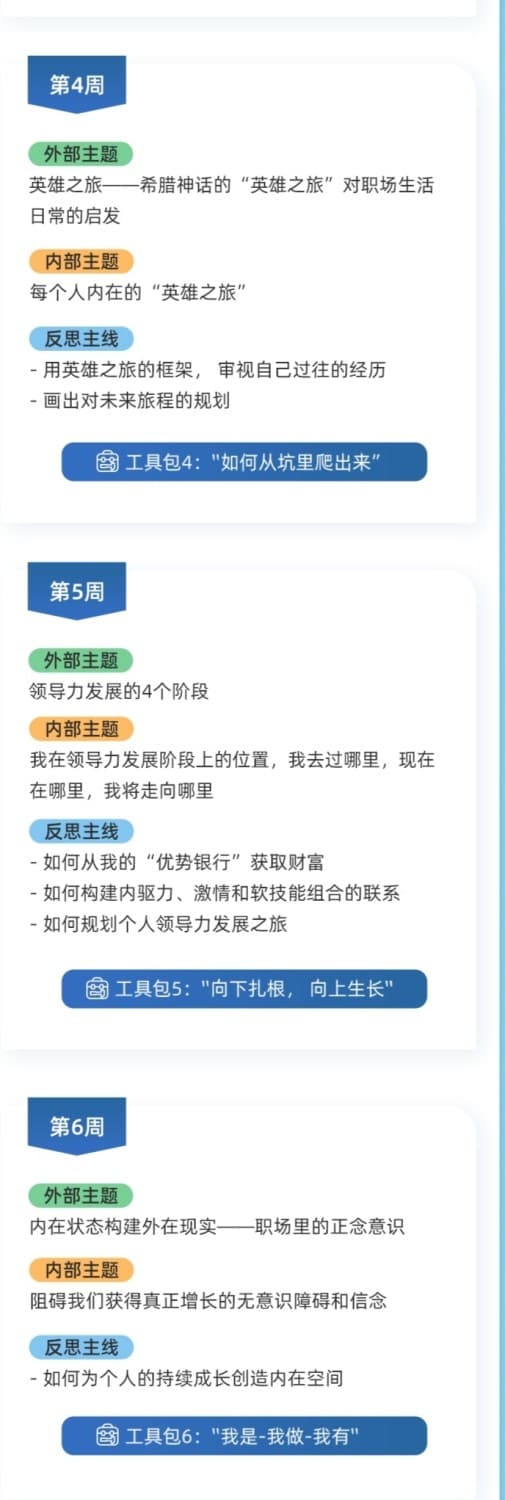
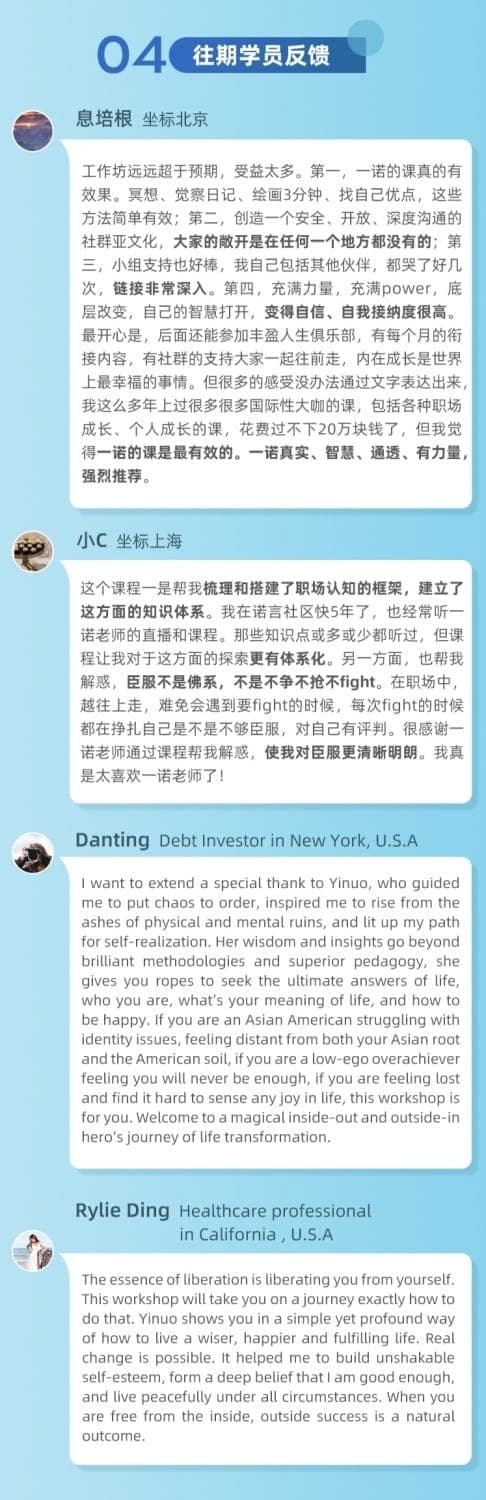
In May of this year, I conducted my first online six-week career workshop, which was designed around two main themes. The first was an external theme, aimed at helping participants understand the historical and social context behind overseas workplace culture. The second was an internal theme, guiding everyone to explore the seemingly mysterious, complex, and even unknowable inner world of "the self."
The first workshop was attended by over a hundred friends, both from North America and within China. The feedback after its completion was overwhelmingly positive. Encouraged by everyone, I launched an advanced second edition of the four-week online workshop in the summer, guiding participants to "look inward" and understand how our internal response patterns are formed. By breaking through internal barriers, we aimed to transform our external work and life situations. The feedback for the second edition was also incredibly enthusiastic, which led to the creation of the Abundance Circle in September this year. This club offers monthly activities such as book readings, meditation sessions, my live sharing sessions, and various group activities to support everyone’s continuous growth. You can find some of the feedback on my website.
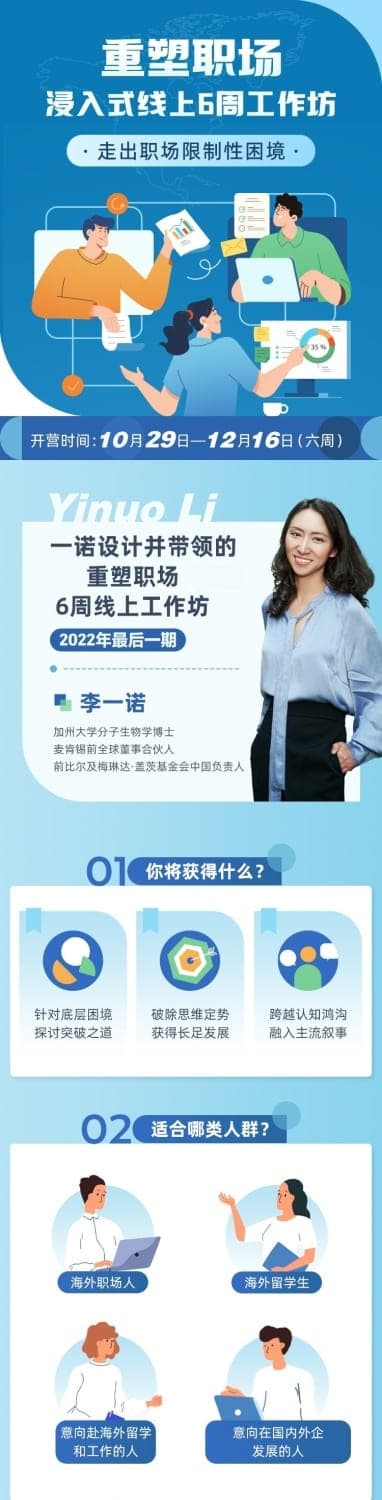
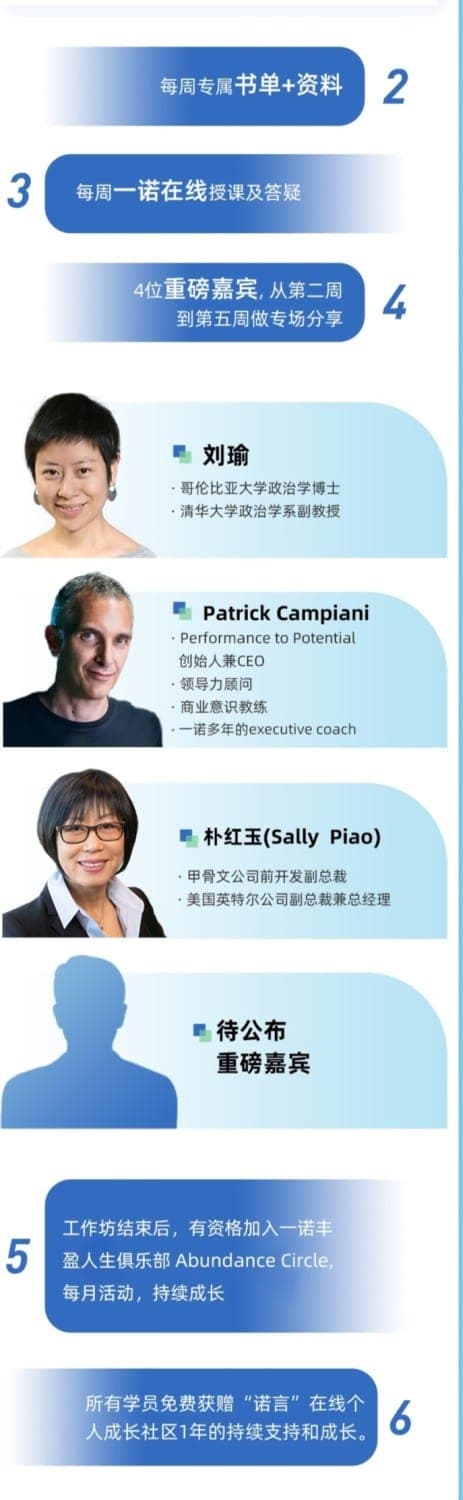
Starting from late October 2022, I will launch another 6-week online career workshop. Similar to the first session, it will follow two main themes: external and internal. In addition to my two-hour weekly lectures and one-hour Q&A sessions, I will also invite four distinguished guests to share their insights during the workshop. Here’s a brief introduction.
The first speaker is Liu Yu, and I believe no introduction is necessary. I am particularly delighted that she could join us to discuss Western society from the perspective of political science.
Second, if you've read my books, you should have come across his name. He is Patrick Campiani, an Executive Coach I've been in touch with since 2013. He has had a significant impact on my personal career development. It was Patrick who recommended the book *The Surrender Experiment* to me in 2016. This past July, when I visited the book's author, Michael Singer, in Florida, I also had a wonderful conversation with Patrick, who lives in Florida as well. We marveled at the various miracles that unfold in life. (For more details, see the article *My Magical Journey*.)
Third, Sally Piao, who was formerly at Oracle and is now a Vice President at Intel. She graduated from the University of Science and Technology of China and Caltech, and became an Oracle VP in 2011, managing a global team of 200 people. In 2018, she joined Intel as Vice President and General Manager of the chip design division. Sally is also an active community volunteer and an outdoor enthusiast—truly an impressive senior alumna.
Workshop details are on the poster below. You can register at https://www.yinuoli.org/workshops.
You are also welcome to follow my website at www.yinuoli.org.