The biggest problem for modern people is inner turmoil.
Since the establishment of Slave Society in 2014, and the launch of Nuoyan in 2017, which offers courses and a community, I have often been asked many questions over the years—whether through writing articles or engaging in conversations within the community—about life, career, education, and life's challenges.
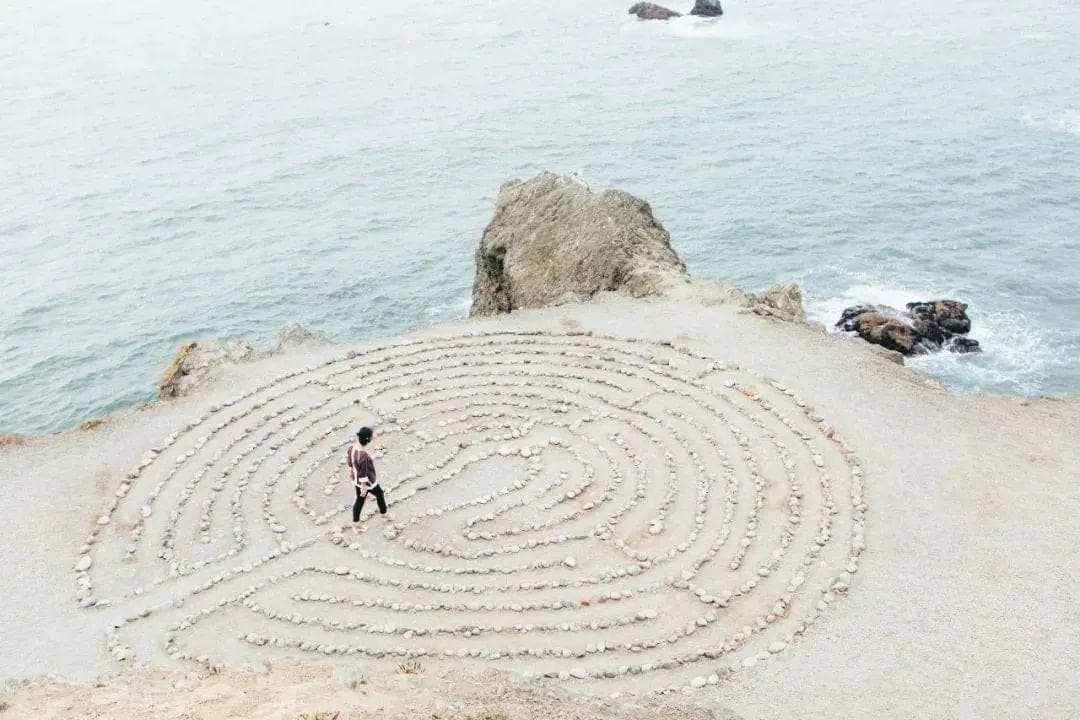
Since the inception of Slaves Society in 2014, and the launch of Nuoyan in 2017, which offers courses and a community, I have been frequently asked many questions over the years—whether through writing articles or engaging in conversations within the community. These questions often revolve around life, career, education, and personal challenges.
Whether in the workplace or in life, we all seem to have various worries and anxieties. On one hand, there appear to be plenty of suggestions and answers for these concerns. Yet, when it comes to ourselves, those methods often seem unable to "take root" in our own problems. Many things sound reasonable, but upon closer examination, they seem contradictory—
Some people will tell you to be brave and be yourself, not to go with the flow. Yet another kind of wisdom advises you to go with the tide and adapt to circumstances. So, should I go with the tide, or should I bravely be myself? How do we resolve this contradiction?
We are taught to have the world in our hearts and care about global affairs. Yet we also hear that we should live in the present, savoring each bowl of porridge and every meal. So, which is the path to happiness—living "on a grand scale," with the world in our hearts, or living "on a small scale," focusing on the little joys of a simple meal?
On one hand, we are taught to be open to good advice and humbly accept others' suggestions in order to continuously improve. On the other hand, we are also told to block out external noise and listen to our inner voice. So, should I listen to others' advice or not? When should I listen to others, and when should I listen to my own voice?
On one hand, you need a career, preferably a very successful one, and you must be financially independent. On the other hand, as you reach a certain age, you hope to start a family and have children. When it comes to career and family, if we lack one, we feel miserable. But if we have both, we often find it difficult to balance them, which also brings pain. Especially for mothers who have children after marriage, failing to achieve this balance becomes the greatest source of suffering. So the question arises: we suffer when we "have" and we suffer when we "don’t have"—how do we reconcile this within ourselves? What exactly are we pursuing?
The same goes for children. Many families suffer because they cannot have children—they pray to the Goddess of Childbirth, undergo IVF treatments, and endure physical and psychological pain. With such relentless pursuit, if they succeed and have a child, does the suffering end? It seems not; having a child brings new pains. Suffering with a child, suffering without a child—what is it that we truly want? At this point, someone might say with earnestness, "Life is inherently bitter, and adversity and suffering are treasures." But if life is fundamentally "bitter," what meaning does this journey hold? Why is it worth living, worth experiencing?
/ 1 /
Looking at the examples above, many of us often find ourselves in a state where we seem to know what we should pursue, but we don’t understand why we are "pursuing" it. Even when we achieve what we’ve been chasing, we still feel deeply unhappy. When faced with various problems, we tend to think one way one moment and another way the next, and these thoughts often contradict each other.
These self-contradictions ultimately stem from the inner chaos within us. We seem to understand certain principles, yet they cannot withstand scrutiny. We appear to grasp many things, but we do not truly comprehend them. As a result, we are constantly torn back and forth in our minds. When our inner world is in disarray, we feel overwhelmed by an endless stream of problems, struggling to keep up. We spend our days rushing around, yet achieve no sense of accomplishment.
You ask, is there a way out?
Yes.
For example, when it comes to the question of "whether to listen to your own voice or to others' advice," the core issue is actually understanding the meaning of the word "self"—that is, what "I" truly is.
We often believe that the thoughts we have are "our own." However, what we perceive as "our" voice may not truly be ours at all—it is often nothing more than the internalized ideas, expectations, and judgments of others. Therefore, before we truly understand what "I" really is, the contradictions we experience are not conflicts between our inner self and the external world, but rather conflicts between the external influences of "A" and "B" reflected through "I." Thus, the answer at this moment is: you don’t need to listen to either of these voices. What you need to hear is the true voice of "I."
So the next question arises: What is the "true self"? How can it be found? Our upbringing and education seem to rarely address these topics. Is the "self" my body? Is it my thoughts? Is it my personality? Is it my memories? Is it my social identity?
These things are not taught in schools, not taught in the workplace, and are often missing in many family upbringings. Yet, "who am I" is the very foundation of our existence as human beings, the bedrock upon which we build our lives. Without exploring these questions, it's like constructing a building without a foundation. No matter how magnificent the structure may appear, it is always at risk of collapse. What seemed solid and impressive just moments ago may crumble into piles of rubble after a minor tremor. The daily struggles we face—whether it's the rat race or anxiety—do we truly have no choice? In reality, we do, but we are either unaware of it or too afraid to choose. Thus, these external struggles ultimately reflect the inner turmoil within us.
To break free from this inner turmoil, there is only one path: go back and diligently lay the foundation, then build the house properly.
/ 2 /
Our inner world is a rich, complex, and multi-layered realm. If we compare the mind to a planet, then when we face it, we find ourselves without a map or navigation. We don't know where to land, which way to go, which direction is which, or what landscapes and terrains lie in each direction.

Ultimately, we need a map of this inner world to set out on our journey; otherwise, we are merely wandering in chaos.
I started the work of observing my inner world and building my inner self around 2013. Before that, I appeared "successful" and had even become a partner at McKinsey, but internally, I was in a state of confusion. That year, I began working with a career coach. Gradually, I started to understand the inner judgments and obstacles I was unaware of, and it was through this process of understanding that I slowly began to "see the light."
By 2014, we started working on "Slave Society." Initially, much of what we wrote was at the methodological level, as we believed that could genuinely help others. However, we soon realized that methods alone could only offer limited assistance. After all, people are not machines or tools—knowing a method doesn’t guarantee they will act accordingly. Each person’s life is complex, mysterious, and unknowable.
Then my second growth mentor appeared: my children. Becoming a mother, I realized that when facing a new life, I was completely unprepared. Although we have endless love, we can only draw from our own childhood experiences of "how we were treated" to guide how we treat our children. This process is very much like a spontaneous, reflexive reaction. In other words, our attitude toward our children is actually a re-projection of our own upbringing experiences.

When we realize that such experiences may not be commensurate with the life before us, it prompts us to understand what life truly is and what the "self" truly means. In fact, the most important principle of family education is that children do not have "problems." The root of all issues lies with adults—that is, with ourselves. It is the constraints within our own minds, the obstacles in our awareness, our tendency to judge, and our deep-seated fears and anxieties that create what we perceive as many of the "problems" in children.
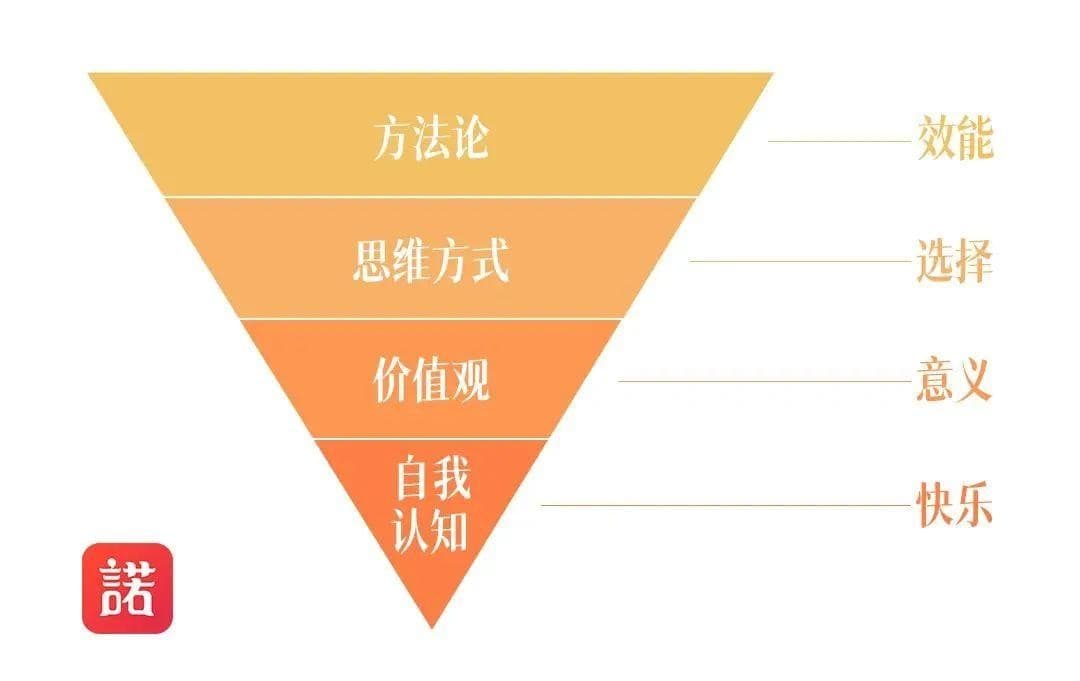
In 2017, I turned forty and started "Promise." By then, I had already been on the path of introspection for three or four years. The first-year course of "Promise" was called "The Upside-Down World." Why was it called the upside-down world? Because the true quality of our lives does not actually depend on what we possess in the material world but stems from our inner experiences. That’s why a phrase often repeated in Promise is—look inward, move forward.
"The Inverted World" can be divided into several layers. The outermost layer is methodology, where the significance of methods lies in granting you self-efficacy. Beneath methodology is the layer of thinking patterns, which correspond to the ability to make choices. Below thinking patterns lies the layer of values, which correspond to the pursuit of meaning—questions of right and wrong, or value judgments. Finally, the innermost layer is self-awareness, which corresponds to our happiness. Ultimately, life is about understanding oneself, accepting oneself, overcoming inner fears, and pursuing profound happiness. Because, in the end, humans seek happiness—not a superficial, shallow, or external kind of joy, but a genuine, heartfelt sense of delight.
How can one achieve inner happiness? Are there paths and methods? The answer is yes, but we often encounter approaches that seem reasonable in theory but, when put into practice, don't seem to help us much.
For example:
We take it for granted that one way to achieve happiness is to tackle our current troubles one by one.
Actually, that's not quite the case. If I have a few major worries at the moment—I’m not married, I don’t own a house, and I haven’t had children—and then there are some minor annoyances, like the flowers I’m growing being eaten by bugs, the sink getting clogged with limescale, or losing a certain key, you might think that once my major worries are resolved, the minor ones won’t matter at all. But what happens in reality? Even after all your major worries are taken care of, you’ll still get annoyed when you can’t find a key or your vegetables are bitten by bugs. Without major worries, minor ones will still fill up your mental space.
So, it's not that by solving each worry one by one, the problems disappear. The real path lies in our attitude toward the things that "annoy" us... It is our attitude that determines our inner state when facing problems, whether big or small. Once our mindset changes, some worries, regardless of their size, can vanish together. If our inner state remains unchanged, even seemingly insignificant matters can become our troubles.
Another path to happiness seems to be satisfying one's desires.
Our anxiety about children's education is a typical example. We believe that whatever the future demands, children must learn it, and they must keep learning. But do we feel more satisfied and at peace the more we let our children learn? The reality is, if you spend time on Chinese, you find math is still lacking; if you spend time on all major subjects, you realize arts and music are still lacking; if you let your child learn arts and music, you see friends posting about their children traveling, and you realize that focusing solely on studies has missed the opportunity to "travel ten thousand miles," leaving your child with insufficient experience. It's like picking up shells on the beach—no matter how many you gather, you'll always find more beautiful ones you haven't picked up or can't carry. So, trying to satisfy desires through addition will never lead to a day of "satisfaction."
The two examples above illustrate that using subtraction to eliminate worries or addition to satisfy desires ultimately fails to reach the "other shore" or attain "happiness." Moreover, in this process, we expend a tremendous amount of time, energy, and resources, only to end up with pain and anxiety.

/ 3 /
So, what should the correct path be? What attitude should we have toward the things we desire? And what attitude should we have toward our troubles?
To answer this question, we must return to what was discussed earlier: we need to understand the map of our inner world and construct our inner landscape in order to emerge from a state of inner chaos.
How should I begin this build? And once I start, when can it be considered complete?
Over the years, we have conducted many live sessions on "Promise," answering numerous similar questions and offering plenty of advice. However, one of my personal goals has always been to systematically organize these insights, and to have the opportunity to explore, understand, and build our inner world together in a structured way.
I often say that within each person's heart lies a gold mine. We are all sitting on our own gold mine, but it is covered by a layer of iron ore and barren soil. Sitting on top of it, we pick up our shovels and rush outside in a hurry to search for gold, only to end up with nothing. So, what is it that we truly need to do? We need to dig deeper. But how do we dig? It doesn’t seem all that easy either. We also need a map, a guide, and ideally, companions to explore together.
Published in 1976, *A Course in Miracles* is a truly remarkable book. Its opening line reads: "Nothing true can be threatened, Nothing untrue exists."
In other words, what we often feel threatened by are actually things that do not exist. They are merely our illusions, or what Buddhist scriptures refer to as "delusions." Yet we mistake them for reality. So how can we see the truth through these illusions? And what is the true self? I think these two sentences have already captured it quite aptly.
Ultimately, the question one must come to understand is how to distinguish between reality and illusion. The reason for our inner suffering lies in being trapped within illusion. Reality is not frightening; it is boundless, loving, and joyful.
But approaching this truth is not easy; we are often held back by our own fears.
So building this inner map is actually quite simple—it ultimately comes down to answering a few questions—
Who am I?
What is my relationship with the world?
How to distinguish between real and fake?
How to pursue truth?
This is a path of looking inward, one that truly has no end. It is a process through which we continuously confront, continuously see, and continuously let go, gradually approaching inner liberation.
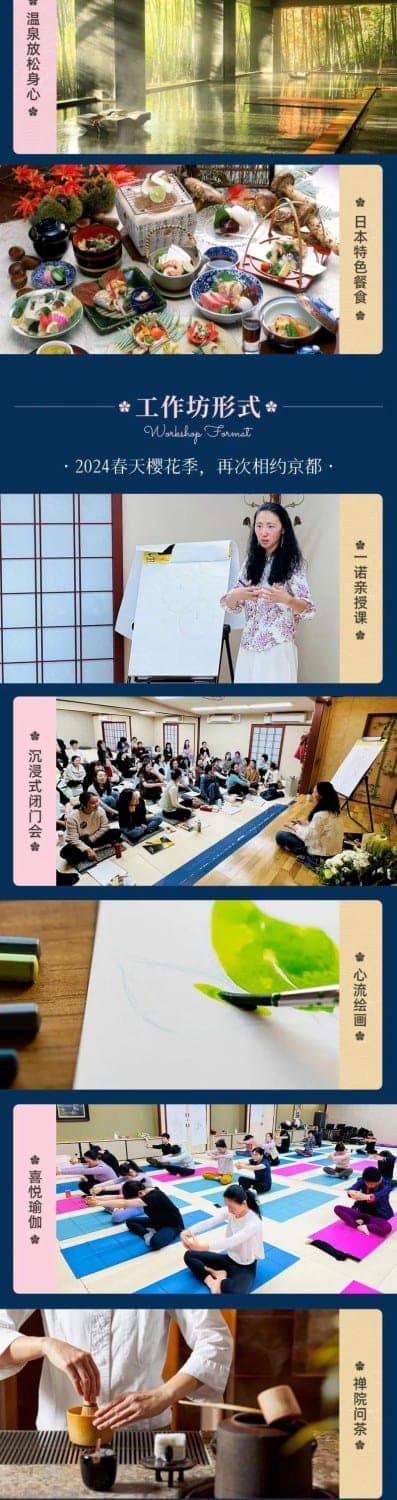
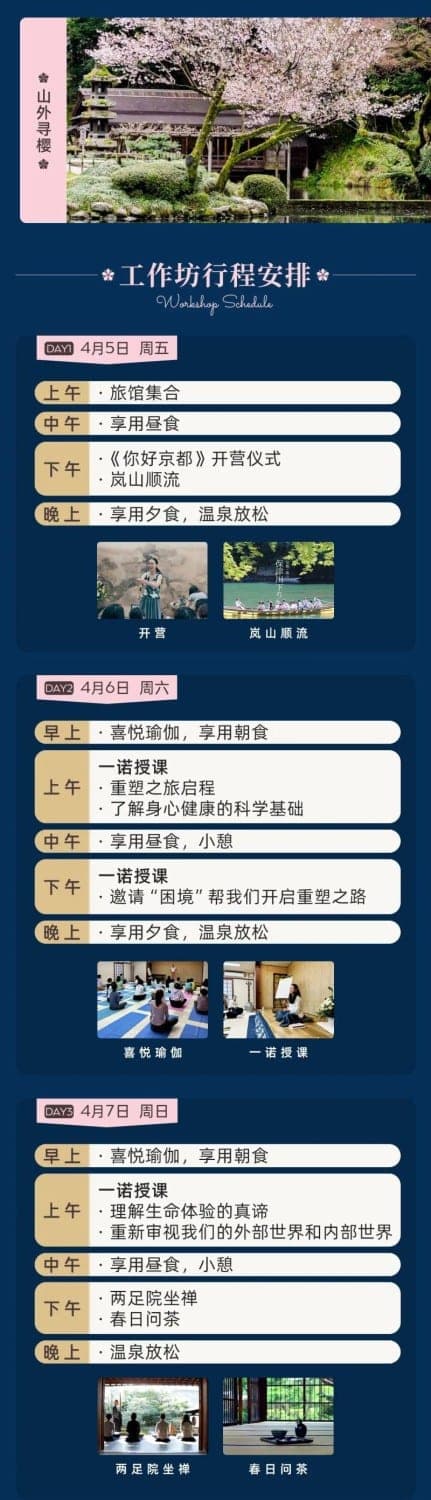
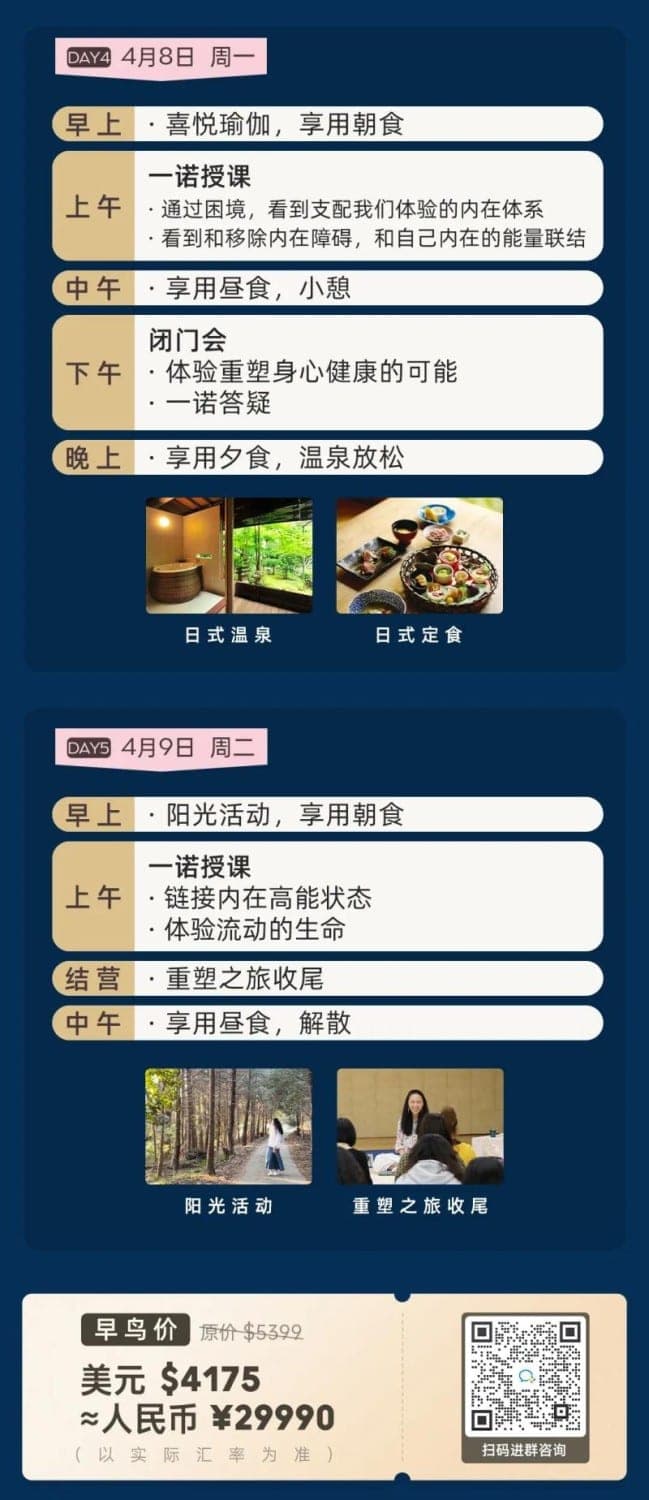
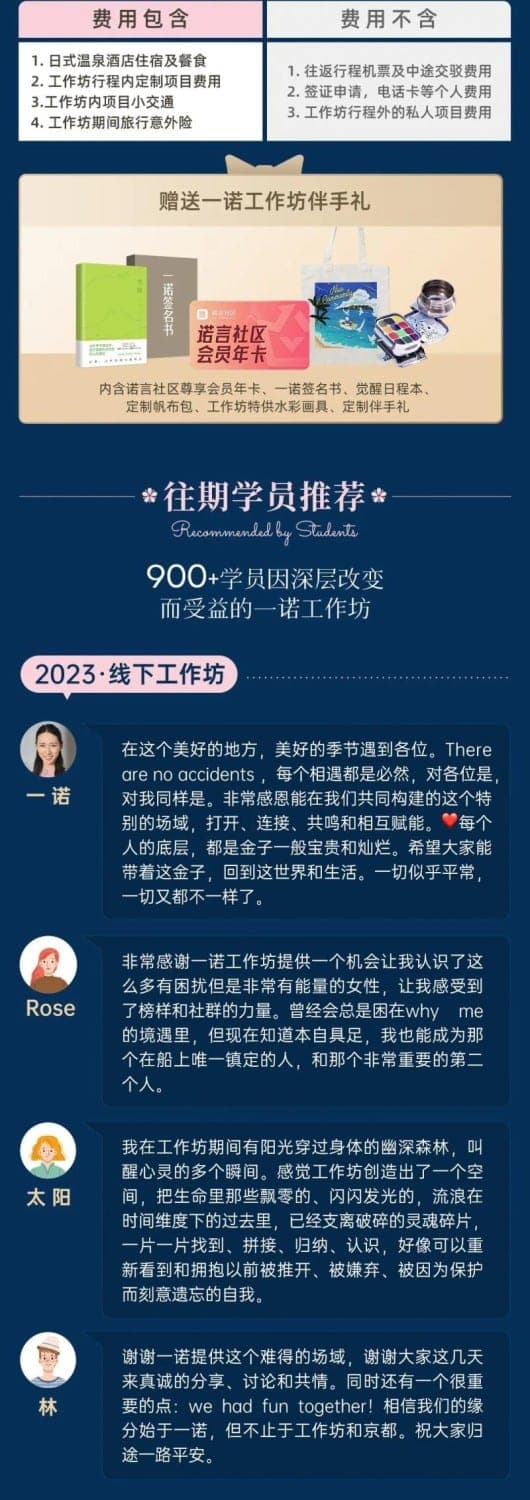
During the 2023 cherry blossom season, I held my first offline workshop in Kyoto, and it was a wonderful experience. Many of the participating friends saw significant improvements in their careers and personal lives. For the 2024 cherry blossom season, from April 5th to 9th, I will be hosting another offline workshop in Kyoto. I believe this time, on the foundation of that wonderful experience, things will be even more beautiful.
The theme of the workshop remains "Reconstructing the Order of Body and Mind." While the theme is similar each time, there are slight variations in each session. The goal is still to support each individual through an immersive environment, providing an opportunity for everyone to observe their underlying state, clarify internal and external challenges, and connect with their inner energy. At the same time, we hope everyone can create a chance for themselves to relax and, on this foundation, rediscover the vitality of life.
For this Kyoto workshop, we will be staying at a hot spring hotel nestled against the mountains. The surroundings are not only adorned with blooming cherry blossoms but also feature several ancient temples, with nearby walking trails perfect for strolling through the forested hills. There is also a centuries-old tea house nearby, where you can enjoy tea while witnessing the true beauty of falling petals. The hotel itself has a long history, boasting excellent hot springs, and its dining and accommodations are truly exceptional... So if you join us, you’re guaranteed a wonderfully relaxing experience—eating well, sleeping well, and enjoying yourself to the fullest.
The spots for the offline workshop are limited, with a cap of 50 participants, so it will be on a first-come, first-served basis. I hope to have the chance to meet everyone in the spring of 2024, in Kyoto, Japan, when the cherry blossoms are in full bloom. Let’s embark on a journey together to relax our minds and bodies and rejuvenate our vitality.
Workshop details and registration information can be found in the poster below. The fee includes accommodation and meals.