The 2.8 Million People Who Disappeared
Because of a recent live stream on LinkedIn, I remembered to take another look at my LinkedIn account, which I haven't used in years.

Because of a recent live stream on LinkedIn, I remembered to take another look at my LinkedIn account, which I haven't used in years.
Since I don't have the need to look for a job, most of the people who contact me on LinkedIn are strangers, so it seems there hasn't been much necessity to use this platform over the years.
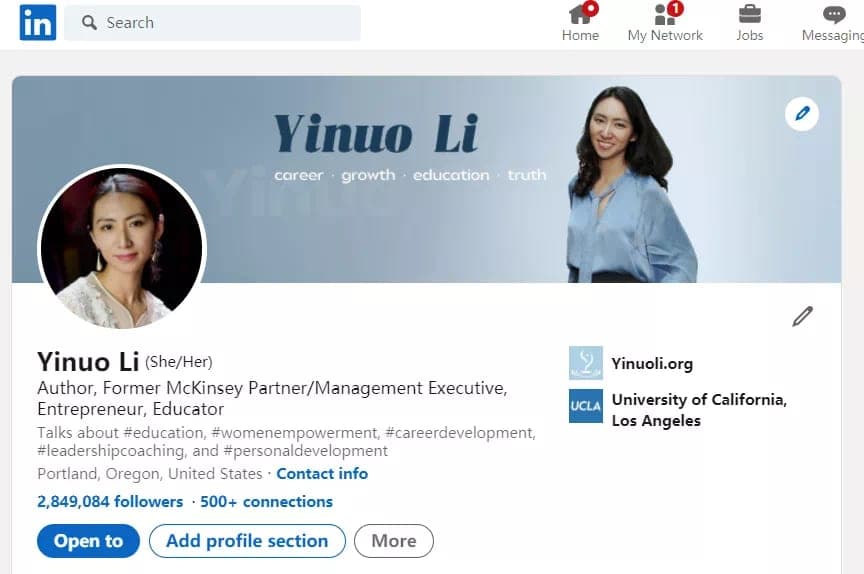
After resetting the password and logging in, I was suddenly struck by the realization—wow, there are actually over 2.8 million followers.
I checked out a few other celebrities, and Ray Dalio has 2.52 million.
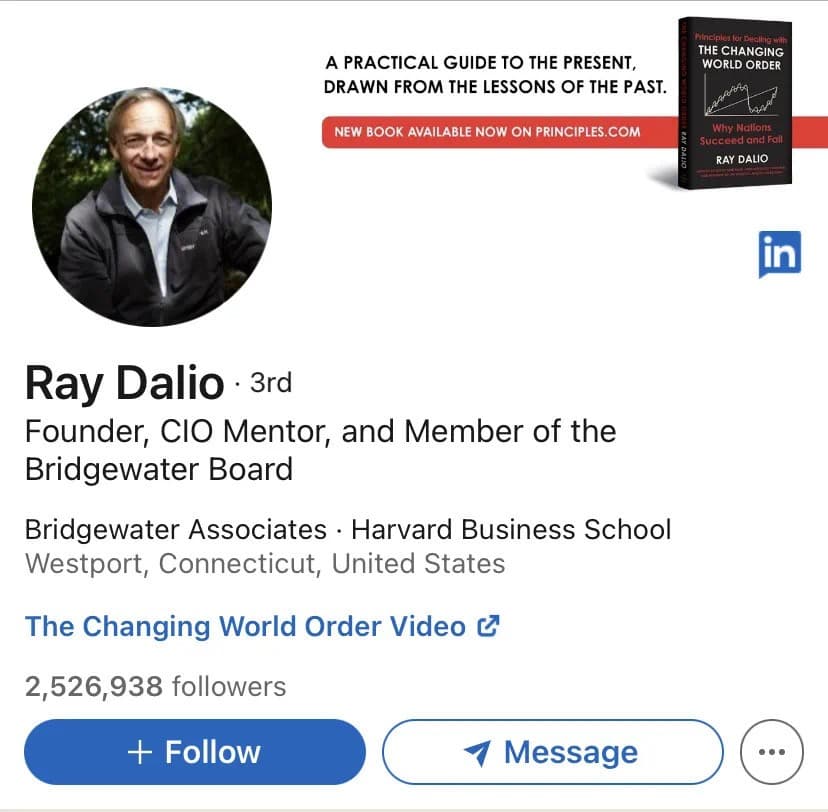
I suddenly feel like I've been swept off my feet—does that mean I have more followers than he does?
Skeptical, I specifically asked a knowledgeable friend, "Are all these accounts of yours just spam?" The answer was, "Our data is all real!"
That's great, I'll start using it right away! I'm currently working on the final overseas career workshop of the year, so isn't this a perfect platform for promotion and enrollment?
But after using it for a few days, I realized it wasn't the case.
LinkedIn has a great user data system. When you post something, you can see how many people can see your post, which is called "Impression." I think at the beginning, we shouldn’t aim too high. If 10% of our followers see what we post, that would be pretty good.
10% of 2.8 million is 280,000. Looking at the numbers, it still feels quite high. So let's cut it down even more drastically—1%, that should be humble enough, right? That would mean around 28,000 impressions as a small goal. But after I posted it, I found that the average impression was far from reaching 28,000; instead, it was only a few thousand, and it took several days to accumulate! In other words, only about 0.1% of people actually saw it.
This leaves me not just shocked and disheartened, but even with a sense of humiliation.
What's going on?
After some thought, it occurred to me that there are only three possibilities:
1. This platform has many zombie accounts and fake accounts. If that's the case, then other big influencers should have impressions similar to mine. Clearly, theirs are much higher. So why are there so many fake accounts following me, and as many as 99.9%? This seems unreasonable.
2. These accounts were once real, but they are no longer using LinkedIn—they have quit, uninstalled the app, but their accounts still exist in the backend. If this is the case, then losing 99.9% of users would be such a significant issue that the platform should have addressed it long ago, because if this assumption were true, I wouldn't be the only one encountering this problem.
3. These accounts are real, but they cannot be accessed. Why can't they be accessed? Because they are behind the Great Firewall.
Seeing the third possibility, to be honest, I felt a wave of sorrow wash over me.
Because if that's the case, they haven't disappeared. But once the wall is erected, I can no longer find them, and they can no longer find me. Only some "accounts" remain, drifting like ghosts across this platform.
I first started using LinkedIn around 2008, and the profile photo I used for over a decade was taken that same year.
Looking through the LinkedIn records, many memories suddenly come alive—those vivid, flesh-and-blood individuals.
I returned to China for work for the first time in 2008, which was eight years after I had gone abroad. The project was in Shanghai, and the client was a foreign company in the medical field. On the first day of the project, we had a meeting at the client's office at 9 a.m.
I flew from the United States to Shanghai, and that morning, I arrived at the client's office building 10 minutes early.
As soon as I entered the lobby of the office building, I was stunned—it was packed with people! Despite the crowd, there was no chaos. Most of the men were dressed in suits and ties, while the women wore meticulously applied makeup. I had never seen such a scene before and thought there must be some event going on. After looking around, I realized everyone was just queuing up for the elevators. Even though I had just returned from the United States, at that moment, I felt like a country bumpkin stepping into the city, completely unfamiliar with the hustle and bustle of a Shanghai office building.
I remember standing in the crowded yet orderly elevator lobby of the office building back then, surrounded by fellow countrymen who were complete strangers yet felt incredibly familiar. I was filled with a whirlwind of emotions. At that moment, I said to myself, no wonder China's economy is soaring—just look at the spirit and energy of the people in this office building elevator lobby. The answer lies right there.
It's hard to believe that was already 15 years ago. Among the experiences of those years, a few faces randomly come to mind.
One of them was when I interviewed a pharmaceutical representative at a hospital in a southern city. The young man had outstanding performance, and I spent half a working day with him at the hospital. When I asked him what his secret was, he said, "Hey! Actually, the main job isn't about explaining drug information—doctors already know that stuff. Even if you talk about it, it's just a few sentences, and you can't say too much anyway. To get doctors to prescribe more of our drugs, the bottom line is to make sure they always see you around. So, the so-called main part of the job is basically running errands. You show up before the doctor's outpatient hours, buy them breakfast, and after their shift, you see if there's anything they need help with—like dropping off dry cleaning or picking up their kids. When doctors have meetings, you help them with their PowerPoint presentations. Lately, I've been even busier because the hospital is holding a sports meet, and I have to run the sprint for the doctor! Later, I found out that not only was I going, but pharmaceutical representatives from other companies were also participating. So, the competition was actually between the pharmaceutical representatives!" He then added, "I never thought being a pharmaceutical representative required such well-rounded skills."
On one hand, this left me utterly bewildered, helpless, and even amused. On the other hand, you could sense his sheer delight—after all, who wouldn’t be happy making money and hitting targets? During that period, every pharmaceutical company in China was thriving.
I wonder what this young man is doing now.
The second one is a senior executive at a foreign company, whom I wrote about in my book. He’s from Singapore, always wears a gloomy expression, but is exceptionally skilled in business. Everyone in the company respects him immensely, yet they also fear him. Whenever I see him, I’m reminded of Bismarck. He lives alone in a serviced apartment, while his family remains in Singapore, and he spends most of his time working. If he isn’t traveling, he arrives at the office incredibly early. I remember thinking back then that, coming in so early, he probably never had to wait in line for the elevator. Every day, he would pass by the office where we were working on projects, and his greatest joy seemed to be mocking us “Ph.D.s” for knowing “nothing about the market or distribution channels.” But this stern, unsmiling man once told me about his first boss, a Dutchman who had adopted two children in China, both with disabilities. One of them had a severe eye condition, bleeding and oozing pus, looking utterly pitiful. He asked his boss why he didn’t adopt a healthy child instead. His boss replied, “You don’t understand. The love we receive from these two children far exceeds what we give. They are a gift from God.” When he shared this story, he was incredibly gentle. This stark contrast in his demeanor left an indelible mark on my mind.
I wonder if Bismarck is still in China now, and what he's doing.
The third is a former colleague from McKinsey, a Harvard PhD graduate, sharp and capable, with teeth as white as those in American toothpaste commercials. Like all those who returned to work in China after graduating from prestigious American universities at the time, he was full of hope for the future, especially in a place like Shanghai. From infrastructure to culture, it was comparable to, if not better than, major American cities, while also being his hometown—with delicious Chinese food, friends, and family. Returning to work after studying abroad was truly the perfect choice.
One year he told us he was getting married, and his fiancée was a former university classmate. Later, he said he was actually gay, and after that, he and his same-sex partner had a child through surrogacy.
On one hand, you can feel the oppression faced by the LGBT community, but on the other hand, you are grateful for the subtle openness in Shanghai. LGBTQ individuals can also pursue a normal family life, with partners and children. At the same time, you feel sorry for your university classmates who are trapped in sham marriages.
I wonder how she's doing now, whether she's found new love, or if she's gotten married again.
I can only smile and say, "Good for you!"
I wonder how he's doing now. Perhaps he has already retired with honors, spending his days on some sunny beach, reflecting on his successful life.
These people and events were nothing earth-shattering, yet for some reason, I remember them with remarkable clarity.
Looking back now, the economic growth and social progress witnessed over the years were often framed in grand narratives that, in hindsight, feel like after-the-fact explanations. Real development was actually built by ordinary people—not heroes, nor necessarily noble individuals—driven by their own small, personal ambitions for a better life, working within countless enterprises. Some genuinely created value, while others navigated office politics. Redundancies and office politics within companies aren’t the end of the world, even though they can be painful when you’re working alongside such colleagues. Taking a step back, as long as the broader environment remains stable, as long as companies can operate and there are people willing to work hard, enterprises will continue to move forward.
As long as a company continues to grow, there will be communication and interaction. The Chinese have an exceptional ability to learn—whenever they see the world beyond, if they set their minds to it, they can always do better.
During my years at foreign companies in China, I found Chinese employees to be among the most hardworking and diligent people, with a strong work ethic.
回到2008年我在国内的第一个项目的第一天,我们开完项目启动会,说了一下我们需要客户提供哪些数据。开完会都已经快6点了。咨询公司加班是日常,所以我们出去吃了个饭,然后回到麦肯锡上海的办公室,继续工作。晚上9点,我收到一封邮件,发现我们跟客户要的数据,客户都整理好发过来了。我当时就震惊了,因为在美国,没有人会加班给你发数据的,你要完了需要不断地催。有时候催到一半人家休假去了,你只能无奈地干等。这样一个数据要求给美国的客户的话,我最乐观的估计,也是一个星期后才能拿到。
So I understand that development isn't just cold, hard data—it's built by ordinary employees like these, who cherish their job opportunities, invest their time and energy, and work as if their lives depend on it every single day.
But now, they have just "vanished" like this.
2.8 million, and that's only what I can see on my account. If my data is less than 1% of the total, what would the overall data look like?
The other day, I came across a piece by Z3 Feng. Southwest University of Finance and Economics truly missed out on a Nobel Prize, but not in the way you might think.
Not because of insufficient effort.
Not because of the evaluation system,
It's simply because we lost touch.
I'd like to ask, what kind of pain is it when 2.8 million people cannot be found?
Silent and unnoticed, it blocks 99.9%.
A pain that is terrifying upon deeper reflection.
Written at the end
This Saturday morning Beijing time, which is Friday evening US time, I will be hosting a live stream.
The several individuals in the live stream have all participated in one of my workshops before. Some are based in China, while others are overseas, and each has their own remarkable experiences. They will also be assisting as mentors in the upcoming workshop. There are special discounts available exclusively in the live stream, and I hope to see everyone both in the live stream and at the workshop. Similarly, the content from this live stream will be uploaded to my YouTube channel after it concludes. Feel free to subscribe and stay tuned.