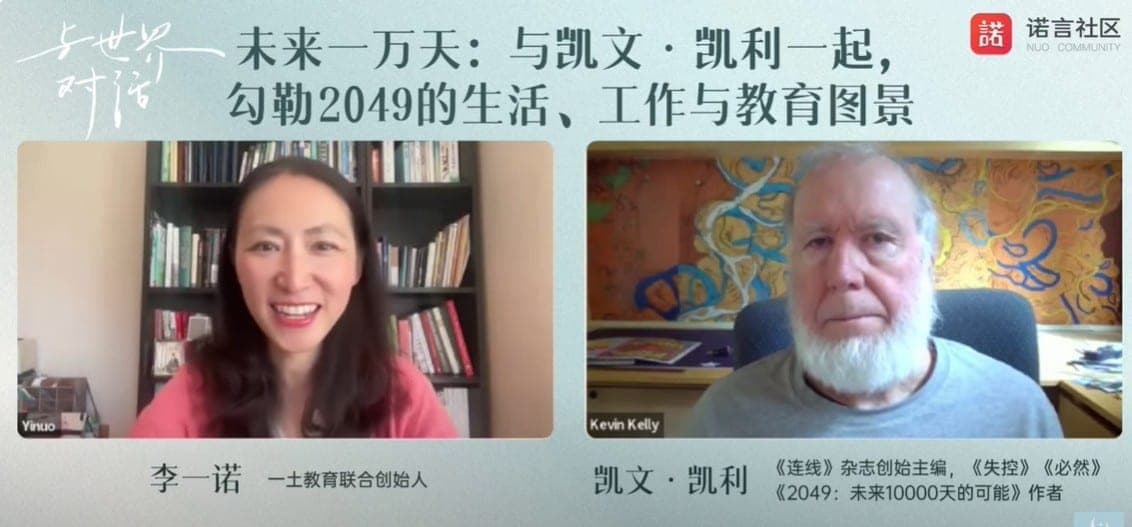
Kevin Kelly: What If the Future Went Right?
When I sat down—virtually—with Kevin Kelly, I thought I knew what to expect. After all, Kevin has been called “the tech prophet” for decades, a thinker whose ideas about technology have shaped how gen...
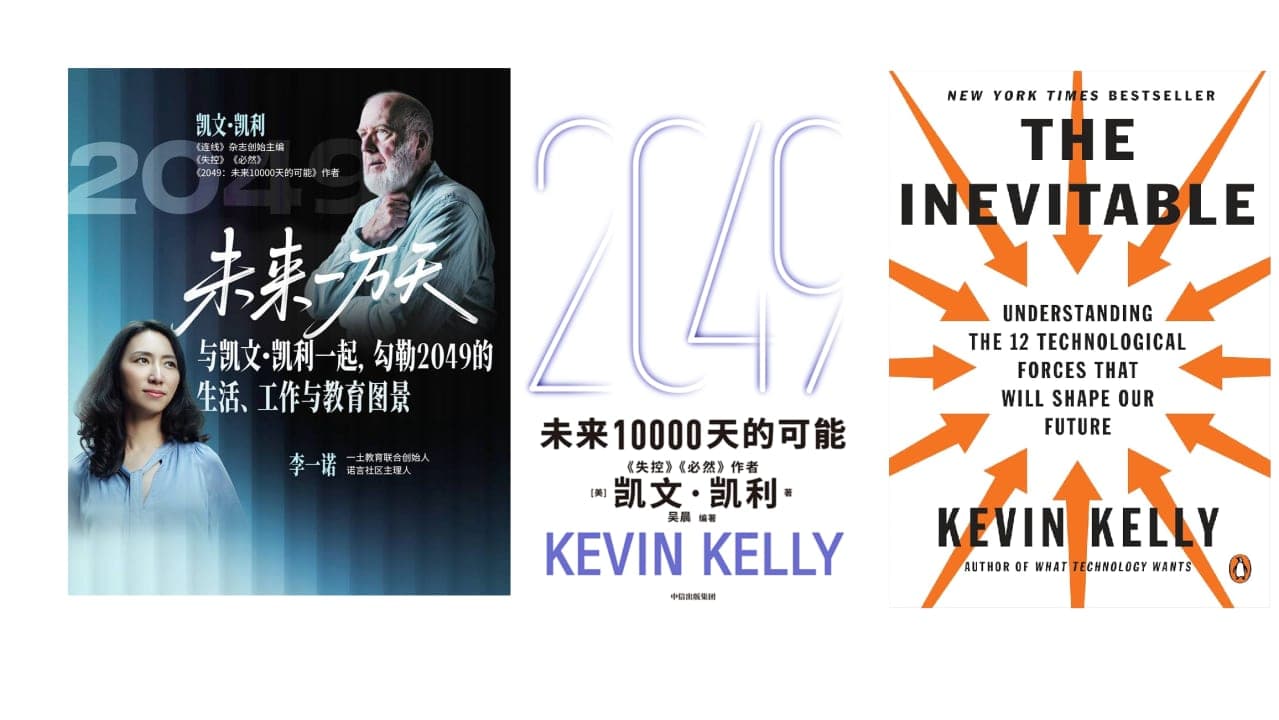
Imagining the Next 10,000 Days of Co-Living with AI
When I sat down—virtually—with Kevin Kelly, I thought I knew what to expect. After all, Kevin has been called “the tech prophet” for decades, a thinker whose ideas about technology have shaped how generations of readers imagine the future. But I found myself less dazzled by his predictions than by something more subtle: his commitment to optimism as a discipline, almost as a duty.
Kevin joined my livestream interview from California, warm and unhurried, with that particular tone of someone who has been thinking about the long arc of civilization for a long time. His new book, 2049, co-authored with Wu Chen, is not a book of prophecies but of possibilities—“positive scenarios,” as Kevin insists, not predictions. It is an exercise in collective imagination:
“If things went right, what would the world look like 10,000 days or twenty-five years from now?”
If things went right
As a reader, and perhaps more importantly as a participant in today’s anxious global climate, I was struck by the daring simplicity of that premise. To imagine a desirable future is not a trivial thing; it is, as Kevin argues, the very engine of progress.
For most people today, the instinct is to ask the opposite question: what if things go wrong?
When I mentioned that some people might call such optimism naïve, Kevin smiled gently, as if he had heard this countless times before. He explained that optimism is not about ignoring problems but about acknowledging evidence. Progress, by the data, is undeniable: longer lives, greater safety, broader choices. The problem, he said, is that bad news happens quickly and therefore makes the headlines, while good news unfolds slowly, almost invisibly. To be truly realistic is to take the long view.
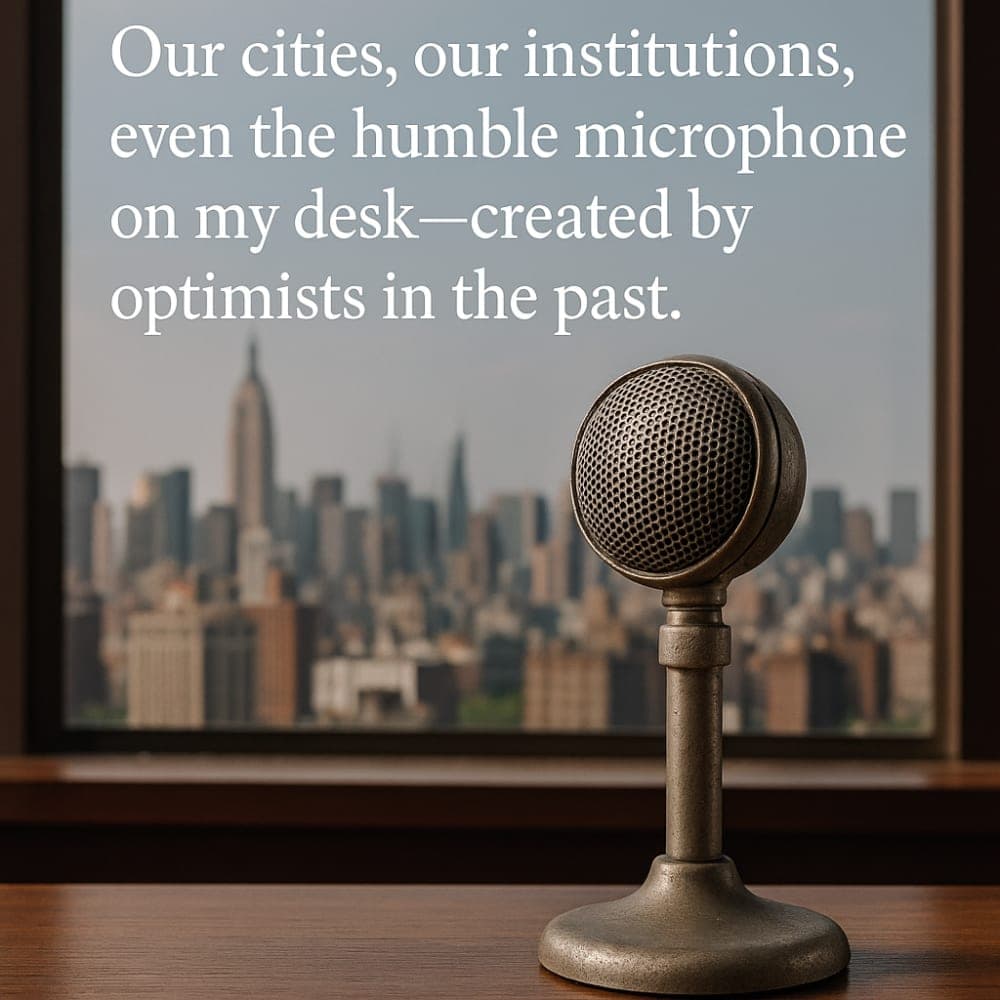
Kevin insists on reversing the premise. He believes optimism is not naïve but realistic, because history itself is the evidence. “The present was built by the optimists of the past,” he said. Look around any room—the microphones, the electric lights, the devices that carry voices across oceans. None of these emerged by accident. They were willed into being by people who believed, against skepticism, that such things could exist. The future, he argued, will be shaped the same way.
Why should the future be any different? He paused on that phrase—if things went right.
I thought of my years at the Gates Foundation, where one of our slogans was to focus on “ordinary data” instead of “extraordinary news.” Disasters dominate headlines because bad news happens quickly. Progress unfolds slowly, almost invisibly. A disease eradicated, a village electrified, a life expectancy extended—all of these only show up in retrospective charts. It struck me that optimism, in Kevin’s sense, is really a discipline of attention: choosing to look at the long view, to see evidence of progress even when the daily mood suggests decline.
Five Lenses on the Next 10,000 Days
From this foundation of optimism, Kevin and Wu Chen built 2049 around five core concepts that they believe will structure the next twenty-five years.
The first is what Kevin calls the mirror world: a digital twin layered over physical reality, accessible through smart glasses. These “magic glasses,” as he described them, will allow us to sit across from each other as three-dimensional avatars, our gestures and expressions faithfully conveyed. The same system will be used by robots and self-driving cars to perceive the world. What reassured me most was his insistence that the mirror world will not substitute for reality but enhance it. “You still see the real world,” he said, “but annotated.”
The second idea reframes how we think about intelligence. Kevin dislikes the phrase “artificial intelligence.” He prefers “artificial aliens.” These systems, he said, are not like us and will never be like us. They are alien minds, powerful partners, perhaps even conscious one day, but forever different. This shift in vocabulary startled me. I realized that much of the fear around AI comes from assuming it will become a “superhuman.” But if instead we see it as another species—strange, useful, not us—the fear loosens.
The third concept is the universal personal agent. Today, only the wealthy can afford capable assistants. In the future, Kevin believes, everyone will have one—or several—digital aides, working tirelessly even while we sleep. Our agents will negotiate with other agents, creating an economy of “bot-to-bot” interactions. I found the thought both thrilling and disorienting. What will ordinary life look like when each of us commands invisible workforces?
But personalization has a price. This led to Kevin’s fourth concept: transparency and covalence. Personalization requires that we reveal ourselves. The problem is not data-sharing itself but one-sidedness. Surveillance is when they see me but I cannot see them. Covalence, in his vision, is two-way transparency: I benefit, I can correct, I know what is happening. This struck me as both obvious and radical. Most of our current systems are far from covalent; they take without giving. Could trust be rebuilt if institutions allowed us to see as much as they see?
The fifth and final concept is abundance in content. In a world where content is infinite, what becomes scarce is not information but human attention. Presence, Kevin suggested, may become the true luxury. That line lingered with me. I thought about how easily my own attention is fractured, how presence already feels like a rare gift.

Beyond “Thinkism”
Listening to these five pillars, I began to see Kevin’s optimism not as a sunny temperament but as a rigorous reframing. Yet he is not blind to risks. What struck me most was his critique of what he calls thinkism—the belief that thinking alone can solve problems. “We’ve been thinking about AI for a hundred years,” he said. “It’s not useful anymore. We have to use it.” Imagined risks and imagined utopias alike, he warned, are fantasies. Real understanding comes only from engagement. His principle is not precautionary but correctionary: make policy from evidence, not from fear.
Rethinking Intelligence
Our conversation turned to intelligence itself. The Hollywood myth of “superintelligence” assumes that intelligence is one-dimensional, like a volume knob. Kevin dismissed this. Intelligence is compound, like chemistry. Just as water is not an element but a combination, cognition is made of many elements. Some animals already surpass humans in certain dimensions. A tiger is not more “intelligent” than Einstein, but in a cage, the tiger wins.
“Intelligence,” Kevin said, “is overrated.” What matters are other human traits: grit, perseverance, communication, enthusiasm. He reminded me of his own piece of advice: “Enthusiasm is worth 25 IQ points.” I thought about education. If intelligence is not the sole axis, what should we be teaching our children? Perhaps resilience, curiosity, moral discernment—skills machines cannot replicate.
Work Without Middles
The implications for work are profound. Contrary to popular fear, Kevin does not believe AI will cause mass unemployment. Jobs are bundles of tasks, and AI will replace some but augment others. The real casualty, he believes, will be middle management. Coordination, reporting, and routine decision-making can be handled by AI, leaving value concentrated at the extremes: the front-line workers, now empowered with executive functions, and the top strategists, who think in decades.
This mirrored my own consulting experience. I remembered the “two-pizza rule”—no manager should have more than nine direct reports. That rule exists because human attention is limited. But what if transparency and AI dissolve those bottlenecks? Entire layers of bureaucracy might become unnecessary. Leadership itself would change shape.
Pace Layers of Leadership
Kevin explained this shift through Stuart Brand’s concept of pace layers. Organizations are divided by time horizon: some people focus on second-by-second responses, others on monthly coordination, others on decade-long strategy. AIs excel at the bottom layers, reacting instantly. Humans remain indispensable at the top, where continuity and long-term vision are required.
Yet he also reminded me that human work is often inefficient—and that this is a strength. Science requires failed experiments; art requires wandering; innovation requires detours. Efficiency is for robots. Inefficiency is for us. Perhaps our value lies precisely in our messiness.
Governing by Evidence
The conversation broadened to governance. Kevin envisions digital governance built on evidence, not ideology. He told the story of architects waiting to see where students carved paths across the lawn before laying sidewalks. Laws, too, could follow behavior rather than dictate it. With AI analyzing patterns, regulation could be adaptive, responsive, fair. He even suggested AI-assisted judiciary systems, impartial by design. Some may find the idea chilling, but Kevin’s optimism is that impartiality is precisely what justice requires.
Closing on Responsibility
As our time drew to a close, I reflected on the thread that tied all his arguments together. Optimism, for Kevin, is not wishful thinking. It is responsibility. The future is not something that happens to us; it is something shaped by those who dare to imagine it positively. Cynicism is easy, even fashionable. But it is optimism, sustained and disciplined, that builds microphones, airplanes, vaccines—and perhaps mirror worlds and covalent societies.
When I ended the livestream, I felt lighter than when I began. Kevin had not erased my doubts, nor had he pretended that the future would be simple. But he had reminded me that to choose optimism is to take ownership. It is not a luxury. It is a duty to the generations who will inherit what we build.
The future is not waiting for us like a trap. It is being built by us, every day, in the choices we make. And if we wish for our children to live in a world worth inhabiting, then optimism is not naïve—it is essential.