Japan Observation: Exceptionally Innovative, Exceptionally Rigid
Living in Japan, you can feel innovation everywhere.
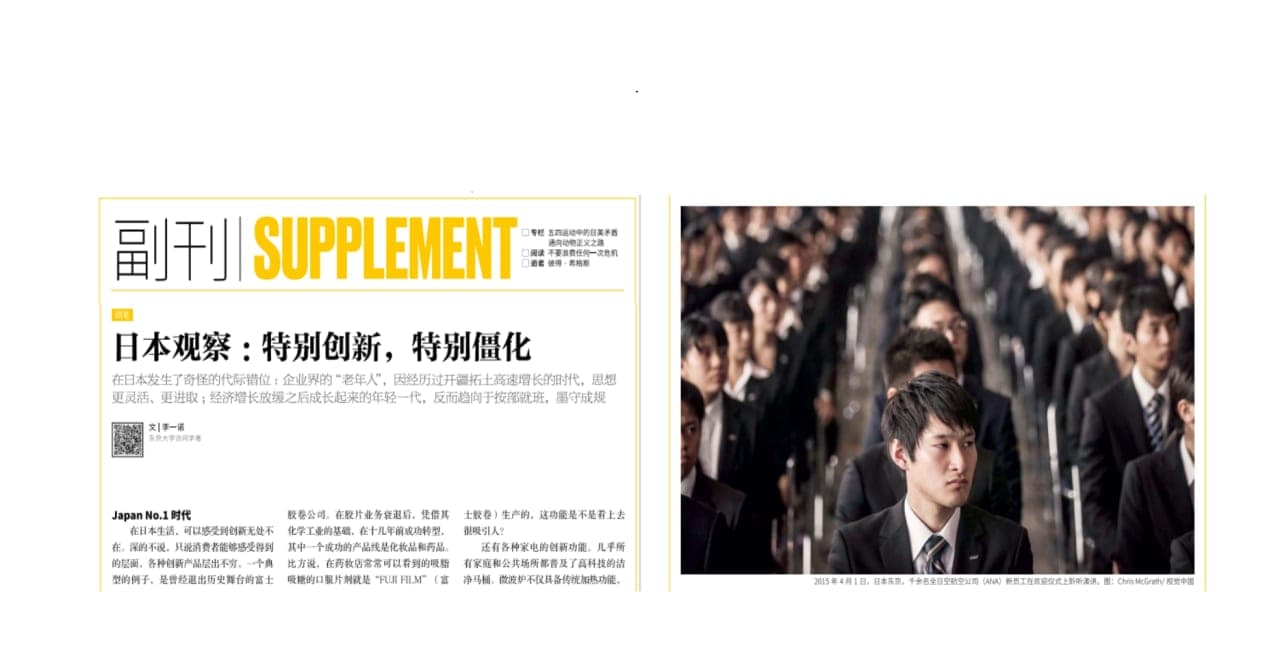
“This article was first published in the April 15th, Issue 15 of *Caixin Weekly*.”
The Era of Japan as Number One
Living in Japan, you can feel innovation everywhere.
Living in Japan, one can feel innovation everywhere. Without delving too deeply, just at the level that consumers can experience, innovative products emerge one after another. A typical example is the once-obsolete Fujifilm company. After the decline of its film business, leveraging its foundation in the chemical industry, it successfully transformed over a decade ago, with one of its successful product lines being cosmetics and pharmaceuticals. For instance, the oral tablets for fat and sugar absorption commonly seen in drugstores are produced by "FUJIFILM." Doesn’t that function sound quite appealing?
There are also various innovative features in household appliances. High-tech clean toilets have become almost ubiquitous in nearly every household and public space. Microwave ovens not only retain their traditional heating functions but also double as ovens and steamers, suitable for a variety of cooking methods. Integrated bathroom designs combine showering, bathing, and clothes drying into one, offering an ultimate user experience. Innovative designs for home washing machines include a "bathwater recycling" feature, which connects to the bathtub's water pipe to use relatively clean water as the initial wash water. Additionally, cooled water from the bathtub is transported through pipes to a gas heating system and then recirculated back to the bathtub, ensuring the water temperature remains comfortable. This design, which embodies energy-saving and eco-friendly principles while efficiently utilizing water resources, is truly astonishing in its level of intelligence. When I learned about and used these features, I could only describe my reaction as "stunned."
Looking back at Japan's post-World War II history, innovation has experienced significant ups and downs, and it is currently far from its peak.
In 1979, Harvard scholar Ezra Vogel published his groundbreaking work "Japan as Number One: Lessons for America" just as Japan's socio-economic rise was about to take off, defining the trend of "learning from Japan" for the following decade. The Singaporean government even listed it as required reading for ministers and senior officials.
The 1970s to the 1990s were indeed the era of "Japan as No. 1." In 1990, the top five companies in the world by market capitalization were all Japanese—Nippon Telegraph and Telephone, Mitsubishi Bank, Industrial Bank of Japan, Sumitomo Bank, and Toyota Motor Corporation.
During this period, Japanese companies created numerous high-tech products that led the world, including endoscopic technology for surgery, the Shinkansen high-speed railway system, light-emitting diode (LED) technology, and Toyota's lean production system, among others. In the consumer goods sector, instant noodles, the Sony Walkman, Nintendo home gaming consoles, and hybrid electric vehicles all originated in Japan. These inventions not only propelled global technological development and profoundly influenced consumer lifestyles but also gave rise to an endless stream of innovative legends.
The inventor of instant noodles, Momofuku Ando, was born in 1910 in Taiwan, China, and later moved to Japan. After World War II, the sight of people queuing for ramen inspired him to create a type of noodle that was quick, delicious, and could be enjoyed even at home. After countless trials and failures, Ando successfully produced the world's first packet of instant noodles.
Living in Japan, you can feel innovation everywhere.
Living in Japan, one can feel that innovation is everywhere. Without delving into the profound aspects, just at the level that consumers can perceive, various innovative products emerge one after another. A typical example is the once-defunct Fujifilm company. After the decline of its film business, leveraging its foundation in the chemical industry, it successfully transformed over a decade ago. One of its successful product lines is cosmetics and pharmaceuticals. For instance, the oral tablets for fat and sugar absorption commonly seen in drugstores are produced by "FUJI FILM." Doesn’t that function sound quite appealing?
There are also various innovative features in household appliances. High-tech clean toilets have become almost ubiquitous in nearly every household and public space. Microwave ovens not only retain their traditional heating functions but also double as ovens and steamers, suitable for a variety of cooking methods. Integrated bathroom designs combine showering, bathing, and clothes drying into one, offering an ultimate user experience. Innovative designs for home washing machines include a "bathwater recycling" feature, which connects to the bathtub's water pipe to use relatively clean water as the initial wash water. Additionally, cooled water from the bathtub is transported through pipes to the gas heating system and then recirculated back to the bathtub, ensuring a suitable water temperature. This design, which embodies energy-saving and environmentally friendly principles while efficiently utilizing water resources, is truly astonishing in its level of intelligence. When I learned about and used these features, I could only describe the experience as "jaw-dropping."
Looking back at Japan's post-World War II history, innovation has experienced significant ups and downs, and it is currently far from its peak.
In 1979, Harvard scholar Ezra Vogel published his groundbreaking work "Japan as Number One: Lessons for America" just as Japan's socio-economic rise was about to take off, defining the trend of "learning from Japan" for the following decade. The Singaporean government even listed it as required reading for ministers and senior officials.
The 1970s to 1990s were indeed the era of "Japan as No. 1." In 1990, the top five companies with the highest market capitalization globally were all Japanese enterprises—Nippon Telegraph and Telephone, Mitsubishi Bank, Industrial Bank of Japan, Sumitomo Bank, and Toyota Motor Corporation.
During this period, Japanese companies created numerous high-tech products that led the world, including endoscopic technology for surgery, the Shinkansen high-speed railway system, light-emitting diode technology, and Toyota's lean production system, among others. In the consumer goods sector, instant noodles, the Sony Walkman, Nintendo home video game consoles, and hybrid electric vehicles all originated in Japan. These inventions not only propelled global technological development and profoundly influenced consumer lifestyles but also gave rise to a continuous stream of innovative legends.
The inventor of instant noodles, Momofuku Ando, was born in 1910 in Taiwan, China, and later moved to Japan. After World War II, the sight of people queuing for ramen inspired him to create a type of noodle that was quick, delicious, and could be enjoyed even at home. After countless trials and failures, Ando successfully produced the world's first packet of instant noodles.

His invention not only brought convenience but also led a revolution in the food industry, making Ando Momofuku a household name. His entrepreneurial story has become one of the symbols of Japan's innovative spirit.
In terms of industrial innovation, Sony's founders, Masaru Ibuka (1908–1997) and Akio Morita (1921–1999), introduced a series of innovations in consumer electronics, including the world's first portable transistor radio (TR-55), color television, and the Walkman portable music player, among others. In the realm of production management innovation, Toyota invented the Toyota Production System (TPS), also known as "lean production" or "just-in-time production." This production method revolutionized manufacturing processes by reducing waste and improving efficiency and quality, and it has since been widely adopted by companies around the world.
In addition to the aforementioned individuals, Konosuke Matsushita, the founder of the Matsushita Group, and Kazuo Inamori, the founder of Kyocera Corporation and DDI (now KDDI), are also representative figures of this era.
Entrepreneurs and enterprises during Japan's peak innovation period benefited from an international perspective.
The founder of Uniqlo, Tadashi Yanai, was born before 1949. Therefore, the common belief that "the younger, the more innovative" has undergone a peculiar generational shift in Japan: the "older generation" in the business world, having experienced an era of pioneering expansion and rapid growth, remains more flexible and proactive in their thinking to this day. In contrast, the younger generation, which grew up during a period of economic slowdown, tends to follow routines and adhere to conventions.
According to statistical data from Japan's "Open Innovation White Paper" (Third Edition) published in May 2020, after the glory of the 1990s, Japan no longer had any companies among the world's top five in terms of valuation. Since 2011, Japan has consistently ranked outside the top 10 in the Global Innovation Index. In the new century, Japan's innovation capability has significantly declined, a fact that even Japan itself has had to acknowledge.
According to statistics from the same white paper, large enterprises with significant influence over Japan's economy control over 60% of total assets and approximately 85% of intellectual property. Among developed countries, Japan has the lowest proportion of entrepreneurial intention and activity; 75% of Japanese people express "no interest at all" in starting a business, compared to about 20% in the United States and even in seemingly laid-back France, the figure is only 40%. The proportion of people actually engaged in entrepreneurship in Japan is only about 4% to 5%, while in other developed countries, this proportion generally ranges from 10% to 15%.
During my years in the United States, I observed a phenomenon: in applications for internships at European and American business schools and companies, Japanese individuals are rarely seen. After coming to Japan, I gained some insight into the reasons behind this—Japanese youth studying abroad. While there are undoubtedly benefits to "gilding" one’s resume overseas, reintegrating into the precise, gear-like machinery of the Japanese workplace upon returning is fraught with difficulties, if not outright impossible. Therefore, unless one plans to stay abroad permanently, the positive value of "gilding" is often insufficient to offset the challenges faced upon returning to Japan. In some cases, such experiences may even become a burden.
Japanese students face unique challenges: while the academic year ends in summer for most schools worldwide, Japan's academic year and the entry of new employees into the workforce occur between March and April. This results in students returning from abroad missing the job-hunting season. You might ask, if they are talented, can't they start in September? The answer is: No! They must wait until the next year's hiring season.
Moreover, if you are not a fresh graduate during the April hiring season, you will be labeled as a "non-fresh graduate," significantly reducing your chances of landing a good job. If students are at risk of missing the hiring season for some reason, they may intentionally fail courses in university, allowing themselves to repeat a year and become fresh graduates the following year or the year after. You might think that being a repeat student doesn’t look good either, but in Japan, the negative impression of a repeat student is far less severe than that of a non-fresh graduate, making this a highly cost-effective sacrifice.
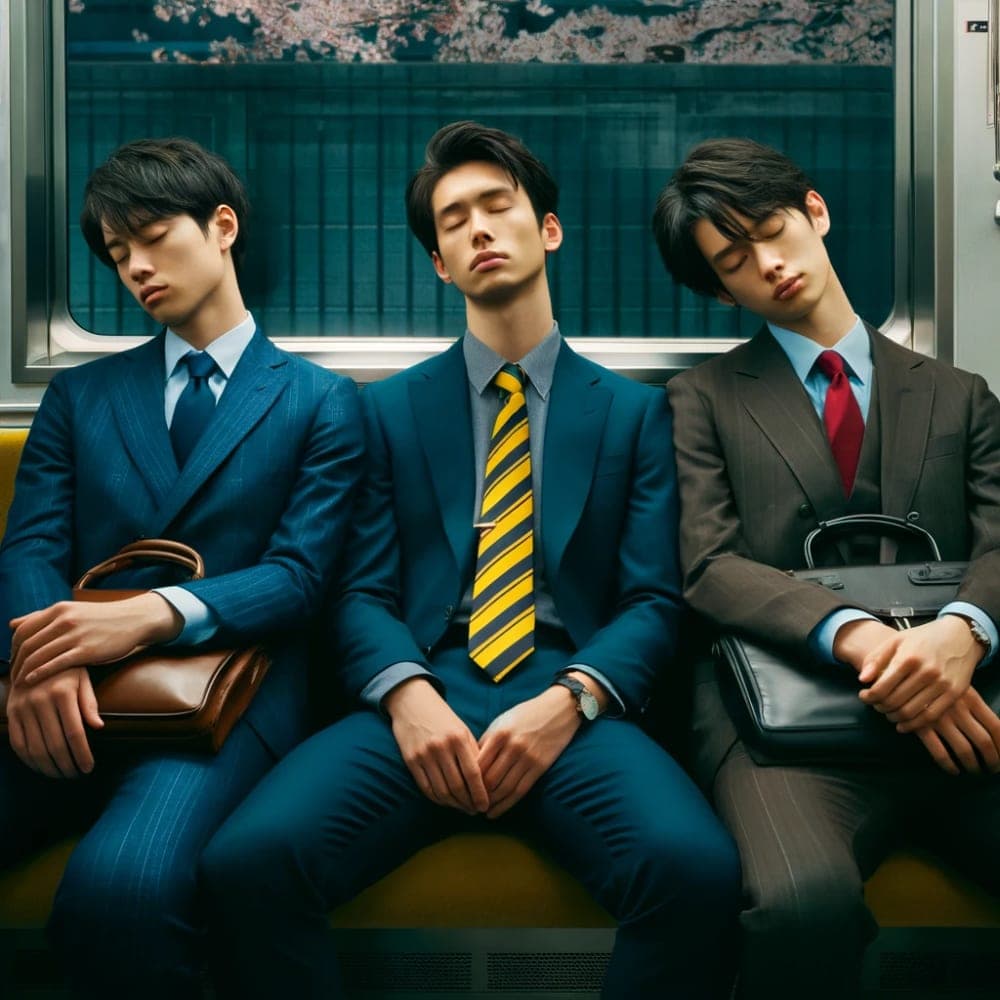
Just think about it with common sense, isn't this a waste of talent for individuals or society? Why can't Japanese companies recruit all year round? The answer is, absolutely impossible! The entire society has a religious-like obsession with these time points. Every early April, on the streets of Japan in the morning, you can see all the newly hired employees wearing suits of the same color and style—all black, not even dark blue—creating a unique sight.
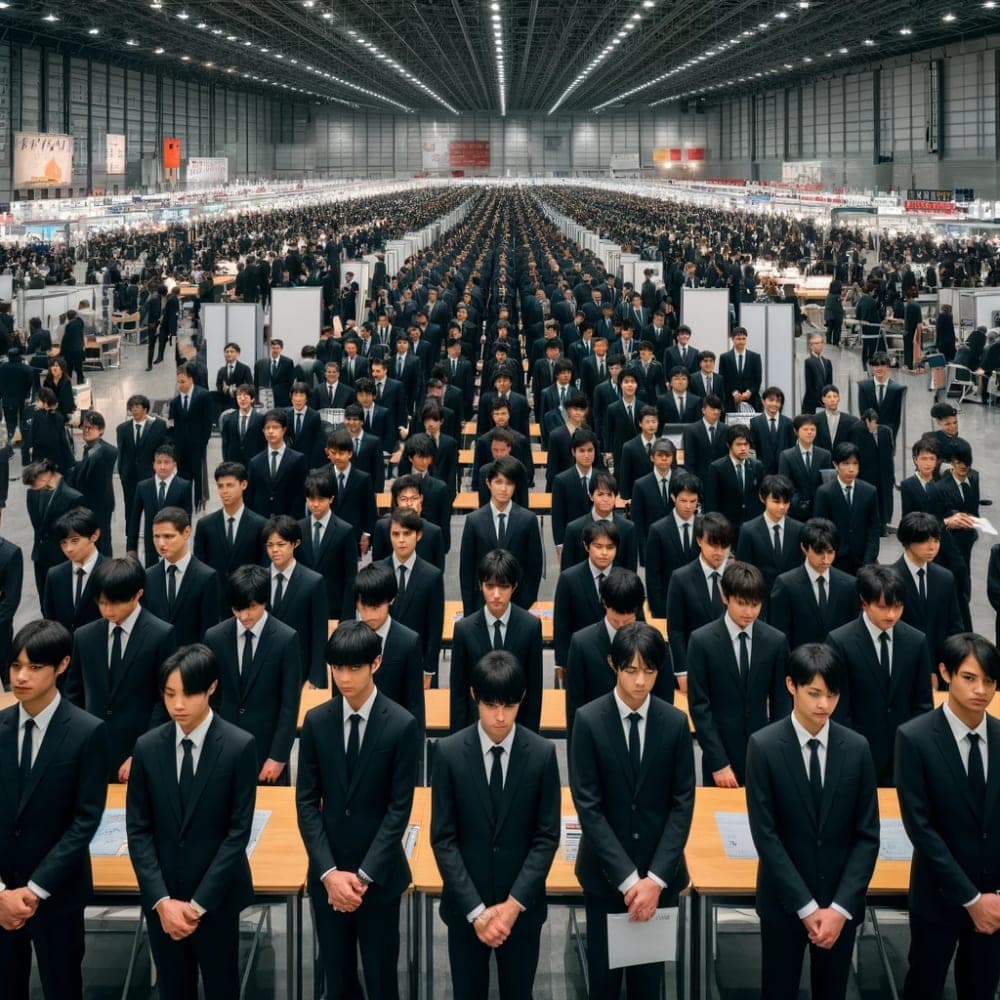
When we first arrived in Japan in early spring last year, my children and I went out one morning. Suddenly, my eldest son Andy shouted, "Mom, look, Stormtroopers!"—referring to the uniformed soldiers from Star Wars. I looked and saw a dense, orderly stream of people pouring out of the subway station, all dressed in the same color and walking at the same pace, just like Stormtroopers. Later, I learned that it was the season for new employees to start work. In Japan, when new employees join a company, much like the start of a university semester, they all wear the same uniform regardless of the company—a distinctly Japanese tradition.
The hiring season coincides with Japan's cherry blossom season. At Ueno Park, cherry blossoms are in full bloom. On weekend mornings, one can see picnic mats spread one after another on the lawn beneath the cherry blossom trees, hosting family gatherings as well as what are clearly company events. The default rule for all company-organized gatherings is that new employees must arrive early to lay out picnic mats under the cherry blossoms to secure a spot. This task also serves as a test of the new employees' work capabilities. If you see a peaceful company gathering under the beautiful cherry blossoms of Ueno Park at 10 a.m., behind it lies the hard work of new employees who woke up before dawn. On one hand, there is the serene beauty of the cherry blossoms, and on the other, the beginning of professional hierarchy and discipline. When these two realities are placed side by side, it truly makes one sigh with emotion.
"Classmates of the same year" is also a culture unique to Japanese society. For example, if they are alumni from the same high school who graduated in the same year (especially from all-boys schools), they graduate and start working at the same time. Due to the stability of the corporate employment system, over the 20 to 30 years of their careers, they may be promoted at roughly the same time, allowing them to support and assist each other. Of course, one must keep pace with the system to enjoy these benefits. If they fail to keep up with this pace or find themselves outside the system, the situation can become quite awkward.
The design flexibility of Japan's entire social system is extremely low, to a certain extent, people operate within a silent "organizational tyranny." Leaving a job is often seen as betrayal, and disobedience leads to exclusion. On the surface, there may be no noise or conflict, but the consequences are severe. As a result, many Japanese organizations also exhibit a "collective mediocrity culture," where compliance with the system brings significant rewards, while the cost of non-compliance is equally substantial. Therefore, even though the spirit of innovation is important, it can only be realized under the premise of obeying this "organizational tyranny."
Invisible Young People and Women
If you pay attention to reports on Japanese companies and biographies of entrepreneurs, you will find that most innovation stories are typically driven from the top down. Those who narrate innovation are often senior individuals in positions of power, rather than young founders or emerging leaders. This indicates that in large enterprises, innovation tends to be driven by those who have served for a long time and reached high positions, while cases of the younger generation driving innovation in large corporations are relatively rare.
Therefore, Japan is a unique society where "the elderly drive innovation."
I believe this is the result of three overlapping factors: First, the "young generation" entrepreneurs from the era of rapid growth have now become the "older generation," yet they remain the driving force behind innovation. Second, according to Japan's mainstream talent system, only by enduring until middle or old age can one gain influence within a company and have the opportunity to drive innovation. Third, today's Japanese youth are increasingly disinterested in entrepreneurship, leading to fewer and fewer entrepreneurs. Even if they have the capability, the seniority-based system prevents young people from taking the lead.
Beyond these reasons, what is even worse is that these phenomena, particularly the rigid talent system resulting from the "organizational violence" at the second level, have been tacitly accepted by society as a whole, forming a vicious cycle.
Of course, if we add a gender perspective, the three reasons mentioned above all belong exclusively to the male world.
Whether during Japan's era of rapid growth or in the present day, there have been almost no major female entrepreneurs, and women in the entrepreneurial field are few and far between. Even the "organizational violence" within large corporations requires "privilege" to endure—specifically, being a male graduate from a prestigious school. For women, even if they graduate from top-tier universities, the likelihood of working full-time in large corporations for decades is significantly lower.
As is well known, most Japanese women become full-time homemakers after becoming mothers, or take on low-paying, part-time, and benefit-free "non-regular employment." According to data from the Gender Equality Bureau of the Cabinet Office of Japan in 2021, non-regular employment accounts for 22% of male workers, while for women, it exceeds 54%. It can be said that "women" and "driving innovation" seem to be disconnected in Japan.
In 2018, Boston Consulting Group published a study showing that globally, although female business owners receive, on average, less than half the investment of their male counterparts, they generate more than twice the revenue. For every dollar invested in a female-owned startup, it yields 78 cents in revenue, compared to 31 cents for male-owned startups. Moreover, over time, companies founded by women tend to perform better. Part of the reason for this is that women are often better suited for leadership roles than men.
A study from BI Norwegian Business School identified five key characteristics of successful leaders: emotional stability, extroversion, openness to new experiences, agreeableness, and conscientiousness. Women scored higher than men in four of these traits. Additionally, various studies have repeatedly found that the more diverse a company's leadership team is—and the higher the proportion of women—the stronger its innovation capabilities. This may be because women are inherently more innovative, but it is more likely that diverse perspectives enable companies to better understand their customers. Whether it is the overlooked youth or women excluded by the system, Japan is missing out on opportunities for innovation.
The least youth-like youth
As someone who drifts on the fringes of society, I often sense a prematurely aged demeanor among Japanese youth within the system. Their primary task is to learn obedience. At the beginning of 2024, I had the opportunity to visit Taiwan, where the mental agility, innovative spirit, and bold drive of young people in organizations left a deep impression on me. In contrast, Japanese youth might be the least youthful of all.
Once when I went to a hot spring, I bought a large bottle of yogurt on the way out, planning to share it with a few people. I asked the staff if there were any paper cups available and was told there weren’t. Next to us was a shelf selling nutritional vinegar drinks for 100 yen per cup, with a stack of paper cups placed nearby. I asked if we could use those cups, and the young staff member replied that we couldn’t. I asked, "Then what should we do?" He said, "I don’t know." The conversation ended awkwardly. As a young staff member, he wasn’t given the responsibility to make customers feel good or solve their problems—saying "no" wouldn’t be wrong. Similarly, if you had taken a cup yourself, he likely wouldn’t have said anything, because stopping you wasn’t his job either. Though simple, this example is very characteristic of Japan.
Another time, I went to an ice cream shop with a friend. The menu had two products: one was a scoop of ice cream with red bean flavor on the bottom and vanilla on top, and the other was a scoop with chocolate flavor on the bottom and green tea on top. My friend asked if it was possible to replace the red bean flavor on the bottom with the green tea flavor on top. The young girl politely said no. My friend then said, "I want this green tea ice cream." The server replied, "Then order two." This kind of response is also very characteristic of Japan.
This is an example from the service industry, which may not seem like a high-end scenario. However, even among graduates from prestigious universities, many grew up in high-pressure private tutoring centers, and their innovative abilities have been significantly undermined by exam-oriented education. As a result, they have not fully benefited from the innovative advantages that youth typically brings.
I have a friend who works in Tsukuba, Ibaraki Prefecture. Tsukuba is a very important science and technology city in Japan, and those who manage to work there as researchers are often graduates of prestigious universities. My friend says that, in his view, the more prestigious the Japanese university a graduate comes from, the less effective they tend to be: first, they tend to wait for instructions on what to do and won’t take initiative unless told; second, if they don’t perform well and you question them, they become very sensitive, as if they’ve been hurt, because this isn’t the way they were accustomed to being treated in their educational experience. So, if given a choice, he would rather hire graduates from second-tier schools or cities, as they tend to be more flexible and open-minded compared to graduates from top-tier prestigious universities.
Nowadays, students at prestigious Japanese universities also prioritize practicality when choosing and considering their majors, showing less concern for public affairs. This is in stark contrast to the spirit and outlook of the younger generation during Japan's period of rapid growth.
Last year, I was invited by the International Exchange Fund to serve as a visiting scholar. My host, Suzuki Hiroshi, was born in the 1960s, graduated from the University of Tokyo, served as the Deputy Minister of Education, and is now a professor at the university. He mentioned that back in his day, the most outstanding students aspired to enter government service and make a difference in the public sector. However, today, the most popular major at the University of Tokyo is not in public administration but in medicine, because it offers the highest income. Their perspective on career choices is highly pragmatic.
Ancient and Modern
Ryuichi Sakamoto (1952-2023), who passed away last year, was a renowned composer. The education he received in his youth remains highly innovative even by today's standards. He spent his childhood at Jiyu Gakuen (Free School). Founded in Tokyo in 1921, Jiyu Gakuen emerged during the Taisho era (1912–1926), a period marked by the Taisho Free Education Movement. This movement was propelled by decades of efforts from figures like Yukichi Fukuzawa during the Meiji Restoration. The Taisho era is regarded as a time of relative political and social openness in Japan, characterized by significant growth in intellectual diversity and cultural vitality.
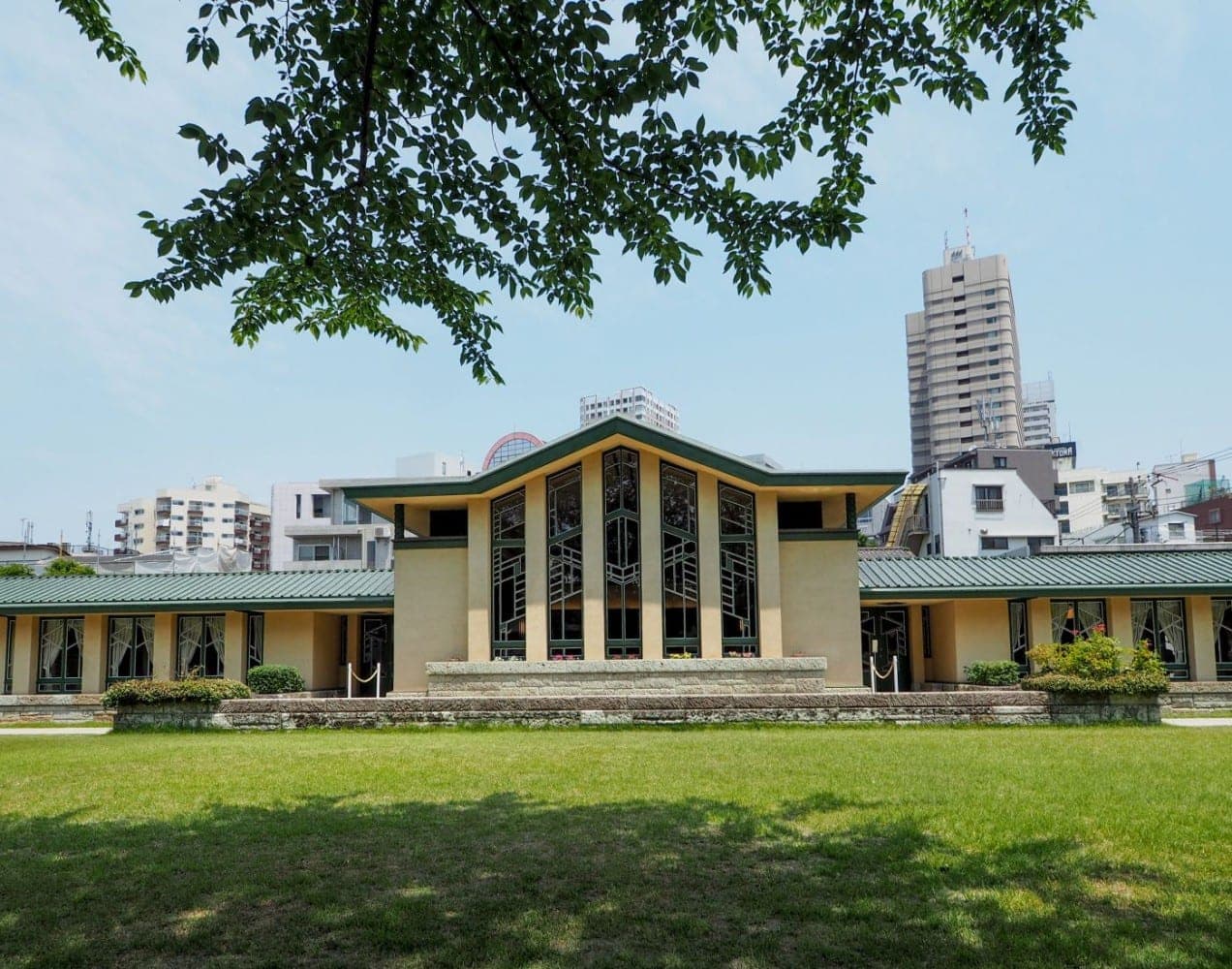
This movement advocates that education should focus on individual autonomy and creativity, emphasizing student-centered learning methods and respecting children's individuality and free will. It opposes traditional, exam- and memorization-centered educational approaches, promoting critical thinking and active learning. The Free School was born in the context of the Taisho Free Education Movement, and looking back at these ideas a century later, they not only remain relevant but are still remarkably advanced.
The founders of Jiyu Gakuen, Motoko and Yoshikazu Hani, were originally journalists by profession. They believed that education should not be about elimination but should aim to foster a cooperative society. Over the course of a century, Jiyu Gakuen has grown from a school with just 26 students into a comprehensive educational institution, encompassing everything from the Children's Life Group (kindergarten) to the highest academic division (university), with over 800 students currently enrolled. In the spring of 2023, I had the opportunity to visit Jiyu Gakuen, where I witnessed its century-long history and the children studying there. The free and refreshing atmosphere on campus was truly moving. It was in this environment of tolerance, acceptance, and trust for children at Jiyu Gakuen that Ryuichi Sakamoto grew up, laying the foundation for his future artistic life.
What should be mentioned here is that the founder of this school was a contemporary of the Chinese educator Tao Xingzhi. Tao Xingzhi traveled extensively across China, visiting and writing about many schools that have long since vanished without a trace. In contrast, this Jiyu Gakuen has undergone a century of uninterrupted development, making the comparison truly poignant.
My visit to Jiyu Gakuen provided me with an opportunity to observe and reflect on Japan's innovation within the context of the 150–200-year span from the Meiji Restoration to the present. Age and generational differences do not simply correspond to innovation. It is not necessarily true that "the older, the more backward" or "the newer, the more innovative." Sometimes, the opposite may be the case. Therefore, in Japan in 2024, I perceive a cross-section where "innovation" and "stagnation" coexist.
The aforementioned Yukichi Fukuzawa (1835–1901) was a renowned Japanese educator and thinker (his portrait appears on the 10,000-yen banknote). His core belief was that national progress could be achieved through the liberation of the individual. During Japan's early period of contact with the West, he had the opportunity to engage with the outside world and began studying "Rangaku" (a term referring to Western science, culture, and technology introduced to Japan by the Dutch during the Edo period's isolationist policy). In 1853, after the arrival of the Black Ships and the signing of the Treaty of Kanagawa between Japan and the United States, he traveled to Yokohama, where he noticed English everywhere but could not understand a single word. He then taught himself English using a dictionary. In 1860, at the age of 25, he traveled to the United States aboard Japan's first trans-Pacific steamship, the Kanrin Maru. This journey exposed him to a wealth of Western ideas, marking the beginning of his lifelong advocacy for educational reform centered on individual liberation.
Yoshida Shoin (1830-1859), a contemporary figure, was also a crucial promoter of Japan's opening to the world, and he was even more radical. In his quest to see the outside world, he secretly boarded an American warship, hiding on board in an attempt to stow away abroad. He was discovered, sentenced, and imprisoned. After his release, he was arrested again and ultimately executed at the age of 29. In his short life, in the remote city of Hagi (which even today takes six hours by train and car to reach Tokyo), he enlightened many young people living nearby in a humble "Shoka Sonjuku" schoolhouse with just eight and a half tatami mats. Among his students, more than 50 later became promoters and participants of the Meiji Restoration, including Ito Hirobumi, who would become Japan's first prime minister. Thus, Hagi is known as the "birthplace of the Meiji Restoration," with the saying, "One city of Hagi, half the history of the Restoration."
At that time, the Japanese were willing to risk their lives to innovate, break through constraints, which was truly moving. These pioneering efforts also served as the initial driving force for Japan's later journey toward openness and modernization, ultimately propelling it into the era of achieving "Japan as Number One."
Therefore, the rigid talent system today is Japan's; the spirit of risking one's life to break through social constraints 150 years ago is also Japan's. Like any nation, Japan's own history contains sufficient spiritual resources to drive change and innovation.
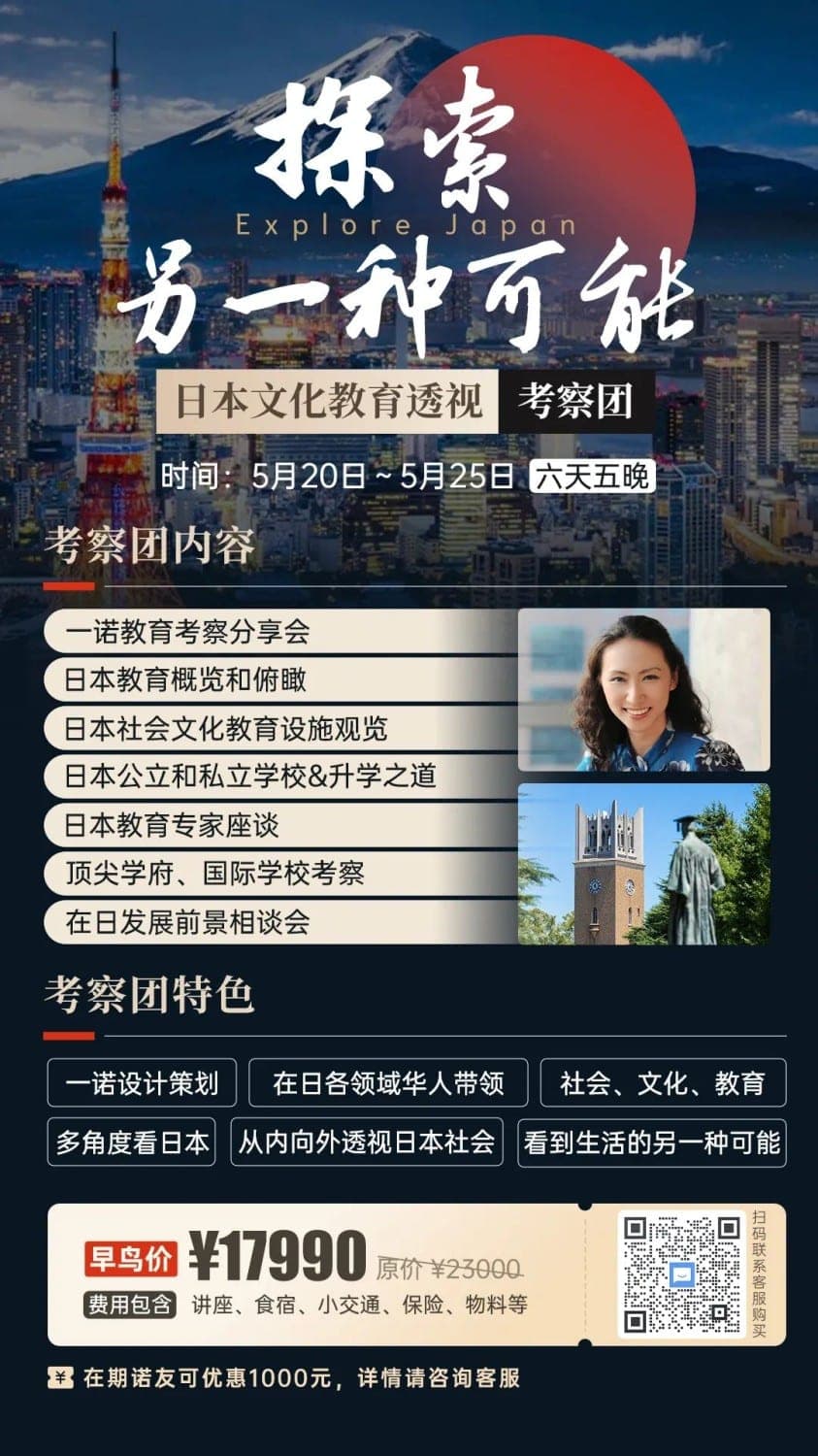
In May of this year, we will organize a cultural and educational study tour to Japan, where we will "see through Japan" alongside Chinese friends who have lived in Japan for many years and local Japanese people, taking a close look at Japanese society, culture, and education. Among our "guides" are university teachers in Japan, a Doctor of Education, Japanese friends who once worked as civil servants in the Japanese government, a professional woman with years of experience in a well-known Japanese company, a stay-at-home mother who accompanied her child through Japan's basic education system, higher education experts, a top-tier lecturer who helps international students gain admission to Japanese universities, and a consultant who supports Chinese families in entering international schools. Over the course of a week, through school visits, multiple lectures, and exchange sessions, we will lead participants to explore Japanese society, culture, and education from the inside out, discovering new possibilities.
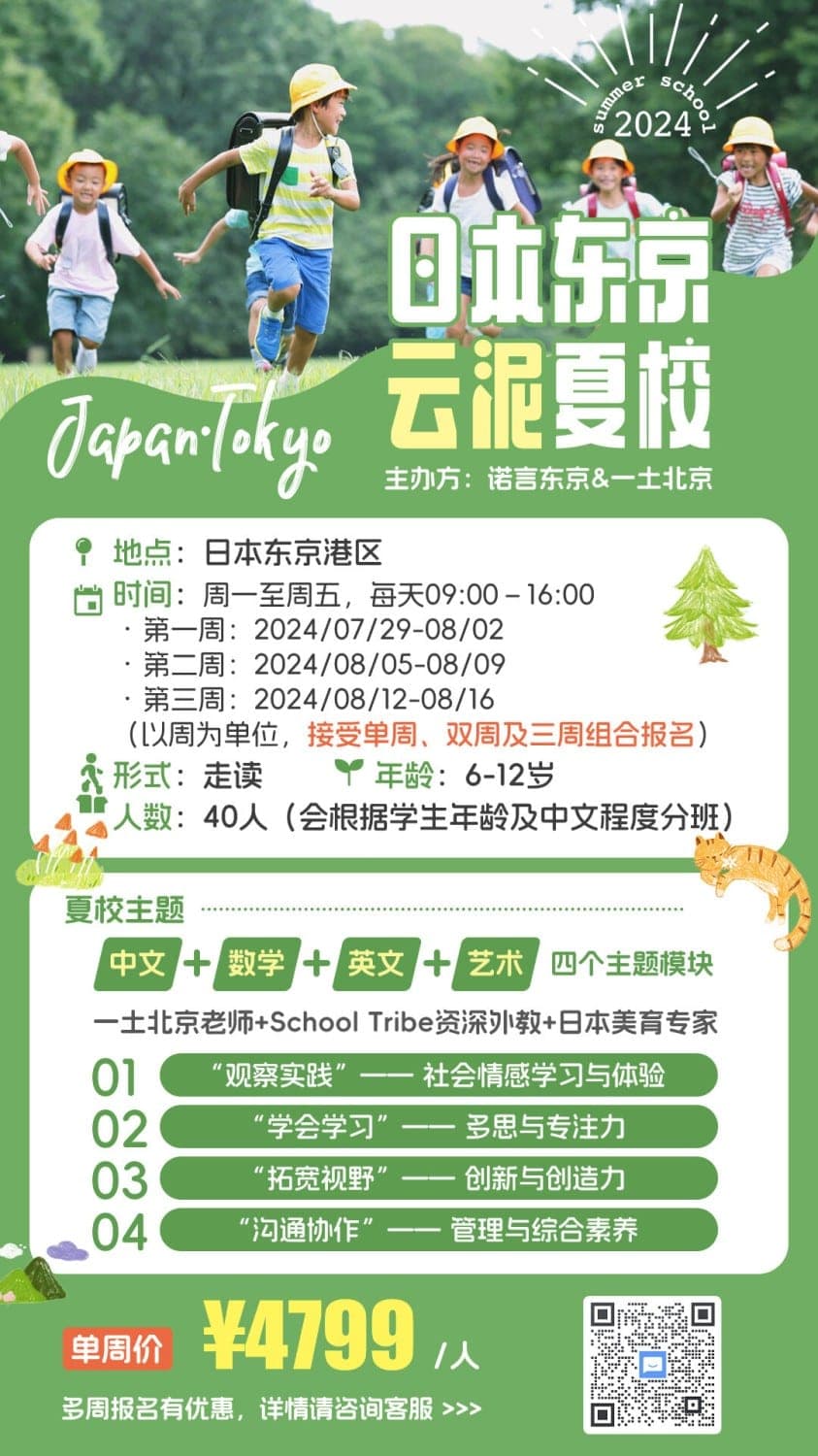
From July to August, we will also hold a three-week summer camp in Tokyo, targeting Chinese children aged 6 to 12 living in Japan. Of course, we also welcome friends who plan to bring their children to Japan for the summer vacation. The design of the summer camp is related to the advantages and issues I have observed in Japanese education. How can Chinese children learn the good aspects of Japanese education while not being limited by its shortcomings? The summer camp will primarily be conducted in Chinese and English, with a team of teachers consisting of educators from Beijing's Yitu School, foreign teachers in Japan, and art education experts.
For more details and registration, please refer to the poster below. Overseas users can contact customer service via email at info@yinuoli.org.