I am a very slow reader.
This content is curated from the live sharing session "Tiger Amber Picks Books," where I recommended ten books.

This content is curated from the live sharing session "Tiger Amber Picks Books," where I recommended ten books.
Can reading still change one's fate? If we don't interpret it in a narrow sense, then of course it can. In recent years, there has often been talk of how it's difficult for children from humble backgrounds to achieve greatness. I believe there is a great deal of conceptual confusion in this notion.
A person's life goes through three stages: family education, school education, and self-education (which includes social education). If you connect these stages, you can clearly see the significant impact of reading on a person. Reading is a lifelong endeavor; do not narrow it down to just school education, as human development is not limited in that way.
I am a very slow reader.
Regarding reading, it seems that everyone today faces a problem: being too busy with work and having no time to read. I am no exception. Moreover, I have another shortcoming—I read slowly.
But I don't feel anxious, and I don't even advocate for speed reading. The books I'm recommending today aren't meant to be finished quickly—they're ones I've read over many years, and some I've even revisited multiple times.
Reading is primarily a matter of habit formation. My advice to everyone is to find good books, avoid anxiety, and read slowly. Even if you only read a few pages at a time, you will still gain something.
Regarding reading, I have a suggestion: while reading, it's important to think and connect the knowledge from the book with your own experiences. Reading isn't like solving practice problems, nor is it simply extracting key points as if dissecting a book. You need to bring your own subjectivity into the process. Only when the words in the book challenge your understanding do you truly establish a connection with the book, and only then are you inspired or nourished by it.
Second, read more grand books.
Just now the host mentioned that there are many grand books on my reading list, and I think that's quite normal. Books that influence personal growth should indeed be quite grand. Teacher Zi has written extensively, but this time he only recommended two books. The first is *20th Century America*, and the second is *Understanding the World, Understanding Oneself*, both of which are relatively grand in scope.
I first came across Professor Zi's books when I was working at the Gates Foundation. The foundation is a public welfare organization, and as the head of the Beijing representative office at the time, I wanted to learn more about Chinese scholars studying public welfare. That’s how I discovered Professor Zi. However, her research into public welfare was far from her "main field." As the former director of the Institute of American Studies at the Chinese Academy of Social Sciences, she began studying this field after discovering the significant role that philanthropy plays in the development of American society.
These are two books about observing the world, primarily focusing on observing America.
For most Chinese people, the United States seems like a very familiar presence, whether in the news or in film and television works, America is always visible.
However, most people don't truly understand the United States and are unaware of the country's origins and development. For example, in the book, Teacher Zi mentions the Gilded Age of the United States. The Gilded Age refers to the latter half of the 19th century, spanning several decades. During this period, the United States rapidly industrialized, and wealth increased dramatically, but it also gave rise to severe social issues, such as environmental pollution, poor treatment of laborers, collusion between government officials and businesses, and corruption. For instance, the founder of Stanford University, Leland Stanford, was someone who amassed wealth through "collusion between government officials and businesses."
Stanford wanted to make money by building a railroad, but constructing the railroad itself carried investment risks. So, he ran for governor and successfully won the election. After becoming governor, Stanford orchestrated a series of maneuvers to ensure his company was the one to build the railroad. How much money did Stanford make from building the railroad? It’s unclear, but after the railroad was completed, Stanford became one of the top ten wealthiest individuals in the United States. In doing so, Stanford essentially shifted the risks onto the taxpayers while keeping the profits for himself.
Of course, he later donated money to establish Stanford University, which is truly remarkable. However, American society did not simply "wipe the slate clean" regarding his earlier actions. Instead, there was significant criticism and reflection, leading to the introduction of various laws to check power. The profession of investigative journalism also emerged during that era. These checks and balances propelled the United States into the Progressive Age of the early 20th century.
What help can reading such books provide us? History is actually closely connected to the present. The emergence of all current social issues has its roots. The balance of power and the lack of accountability are often the underlying causes of social problems. Observing how the checks and balances mechanism in the United States developed amidst twists and turns can help us understand the current dilemmas.
III. Be Your Own Hero
Now let's talk about *The Hero with a Thousand Faces*, a book I really love, written in 1949. It's actually not an easy read, but once you understand it, you'll see why so many people consider it a classic.
We all know that almost every nation has its own mythology, and within these myths, there are their own heroes. However, the author of this book, Joseph Campbell, argues that these heroes are all the same hero, and their stories are all the same story. In the book, Campbell extracts a "Hero's Journey" model based on the commonalities of these mythological stories, which is the essence of the book.
The "Hero's Journey" structure consists of seventeen steps, with its core being as follows: an ordinary-seeming individual is compelled to enter a perilous situation, undergoes various challenges along the way, experiences a farewell to their former self and their past "father," confronts death, rebirth, and ultimately achieves victory before returning to their "village." Though seemingly returning to the starting point, they have become a different version of themselves.
For Hollywood screenwriters, this is essential reading because it reveals the common foundation of all stories. If you deconstruct Hollywood films, you'll find their underlying logic is the "Hero's Journey." Stories we are all familiar with, such as *The Lion King*, *Kung Fu Panda*, and *Star Wars*, all follow this pattern.
Back in real life, everyone is their own hero. We may not embark on such fantastical journeys, but internally, we go through the same process: bidding farewell to our past selves, saying goodbye to the authority and traditions represented by the "father," and experiencing death and rebirth. And it’s not just once—it happens again and again.
IV. Everyone Should Read Some Philosophy
"Opening Up" is an introductory book to philosophy. For general readers, if you want to gain a basic understanding of the philosophical system, this book can help you achieve that. The author, Zhou Lian, is a professor in the Department of Philosophy at Renmin University.
Why do we need to study philosophy? Because humans are beings who seek meaning. In our daily lives, we often think about education, work, and matters both inside and outside the home—this is normal, as we do not live in a vacuum. However, everyone has moments of stillness, moments of inner dialogue. During such times, our thoughts are often, in essence, philosophical reflections.
This book contains a chapter about ancient Greece's Athens and Sparta. Ancient Greece was a collection of city-states, where each city functioned as an independent nation. The city-state of Athens valued freedom and held the belief that when rulers possess more knowledge than the people, it creates an unstable structure and paves the way for tyranny. Therefore, they ensured that all children attended school, viewing education as a means to combat ignorance. Sparta, on the other hand, was different. Sparta was militaristic, and their children were required to join the military at the age of seven. From a young age, they ran barefoot, hardening the soles of their feet until they developed calluses.
These two vastly different value systems meant entirely different destinies for the citizens of these two city-states. As readers today, we can intuitively sense the profound impact of ideas on individuals and even on the fate of an entire nation.
V. Understand Your Foundation
I first started reading psychology-related books when I became a partner at McKinsey, during a training session I had to attend. Initially, I thought the training would involve PowerPoint presentations and discussions about how partners "divide the profits," but it turned out to be something entirely different. At the time, there was a training coach who kept asking us to reflect on ourselves: What is your purpose? What is the underlying meaning and goal of your career?
This training really opened my eyes. It turns out that these top "big shots" aren't thinking about how to divide the profits. A company that has been around for nearly 100 years—its ability to survive for so long is closely tied to this kind of deep, fundamental questioning.
People actually have three levels: the first level is "have," which refers to what I possess; beneath "have" lies "doing," which is the second level. Logically, "doing" determines "have"—what you do determines what you have. The third level is "being," which is the most fundamental. The kind of person you are ultimately determines what you will do.
For humans, the foundation determines the superstructure. This principle is actually quite simple. For example, if your foundation is filled with fear, you cannot possibly exhibit courageous behavior, nor can you achieve results that come from brave efforts.
I read psychology and personal growth books because I want to understand my "inner foundation."
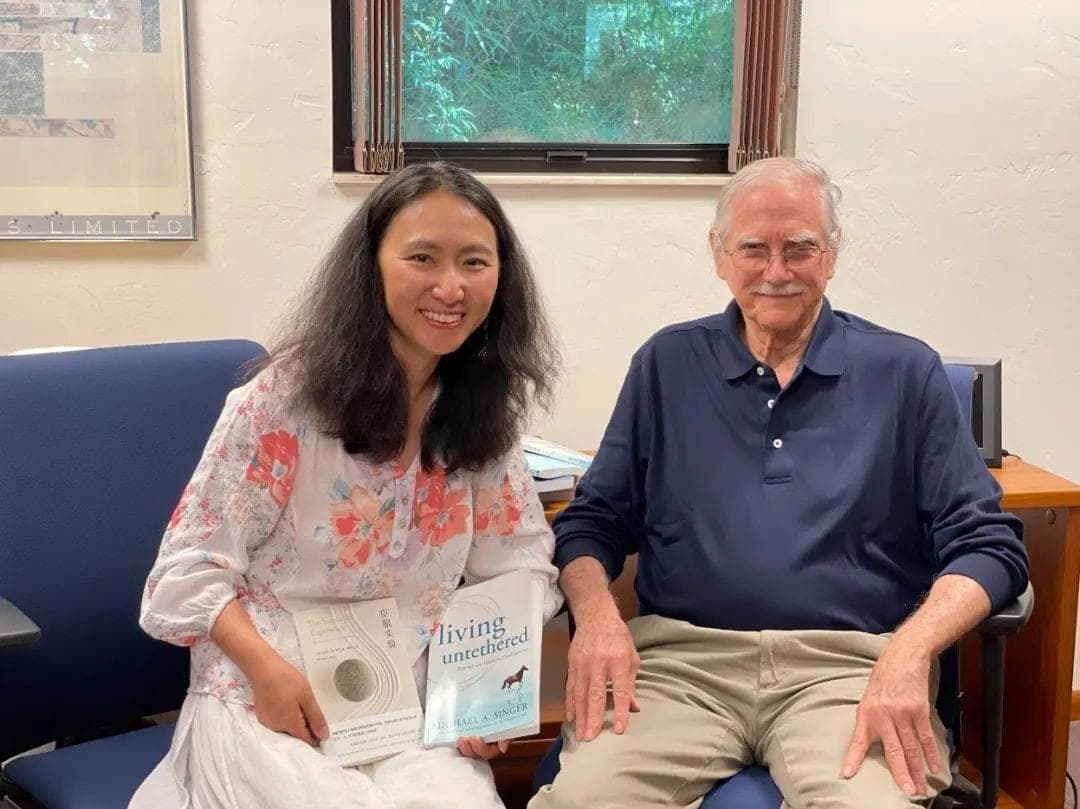
"The Surrender Experiment" has been profoundly inspiring to me; I was moved to tears while reading it. In the author's view, surrender is not about submission, but about acceptance and following the guidance of life itself. It is not passive, but a deep form of active engagement. It is about allowing oneself to let go of the voices in the mind and instead see and follow life as it unfolds.
I first read the English version of this book, and after finishing it, I wrote a reflection. An editor from the publishing house happened to see it, which led to the Chinese edition. The publication of the Chinese version is also a gift from life.
Six. Where Does Strength Come From?
The host just asked if elites are all conflicted. I think everyone experiences conflict, as well as fear and pain. So, what should we do when we encounter such situations?
I wrote a book titled "Where Does Strength Come From," in which I share the strategies I've used over the past twenty years to navigate moments of hesitation or "fear."
The "Five Whys" method I mentioned in the book is a highly effective tool for personal growth. When faced with a dilemma, you can ask yourself questions and continuously probe deeper by asking "why," ultimately uncovering the essence of the issue. Of course, "Five Whys" is a general term—sometimes you might need to ask six, while other times three may suffice.
I also mentioned a case in the book, which is the story of me enrolling my daughter in a performance class. It was a very high-end performance class, run by one of my friends, but after attending one session, my daughter didn’t want to go anymore. She said she didn’t like it. I thought that wasn’t acceptable—such a great course, you have to go even if you don’t like it. In the end, I forced her to go, but she remained resistant the whole time.
I used the "Five Whys" method to reflect on this matter. Why did I insist on sending my child to this class? The surface reason was simple—it seemed like the best performing arts class available, so of course they should attend. But through continuous self-questioning and digging deeper, I realized that I was afraid my child would fall behind at the starting line. Ultimately, it was my own fear at play. In the end, we decided not to enroll in the class.
Once you can see and confront your fears, many things become clear. It's just that often we dare not face them, so we end up running from fear every day. Much of what appears as busyness is actually just running away from it.
Therefore, having a conversation with oneself and facing fear is the path to liberation.
Seven, communication is a result.
The host just mentioned that in the publishing industry, communication is a topic that often leads to bestsellers. I think treating communication as a skill misses the point. At its core, communication is not a matter of skill but rather a matter of mindset.
Take *Nonviolent Communication* for example. I don't think it's a book about communication, even though it appears to be about communication in form. As the author says, communication is a result, and its foundation lies in our "needs." When you get angry because of someone's words, is it really those words that made you angry? No, it's because your needs were not met.
To introduce Nonviolent Communication, Dr. Marshall also named two communication modes: the Jackal Mode and the Giraffe Mode. What is a jackal? It is an animal smaller than a wolf, short-sighted, impatient, and aggressive. As for the giraffe, it stands tall, sees far, remains calm, and is non-aggressive—serving as the spokesperson for Nonviolent Communication.
Most of our daily communication tends to be in the "jackal mode" rather than the "giraffe mode." Why is that? As I mentioned earlier, your underlying foundation determines how you behave. For example, why do those great monks and masters appear so compassionate and never get angry? It’s not because they have a "good temper"—it’s because their inner foundation naturally prevents them from getting angry. If your foundation isn’t that of a giraffe, you simply cannot practice nonviolent communication. You might be able to pretend for a day or two, but sooner or later, the truth will come out.
Eight, Making Peace with Oneself
Some readers have said that *The New World* resembles Western Buddhism, and I find this perspective quite interesting. Indeed, there are many psychological and personal growth books in the West that, as you read them, feel like reading Buddhist teachings. At their core, they share common ground.
Psychology originated in the 19th century, but humanity's study of the mind has spanned thousands of years. For example, Buddhism has long been focused on inward exploration of the human psyche. Therefore, I do not approach Buddhist teachings as a religion but as an ancient yet modern philosophy and psychology. The *Diamond Sutra* teaches us to "skillfully guard our thoughts" and observe every single thought, which helps us gain a deeper understanding of ourselves. The previously mentioned method of asking "five whys" is an application of this practice of "skillfully guarding our thoughts."
Returning to the topic of reading, why do we read?
We have an old saying: "Reading changes destiny." We also refer to those who attend school as "readers." However, the meaning of "reading" here is not the same. In a narrow sense, reading refers to attending school and obtaining a degree. When we say "reading changes destiny," we often refer to degrees and academic qualifications. In a broader sense, reading is a continuous process of self-education. This has nothing to do with academic qualifications or one's field of study.
The broader purpose of reading, as Teacher Zi's second book title suggests, is to understand the world and understand ourselves. In essence, these are the two things we spend our lives doing.
Everything we buy comes with an instruction manual, telling us how to use it. But for ourselves and the world—the most important things—there is no manual. Reading, in a way, is about searching for and constructing our own manual.